Thank you for visiting SNEWPapers!
Sign up free
Story
May 8, 1960
The Key West Citizen
Key West, Monroe County, Florida
What is this article about?
Reprint of 1871 Harper's article on Florida Reef's North Key in Dry Tortugas: its shifting sands, secure harbor for Fort Jefferson, diverse corals, sea creatures, birds, weeds, and defenses; includes moral note against hunting and bird soaring mechanics. (248 characters)
Clipping
OCR Quality
95%
Excellent
Full Text
Sunday, May 8, 1960
THE KEY WEST CITIZEN
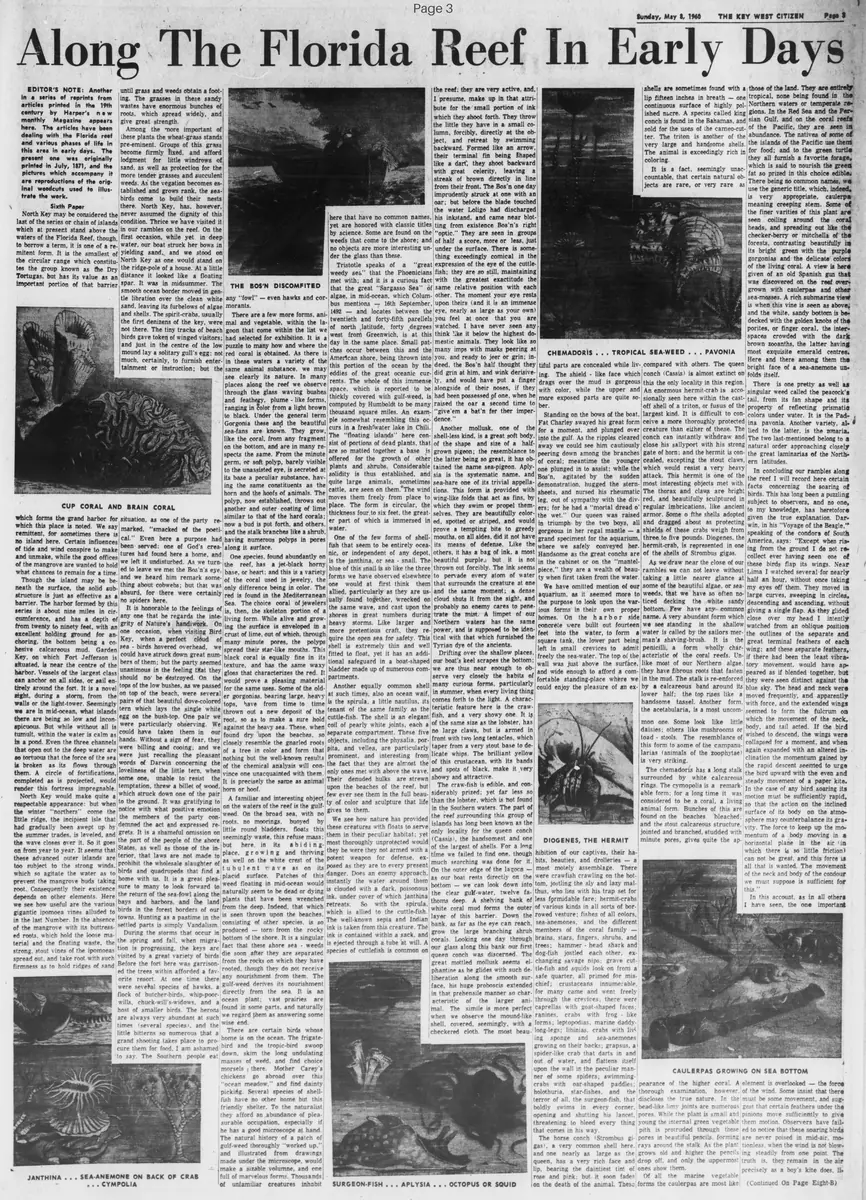
Along The Florida Reef In Early Days
EDITOR'S NOTE: Another in a series of reprints from articles printed in the 19th century by Harper's new monthly Magazine appears here. The articles have been dealing with the Florida reef and various phases of life in this area in early days. The present one was originally printed in July, 1871, and the pictures which accompany it are reproductions of the original woodcuts used to illustrate the work.
Sixth Paper
North Key may be considered the last of the series or chain of islands which at present stand above the waters of the Florida Reef, though, to borrow a term, it is one of a remittent form. It is the smallest of the circular range which constitutes the group known as the Dry Tortugas, but has its value as an important portion of that barrier which forms the grand harbor for which this place is noted. We say remittent, for sometimes there is no island here. Certain influences of tide and wind conspire to make and unmake, while the good offices of the mangrove are wanted to hold what chances to remain for a time.
Until grass and weeds obtain a footing. The grasses in these sandy wastes have enormous bunches of roots, which spread widely, and give great strength. Among the more important of these plants the wheat-grass stands pre-eminent. Groups of this grass become firmly fixed, and afford lodgment for little windrows of sand, as well as protection for the more tender grasses and succulent weeds. As the vegetation becomes established and grows rank, the sea-birds come to build their nests there. North Key, has, however, never assumed the dignity of this condition. Thrice we have visited it in our rambles on the reef. On the first occasion, while yet in deep water, our boat struck her bows in yielding sand, and we stood on North Key as one would stand on the ridge-pole of a house. At a little distance it looked like a floating spar. It was in midsummer. The smooth ocean border moved in gentle libration over the clean white sand. Though the island may be beneath the surface, the solid sub-structure is just as effective as a barrier. The harbor formed by this series is about nine miles in circumference, and has a depth of from twenty to ninety feet, with an excellent holding ground for anchoring, the bottom being a cohesive calcareous mud. Garden Key, on which Fort Jefferson is situated, is near the centre of the harbor. Vessels of the largest class can anchor on all sides, or sail entirely around the fort. It is a novel sight, during a storm, from the walls or the light-tower. Seemingly we are in mid-ocean, what islands there are being so low and inconspicuous. But while without all is tumult, within the water is calm as in a pond. Even the three channels that open out to the deep water are so tortuous that the force of the sea is broken as it flows through them. A circle of fortifications, completed as is projected, would render this fortress impregnable.
CUP CORAL AND BRAIN CORAL
North Key would make quite a respectable appearance: but when the winter "northers" come the little ridge, the incipient isle that had gradually been swept up by the summer trades, is leveled, and the wave closes over it. So it goes on from year to year. It seems that these advanced outer islands are too subject to the strong winds, which so agitate the water as to prevent the mangrove buds taking root. Consequently their existence depends on other elements. Here we see how useful are the various gigantic ipomoea vines alluded to in the last Number. In the absence of the mangrove with its buttressed roots, which hold the loose material and the floating waste, the strong, stout vines of the ipomoeas spread out, and take root with such firmness as to hold ridges of sand to the ground. It was gratifying to notice with what positive emotion the members of the party condemned the act and expressed regrets. It is a shameful omission on the part of the people of the shore States, as well as those of the interior, that laws are not made to prohibit the wholesale slaughter of birds and quadrupeds that find a home with us. It is a great pleasure to many to look forward to the return of the sea-fowl along the bays and harbors, and the land birds in the forest borders of our towns. Hunting as a pastime in the settled parts is simply Vandalism. During the storms that occur in the spring and fall, when migration is progressing, the keys are visited by a great variety of birds.
THE BOS'N DISCOMFITED
Even here a purpose had been served: one of God's creatures had found here a home, and we left it undisturbed. As we turned to leave we met the Bos'n's eye, and we heard him remark something about cobwebs: but that was absurd, for there were certainly no spiders here. It is honorable to the feelings of any one that he regards the integrity of Nature's handiwork. On one occasion, when visiting Bird Key, when a perfect cloud of sea-birds hovered overhead, we could have struck down great numbers of them; but the party seemed unanimous in the feeling that they should not be destroyed. On the tops of the low bushes, as we passed on top of the beach, were several pairs of that beautiful dove-colored tern which lays the single white egg on the bush-top. One pair we were particularly observing. We could have taken them in our hands. Without a sign of fear, they were billing and cooing: and we were just recalling the pleasant words of Darwin concerning the loveliness of the little tern, when some one, unable to resist the temptation, threw a billet of wood. It is marked, "smacked of the poetical."
now a bud is put forth, and others, and the stalk branches like a shrub, having numerous polyps in pores along its surface. One species, found abundantly on the reef, has a jet-black horny base, or heart; and this is a variety of the coral used in jewelry, the only difference being in color. The red is found in the Mediterranean Sea. The choice coral of jewelers is, then, the skeleton portion of a living form. While alive and growing the surface is enveloped in a crust of lime, out of which, through many minute pores, the polyps spread their star-like mouths. This black coral is equally fine in its texture, and has the same waxy gloss that characterizes the red. It would prove a pleasing material for the same uses. Some of the older gorgonias, bearing large, heavy tops, have from time to time thrown out a new deposit of the root, so as to make a sure hold against the heavy sea. These, when found dry upon the beaches, so closely resemble the gnarled roots of a tree in color and form that nothing but the well-known results of the chemical analysis will convince one unacquainted with them. It is precisely the same as animal horn or hoof.
A familiar and interesting object on the waters of the reef is the gulf-weed. On the broad sea, with no roots, no moorings, buoyed by little round bladders, floats this seemingly waste, this refuse mass: but here, in its abiding-place, growing and thriving as well on the white crest of the turbulent wave as on its placid surface. Patches of this weed floating in mid-ocean would naturally seem to be dead or dying plants that have been wrenched from the deep. Indeed, that which is seen thrown upon the beaches, consisting of other species, is so produced - torn from the rocky bottom of the shore. It is a singular fact that these shore sea-weeds die soon after they are separated from the rocks on which they have rooted, though they do not receive any nourishment from them. The gulf-weed derives its nourishment directly from the sea. It is an ocean plant; vast prairies are found in some parts, and naturally we regard them as answering some wise end.
There are certain birds whose home is on the ocean. The frigate-bird and the tropic-bird swoop down, skim the long undulating masses of weed, and find choice morsels there. Mother Carey's chickens go abroad over this "ocean meadow," and find dainty picking. Several species of shell-fish have no other home but this friendly shelter. To the naturalist they afford an abundance of pleasurable occupation, especially if he has a good microscope at hand. The natural history of a patch of gulf-weed thoroughly "worked up," and illustrated from drawings made under the microscope, would make a sizable volume, and one full of marvelous forms. Thousands of unfamiliar creatures inhabit it.
a 2 met with; and it is a curious fact that the great "Sargasso Sea" of algae, in mid-ocean, which Columbus mentions - 16th September, 1492 - and locates between the twentieth and forty-fifth parallels of north latitude, forty degrees west from Greenwich, is at this day in the same place. Small patches occur between this and the American shore, being thrown into this portion of the ocean by the eddies of the great oceanic currents. The whole of this immense space, which is reported to be thickly covered with gulf-weed, is computed by Humboldt to be many thousand square miles. An example somewhat resembling this occurs in a fresh-water lake in Chili. The "floating islands" here consist of portions of dead plants, that are so matted together a base is offered for the growth of other plants and shrubs. Considerable solidity is thus established, and quite large animals, sometimes cattle, are seen on them. The wind moves them freely from place to place. The form is circular, the thickness four to six feet, the greater part of which is immersed in water.
One of the few forms of shell-fish that seem to be entirely oceanic, or independent of any depot, is the janthina, or sea-snail. The blue of this snail is so like the three forms we have observed elsewhere one would at first think them allied, particularly as they are usually found together, wrecked on the same wave, and cast upon the shores in great numbers during heavy storms. Like larger and more pretentious craft, they require the open sea for safety. This shell is extremely thin and well fitted to float, yet it has an additional safeguard in a boat-shaped bladder made up of numerous compartments. Another equally common shell at such times, also an ocean waif, is the spirula, a little nautilus, its tenant of the same family as the cuttle-fish. The shell is an elegant coil of pearly white joints, each a separate compartment. These five objects, including the physalia, porpita, and vellea, are particularly prominent, and interesting from the fact that they are almost the only ones met with above the wave. Their denuded hulks are strewn upon the beaches of the reef, but few ever see them in the full beauty of color and sculpture that life gives to them.
We see how nature has provided these creatures with floats to serve them in their peculiar habitat: yet most thoroughly unprotected would they be were they not armed with a potent weapon for defense, exposed as they are to every present danger. Does an enemy approach, instantly the water around them is clouded with a dark, poisonous ink, under cover of which janthina retreats. So with the spirula, which is allied to the cuttle-fish. The well-known sepia and Indian ink is taken from this creature. The ink is contained within a sack, and is ejected through a tube at will. A species of cuttlefish is common on the reef: they are very active, and, I presume, make up in that attribute for the small portion of ink which they shoot forth. They throw the little they have in a small column, forcibly, directly at the object, and retreat by swimming backward. Formed like an arrow, their terminal fin being shaped like a dart, they shoot backward with great celerity, leaving a streak of brown directly in line from their front. The Bos'n one day imprudently struck at one with an oar: but before the blade touched the water Loligo had discharged his inkstand, and came near blotting from existence Bos'n's right "optic." They are seen in groups of half a score, more or less, just under the surface. There is something exceedingly comical in the expression of the eye of the cuttle-fish; they are so still, maintaining with the greatest exactitude the same relative position with each other. The moment your eye rests upon theirs (and it is an immense eye, nearly as large as your own) you feel at once that you are watched. I have never seen any thing like it below the highest domestic animals. They look like so many imps with masks peering at you, and ready to jeer or grin: indeed, the Bos'n half thought they did grin at him, and wink derisively, and would have put a finger alongside of their noses, if they had been possessed of one, when he raised the oar a second time to "give'em a bat'n fer ther imper'dence."
Another mollusk, one of the shell-less kind, is a great soft body, of the shape and size of a half-grown pigeon; the resemblance to the latter being so great, it has obtained the name sea-pigeon. Aplysia is the systematic name, and sea-hare one of its trivial appellations. This form is provided with wing-like folds that act as fins, by which they swim or propel themselves. They are beautifully colored, spotted or striped, and would prove a tempting bite to greedy mouths, on all sides, did it not have its means of defense. Like the others, it has a bag of ink, a most beautiful purple, but it is not thrown out forcibly. The ink seems to pervade every atom of water that surrounds the creature at one and the same moment; a dense cloud shuts it from the sight, and probably no enemy cares to penetrate the mist. A limpet of our Northern waters has the same power, and is supposed to be identical with that which furnished the Tyrian dye of the ancients.
we are thus near enough to observe very closely the habits of many curious forms, particularly in summer, when every living thing comes forth to the light. A characteristic feature here is the craw-fish, and a very showy one. It is of the same size as the lobster, has no large claws, but is armed in front with two long tentacles, which taper from a very stout base to delicate whips. The brilliant yellow of this crustacean, with its bands and spots of black, make it very showy and attractive. The craw-fish is edible, and considerably prized; yet far less so than the lobster, which is not found in the Southern waters. The part of the reef surrounding this group of islands has long been known as the only locality for the queen conch (Cassis), the handsomest and one of the largest of shells. For a long time we failed to find one, though much searching was done for it. On the outer edge of the lagoon - as our boat rests directly on the bottom - we can look down into the clear gulf-water, twelve fathoms deep. A shelving bank of white coral mud forms the outer layer of this barrier. Down the bank, as far as the eye can reach, grow the large branching shrub corals. Looking one day through our glass along this bank our first queen conch was discerned. The great mottled mollusk seems elephantine as he glides with such deliberation along the smooth surface, his huge proboscis extended in that prehensile manner so characteristic of the larger animals. The simile is more perfect.
SURGEON-FISH... APLYSIA ... OCTOPUS OR SQUID
shells are sometimes found with a lip fifteen inches in breadth - one continuous surface of highly polished nacre. A species called king conch is found in the Bahamas, and sold for the uses of the cameo-cutter. The triton is another of the very large and handsome shells. The animal is exceedingly rich in coloring. It is a fact, seemingly unaccountable, that certain natural objects are rare, or very rare as compared with others. The queen conch (Cassis) is almost extinct on this the only locality in this region. An enormous hermit-crab is occasionally seen here within the cast-off shell of a triton, or fusus of the largest kind. It is difficult to conceive a more thoroughly protected creature than either of these. The conch can instantly withdraw and close his sallyport with his strong gate of horn: and the hermit is concealed, excepting the stout claws, which would resist a very heavy attack. This hermit is one of the most interesting objects met with. The thorax and claws are bright red, and beautifully sculptured in regular imbrications, like ancient armor. Some of the shells adopted and dragged about as protecting shields of these crabs weigh from three to five pounds. Diogenes, the hermit-crab, is represented in one of the shells of Strombus gigas.
Standing on the bows of the boat, Fat Charley swayed his great form for a moment, and plunged over into the gulf. As the ripples cleared away we could see him cautiously peering down among the branches of coral; meantime the younger one plunged in to assist; while the Bos'n, agitated by the sudden demonstration, hugged the stern-sheets, and nursed his rheumatic leg, out of sympathy with the divers: for he had a "mortal dread o' the wet." Our queen was raised in triumph by the two boys, all gorgeous in her regal mantle - a grand specimen for the aquarium, where we safely conveyed her. Handsome as the great conchs are in the cabinet or on the "mantel-piece," they are a wealth of beauty when first taken from the water. We have omitted mention of our aquarium, as it seemed more to the purpose to look upon the various forms in their own proper homes. On the harbor side concrete were built out fourteen feet into the water, to form a square tank, the lower part being left in small crevices to admit freely the sea-water. The top of the wall was just above the surface, and wide enough to afford a comfortable standing-place where we could enjoy the pleasure of an exhibition of our captives, their habits, beauties, and drolleries - a most motley assemblage. There were crawfish crawling on the bottom, jostling the sly and lazy mollusks, who lies with his trap set for less formidable fare: hermit-crabs of various kinds in all sorts of borrowed vesture: fishes of all colors, sea-anemones, and the different members of the coral family - brains, stars, fingers, shrubs, and trees; hammer-head shark and dog-fish jostled each other, exchanging savage nips; grave cuttle-fish and squids look on from a safe quarter, all primed for mischief: crustaceans innumerable, for many came and went freely through the crevices: there were caprellas with goat-shaped faces: ranines, crabs with frog-like forms: leptopodias, marine daddy-long-legs: libinias, crabs with living sponge and sea-anemones growing on their backs; grapsus, a spider-like crab that darts in and out of water, and flattens itself upon the wall in the peculiar manner of some spiders: swimming-crabs with oar-shaped paddles: holothuria, star-fishes, and the terror of all, the surgeon-fish, that boldly swims in every corner, opening and shutting his lancet, threatening to bleed every thing that comes in his way. The horse conch (Strombus gigas), a very common shell here, and one nearly as large as the queen, has a very rich face and lip, bearing the daintiest tint of rose and pink: but it soon fades on the death of the animal. These.
As we draw near the close of our rambles we can not leave without taking a little nearer glance at some of the beautiful algae, or sea-weeds, that we have so often noticed decking the white sandy bottom. Few have any common name. A very abundant form which we see standing in the shallow water is called by the sailors mermaid's shaving-brush. It is the penicilli, a form wholly characteristic of the coral reefs. Unlike most of our Northern algae, they have fibrous roots that fasten in the mud. The stalk is re-enforced by a calcareous band around its lower half; the top rises like a handsome tassel. Another form, the acetabularia, is a most uncommon one. Some look like little daisies: others like mushrooms or toad-stools. The resemblance of this form to some of the campanularias (animals of the zoophytae) is very striking. The chemadoris has a long stalk surrounded by white calcareous rings. The cymopolia is a remarkable form: for a long time it was considered to be a coral, a living animal form. Bunches of this are found on the beaches bleached: and the stout calcareous structure, jointed and branched, studded with minute pores, gives quite the appearance of the higher coral. A thorough examination, however, discloses the true nature. In the bead-like limy joints are numerous pores. While the plant is small and young the internal green vegetable pith is protruded through these pores in beautiful pencils, forming rays around the stalk. As the plant grows old and higher the pencils drop off, and only the uppermost ones show them.
Of all the marine vegetable
those of the land. They are entirely tropical, none being found in the Northern waters or temperate regions. In the Red Sea and the Persian Gulf, and on the coral reefs of the Pacific, they are seen in abundance. The natives of some of the islands of the Pacific use them for food; and to the green turtle they all furnish a favorite forage.
There being no common names, we use the generic title, which, indeed, is very appropriate, caulerpa meaning creeping stem. Some of the finer varieties of this plant are seen coiling around the coral heads, and spreading out like the checker-berry or mitchella of the forests, contrasting beautifully in its bright green with the purple gorgonias and the delicate colors of the living coral. A view is here given of an old Spanish gun that was discovered on the reef overgrown with caulerpas and other sea-mosses. A rich submarine view is when this vine is seen as above, and the white, sandy bottom is bedecked with the golden knobs of the porites, or finger coral, the inter-spaces crowded with the dark brown zooanths, the latter having most exquisite emerald centres. Here and there among them the bright face of a sea-anemone unfolds itself. There is one pretty as well as singular weed called the peacock's tail, from its fan shape and its property of reflecting prismatic colors under water. It is the Padina pavonia. Another variety, allied to the latter, is the zonaria. The two last-mentioned belong to a natural order approaching closely the great laminarias of the Northern latitudes.
In concluding our rambles along the reef I will record here certain facts concerning the soaring of birds. This has long been a puzzling subject to observers, and no one, to my knowledge, has heretofore given the true explanation. Darwin, in his "Voyage of the Beagle," speaking of the condors of South America, says: "Except when rising from the ground I do not recollect ever having seen one of these birds flap its wings. Near Lima I watched several - for nearly half an hour, without once taking my eyes off them. They moved in large curves, sweeping in circles, descending and ascending, without giving a single flap. As they glided close over my head I intently watched from an oblique position the outlines of the separate and great terminal feathers of each wing: and these separate feathers, if there had been the least vibratory movement, would have appeared as if blended together, but they were seen distinct against the blue sky. The head and neck were moved frequently, and apparently with force, and the extended wings seemed to form the fulcrum on which the movement of the neck, body, and tail acted. If the bird wished to descend, the wings were collapsed for a moment, and when again expanded with an altered inclination the momentum gained by the rapid descent seemed to urge the bird upward with the even and steady movement of a paper kite."
In the case of any bird soaring its motion must be sufficiently rapid, so that the action on the inclined surface of its body on the atmosphere may counterbalance its gravity. The force to keep up the momentum of a body moving in a horizontal plane in the air (in which there is so little friction) can not be great, and this force is all that is wanted. The movement
Of all the marine
element is overlooked - the force of the wind. Some insist that there must be some movement, and suggest that certain feathers under the pinions move sufficiently to give them motion. Observers have failed to notice that these soaring birds are never poised in mid-air, motionless, when the wind is not blowing steadily from one point. The truth is, they remain in the air precisely as a boy's kite does, li
(Continued On Page Eight-B)
THE KEY WEST CITIZEN
Along The Florida Reef In Early Days
EDITOR'S NOTE: Another in a series of reprints from articles printed in the 19th century by Harper's new monthly Magazine appears here. The articles have been dealing with the Florida reef and various phases of life in this area in early days. The present one was originally printed in July, 1871, and the pictures which accompany it are reproductions of the original woodcuts used to illustrate the work.
Sixth Paper
North Key may be considered the last of the series or chain of islands which at present stand above the waters of the Florida Reef, though, to borrow a term, it is one of a remittent form. It is the smallest of the circular range which constitutes the group known as the Dry Tortugas, but has its value as an important portion of that barrier which forms the grand harbor for which this place is noted. We say remittent, for sometimes there is no island here. Certain influences of tide and wind conspire to make and unmake, while the good offices of the mangrove are wanted to hold what chances to remain for a time.
Until grass and weeds obtain a footing. The grasses in these sandy wastes have enormous bunches of roots, which spread widely, and give great strength. Among the more important of these plants the wheat-grass stands pre-eminent. Groups of this grass become firmly fixed, and afford lodgment for little windrows of sand, as well as protection for the more tender grasses and succulent weeds. As the vegetation becomes established and grows rank, the sea-birds come to build their nests there. North Key, has, however, never assumed the dignity of this condition. Thrice we have visited it in our rambles on the reef. On the first occasion, while yet in deep water, our boat struck her bows in yielding sand, and we stood on North Key as one would stand on the ridge-pole of a house. At a little distance it looked like a floating spar. It was in midsummer. The smooth ocean border moved in gentle libration over the clean white sand. Though the island may be beneath the surface, the solid sub-structure is just as effective as a barrier. The harbor formed by this series is about nine miles in circumference, and has a depth of from twenty to ninety feet, with an excellent holding ground for anchoring, the bottom being a cohesive calcareous mud. Garden Key, on which Fort Jefferson is situated, is near the centre of the harbor. Vessels of the largest class can anchor on all sides, or sail entirely around the fort. It is a novel sight, during a storm, from the walls or the light-tower. Seemingly we are in mid-ocean, what islands there are being so low and inconspicuous. But while without all is tumult, within the water is calm as in a pond. Even the three channels that open out to the deep water are so tortuous that the force of the sea is broken as it flows through them. A circle of fortifications, completed as is projected, would render this fortress impregnable.
CUP CORAL AND BRAIN CORAL
North Key would make quite a respectable appearance: but when the winter "northers" come the little ridge, the incipient isle that had gradually been swept up by the summer trades, is leveled, and the wave closes over it. So it goes on from year to year. It seems that these advanced outer islands are too subject to the strong winds, which so agitate the water as to prevent the mangrove buds taking root. Consequently their existence depends on other elements. Here we see how useful are the various gigantic ipomoea vines alluded to in the last Number. In the absence of the mangrove with its buttressed roots, which hold the loose material and the floating waste, the strong, stout vines of the ipomoeas spread out, and take root with such firmness as to hold ridges of sand to the ground. It was gratifying to notice with what positive emotion the members of the party condemned the act and expressed regrets. It is a shameful omission on the part of the people of the shore States, as well as those of the interior, that laws are not made to prohibit the wholesale slaughter of birds and quadrupeds that find a home with us. It is a great pleasure to many to look forward to the return of the sea-fowl along the bays and harbors, and the land birds in the forest borders of our towns. Hunting as a pastime in the settled parts is simply Vandalism. During the storms that occur in the spring and fall, when migration is progressing, the keys are visited by a great variety of birds.
THE BOS'N DISCOMFITED
Even here a purpose had been served: one of God's creatures had found here a home, and we left it undisturbed. As we turned to leave we met the Bos'n's eye, and we heard him remark something about cobwebs: but that was absurd, for there were certainly no spiders here. It is honorable to the feelings of any one that he regards the integrity of Nature's handiwork. On one occasion, when visiting Bird Key, when a perfect cloud of sea-birds hovered overhead, we could have struck down great numbers of them; but the party seemed unanimous in the feeling that they should not be destroyed. On the tops of the low bushes, as we passed on top of the beach, were several pairs of that beautiful dove-colored tern which lays the single white egg on the bush-top. One pair we were particularly observing. We could have taken them in our hands. Without a sign of fear, they were billing and cooing: and we were just recalling the pleasant words of Darwin concerning the loveliness of the little tern, when some one, unable to resist the temptation, threw a billet of wood. It is marked, "smacked of the poetical."
now a bud is put forth, and others, and the stalk branches like a shrub, having numerous polyps in pores along its surface. One species, found abundantly on the reef, has a jet-black horny base, or heart; and this is a variety of the coral used in jewelry, the only difference being in color. The red is found in the Mediterranean Sea. The choice coral of jewelers is, then, the skeleton portion of a living form. While alive and growing the surface is enveloped in a crust of lime, out of which, through many minute pores, the polyps spread their star-like mouths. This black coral is equally fine in its texture, and has the same waxy gloss that characterizes the red. It would prove a pleasing material for the same uses. Some of the older gorgonias, bearing large, heavy tops, have from time to time thrown out a new deposit of the root, so as to make a sure hold against the heavy sea. These, when found dry upon the beaches, so closely resemble the gnarled roots of a tree in color and form that nothing but the well-known results of the chemical analysis will convince one unacquainted with them. It is precisely the same as animal horn or hoof.
A familiar and interesting object on the waters of the reef is the gulf-weed. On the broad sea, with no roots, no moorings, buoyed by little round bladders, floats this seemingly waste, this refuse mass: but here, in its abiding-place, growing and thriving as well on the white crest of the turbulent wave as on its placid surface. Patches of this weed floating in mid-ocean would naturally seem to be dead or dying plants that have been wrenched from the deep. Indeed, that which is seen thrown upon the beaches, consisting of other species, is so produced - torn from the rocky bottom of the shore. It is a singular fact that these shore sea-weeds die soon after they are separated from the rocks on which they have rooted, though they do not receive any nourishment from them. The gulf-weed derives its nourishment directly from the sea. It is an ocean plant; vast prairies are found in some parts, and naturally we regard them as answering some wise end.
There are certain birds whose home is on the ocean. The frigate-bird and the tropic-bird swoop down, skim the long undulating masses of weed, and find choice morsels there. Mother Carey's chickens go abroad over this "ocean meadow," and find dainty picking. Several species of shell-fish have no other home but this friendly shelter. To the naturalist they afford an abundance of pleasurable occupation, especially if he has a good microscope at hand. The natural history of a patch of gulf-weed thoroughly "worked up," and illustrated from drawings made under the microscope, would make a sizable volume, and one full of marvelous forms. Thousands of unfamiliar creatures inhabit it.
a 2 met with; and it is a curious fact that the great "Sargasso Sea" of algae, in mid-ocean, which Columbus mentions - 16th September, 1492 - and locates between the twentieth and forty-fifth parallels of north latitude, forty degrees west from Greenwich, is at this day in the same place. Small patches occur between this and the American shore, being thrown into this portion of the ocean by the eddies of the great oceanic currents. The whole of this immense space, which is reported to be thickly covered with gulf-weed, is computed by Humboldt to be many thousand square miles. An example somewhat resembling this occurs in a fresh-water lake in Chili. The "floating islands" here consist of portions of dead plants, that are so matted together a base is offered for the growth of other plants and shrubs. Considerable solidity is thus established, and quite large animals, sometimes cattle, are seen on them. The wind moves them freely from place to place. The form is circular, the thickness four to six feet, the greater part of which is immersed in water.
One of the few forms of shell-fish that seem to be entirely oceanic, or independent of any depot, is the janthina, or sea-snail. The blue of this snail is so like the three forms we have observed elsewhere one would at first think them allied, particularly as they are usually found together, wrecked on the same wave, and cast upon the shores in great numbers during heavy storms. Like larger and more pretentious craft, they require the open sea for safety. This shell is extremely thin and well fitted to float, yet it has an additional safeguard in a boat-shaped bladder made up of numerous compartments. Another equally common shell at such times, also an ocean waif, is the spirula, a little nautilus, its tenant of the same family as the cuttle-fish. The shell is an elegant coil of pearly white joints, each a separate compartment. These five objects, including the physalia, porpita, and vellea, are particularly prominent, and interesting from the fact that they are almost the only ones met with above the wave. Their denuded hulks are strewn upon the beaches of the reef, but few ever see them in the full beauty of color and sculpture that life gives to them.
We see how nature has provided these creatures with floats to serve them in their peculiar habitat: yet most thoroughly unprotected would they be were they not armed with a potent weapon for defense, exposed as they are to every present danger. Does an enemy approach, instantly the water around them is clouded with a dark, poisonous ink, under cover of which janthina retreats. So with the spirula, which is allied to the cuttle-fish. The well-known sepia and Indian ink is taken from this creature. The ink is contained within a sack, and is ejected through a tube at will. A species of cuttlefish is common on the reef: they are very active, and, I presume, make up in that attribute for the small portion of ink which they shoot forth. They throw the little they have in a small column, forcibly, directly at the object, and retreat by swimming backward. Formed like an arrow, their terminal fin being shaped like a dart, they shoot backward with great celerity, leaving a streak of brown directly in line from their front. The Bos'n one day imprudently struck at one with an oar: but before the blade touched the water Loligo had discharged his inkstand, and came near blotting from existence Bos'n's right "optic." They are seen in groups of half a score, more or less, just under the surface. There is something exceedingly comical in the expression of the eye of the cuttle-fish; they are so still, maintaining with the greatest exactitude the same relative position with each other. The moment your eye rests upon theirs (and it is an immense eye, nearly as large as your own) you feel at once that you are watched. I have never seen any thing like it below the highest domestic animals. They look like so many imps with masks peering at you, and ready to jeer or grin: indeed, the Bos'n half thought they did grin at him, and wink derisively, and would have put a finger alongside of their noses, if they had been possessed of one, when he raised the oar a second time to "give'em a bat'n fer ther imper'dence."
Another mollusk, one of the shell-less kind, is a great soft body, of the shape and size of a half-grown pigeon; the resemblance to the latter being so great, it has obtained the name sea-pigeon. Aplysia is the systematic name, and sea-hare one of its trivial appellations. This form is provided with wing-like folds that act as fins, by which they swim or propel themselves. They are beautifully colored, spotted or striped, and would prove a tempting bite to greedy mouths, on all sides, did it not have its means of defense. Like the others, it has a bag of ink, a most beautiful purple, but it is not thrown out forcibly. The ink seems to pervade every atom of water that surrounds the creature at one and the same moment; a dense cloud shuts it from the sight, and probably no enemy cares to penetrate the mist. A limpet of our Northern waters has the same power, and is supposed to be identical with that which furnished the Tyrian dye of the ancients.
we are thus near enough to observe very closely the habits of many curious forms, particularly in summer, when every living thing comes forth to the light. A characteristic feature here is the craw-fish, and a very showy one. It is of the same size as the lobster, has no large claws, but is armed in front with two long tentacles, which taper from a very stout base to delicate whips. The brilliant yellow of this crustacean, with its bands and spots of black, make it very showy and attractive. The craw-fish is edible, and considerably prized; yet far less so than the lobster, which is not found in the Southern waters. The part of the reef surrounding this group of islands has long been known as the only locality for the queen conch (Cassis), the handsomest and one of the largest of shells. For a long time we failed to find one, though much searching was done for it. On the outer edge of the lagoon - as our boat rests directly on the bottom - we can look down into the clear gulf-water, twelve fathoms deep. A shelving bank of white coral mud forms the outer layer of this barrier. Down the bank, as far as the eye can reach, grow the large branching shrub corals. Looking one day through our glass along this bank our first queen conch was discerned. The great mottled mollusk seems elephantine as he glides with such deliberation along the smooth surface, his huge proboscis extended in that prehensile manner so characteristic of the larger animals. The simile is more perfect.
SURGEON-FISH... APLYSIA ... OCTOPUS OR SQUID
shells are sometimes found with a lip fifteen inches in breadth - one continuous surface of highly polished nacre. A species called king conch is found in the Bahamas, and sold for the uses of the cameo-cutter. The triton is another of the very large and handsome shells. The animal is exceedingly rich in coloring. It is a fact, seemingly unaccountable, that certain natural objects are rare, or very rare as compared with others. The queen conch (Cassis) is almost extinct on this the only locality in this region. An enormous hermit-crab is occasionally seen here within the cast-off shell of a triton, or fusus of the largest kind. It is difficult to conceive a more thoroughly protected creature than either of these. The conch can instantly withdraw and close his sallyport with his strong gate of horn: and the hermit is concealed, excepting the stout claws, which would resist a very heavy attack. This hermit is one of the most interesting objects met with. The thorax and claws are bright red, and beautifully sculptured in regular imbrications, like ancient armor. Some of the shells adopted and dragged about as protecting shields of these crabs weigh from three to five pounds. Diogenes, the hermit-crab, is represented in one of the shells of Strombus gigas.
Standing on the bows of the boat, Fat Charley swayed his great form for a moment, and plunged over into the gulf. As the ripples cleared away we could see him cautiously peering down among the branches of coral; meantime the younger one plunged in to assist; while the Bos'n, agitated by the sudden demonstration, hugged the stern-sheets, and nursed his rheumatic leg, out of sympathy with the divers: for he had a "mortal dread o' the wet." Our queen was raised in triumph by the two boys, all gorgeous in her regal mantle - a grand specimen for the aquarium, where we safely conveyed her. Handsome as the great conchs are in the cabinet or on the "mantel-piece," they are a wealth of beauty when first taken from the water. We have omitted mention of our aquarium, as it seemed more to the purpose to look upon the various forms in their own proper homes. On the harbor side concrete were built out fourteen feet into the water, to form a square tank, the lower part being left in small crevices to admit freely the sea-water. The top of the wall was just above the surface, and wide enough to afford a comfortable standing-place where we could enjoy the pleasure of an exhibition of our captives, their habits, beauties, and drolleries - a most motley assemblage. There were crawfish crawling on the bottom, jostling the sly and lazy mollusks, who lies with his trap set for less formidable fare: hermit-crabs of various kinds in all sorts of borrowed vesture: fishes of all colors, sea-anemones, and the different members of the coral family - brains, stars, fingers, shrubs, and trees; hammer-head shark and dog-fish jostled each other, exchanging savage nips; grave cuttle-fish and squids look on from a safe quarter, all primed for mischief: crustaceans innumerable, for many came and went freely through the crevices: there were caprellas with goat-shaped faces: ranines, crabs with frog-like forms: leptopodias, marine daddy-long-legs: libinias, crabs with living sponge and sea-anemones growing on their backs; grapsus, a spider-like crab that darts in and out of water, and flattens itself upon the wall in the peculiar manner of some spiders: swimming-crabs with oar-shaped paddles: holothuria, star-fishes, and the terror of all, the surgeon-fish, that boldly swims in every corner, opening and shutting his lancet, threatening to bleed every thing that comes in his way. The horse conch (Strombus gigas), a very common shell here, and one nearly as large as the queen, has a very rich face and lip, bearing the daintiest tint of rose and pink: but it soon fades on the death of the animal. These.
As we draw near the close of our rambles we can not leave without taking a little nearer glance at some of the beautiful algae, or sea-weeds, that we have so often noticed decking the white sandy bottom. Few have any common name. A very abundant form which we see standing in the shallow water is called by the sailors mermaid's shaving-brush. It is the penicilli, a form wholly characteristic of the coral reefs. Unlike most of our Northern algae, they have fibrous roots that fasten in the mud. The stalk is re-enforced by a calcareous band around its lower half; the top rises like a handsome tassel. Another form, the acetabularia, is a most uncommon one. Some look like little daisies: others like mushrooms or toad-stools. The resemblance of this form to some of the campanularias (animals of the zoophytae) is very striking. The chemadoris has a long stalk surrounded by white calcareous rings. The cymopolia is a remarkable form: for a long time it was considered to be a coral, a living animal form. Bunches of this are found on the beaches bleached: and the stout calcareous structure, jointed and branched, studded with minute pores, gives quite the appearance of the higher coral. A thorough examination, however, discloses the true nature. In the bead-like limy joints are numerous pores. While the plant is small and young the internal green vegetable pith is protruded through these pores in beautiful pencils, forming rays around the stalk. As the plant grows old and higher the pencils drop off, and only the uppermost ones show them.
Of all the marine vegetable
those of the land. They are entirely tropical, none being found in the Northern waters or temperate regions. In the Red Sea and the Persian Gulf, and on the coral reefs of the Pacific, they are seen in abundance. The natives of some of the islands of the Pacific use them for food; and to the green turtle they all furnish a favorite forage.
There being no common names, we use the generic title, which, indeed, is very appropriate, caulerpa meaning creeping stem. Some of the finer varieties of this plant are seen coiling around the coral heads, and spreading out like the checker-berry or mitchella of the forests, contrasting beautifully in its bright green with the purple gorgonias and the delicate colors of the living coral. A view is here given of an old Spanish gun that was discovered on the reef overgrown with caulerpas and other sea-mosses. A rich submarine view is when this vine is seen as above, and the white, sandy bottom is bedecked with the golden knobs of the porites, or finger coral, the inter-spaces crowded with the dark brown zooanths, the latter having most exquisite emerald centres. Here and there among them the bright face of a sea-anemone unfolds itself. There is one pretty as well as singular weed called the peacock's tail, from its fan shape and its property of reflecting prismatic colors under water. It is the Padina pavonia. Another variety, allied to the latter, is the zonaria. The two last-mentioned belong to a natural order approaching closely the great laminarias of the Northern latitudes.
In concluding our rambles along the reef I will record here certain facts concerning the soaring of birds. This has long been a puzzling subject to observers, and no one, to my knowledge, has heretofore given the true explanation. Darwin, in his "Voyage of the Beagle," speaking of the condors of South America, says: "Except when rising from the ground I do not recollect ever having seen one of these birds flap its wings. Near Lima I watched several - for nearly half an hour, without once taking my eyes off them. They moved in large curves, sweeping in circles, descending and ascending, without giving a single flap. As they glided close over my head I intently watched from an oblique position the outlines of the separate and great terminal feathers of each wing: and these separate feathers, if there had been the least vibratory movement, would have appeared as if blended together, but they were seen distinct against the blue sky. The head and neck were moved frequently, and apparently with force, and the extended wings seemed to form the fulcrum on which the movement of the neck, body, and tail acted. If the bird wished to descend, the wings were collapsed for a moment, and when again expanded with an altered inclination the momentum gained by the rapid descent seemed to urge the bird upward with the even and steady movement of a paper kite."
In the case of any bird soaring its motion must be sufficiently rapid, so that the action on the inclined surface of its body on the atmosphere may counterbalance its gravity. The force to keep up the momentum of a body moving in a horizontal plane in the air (in which there is so little friction) can not be great, and this force is all that is wanted. The movement
Of all the marine
element is overlooked - the force of the wind. Some insist that there must be some movement, and suggest that certain feathers under the pinions move sufficiently to give them motion. Observers have failed to notice that these soaring birds are never poised in mid-air, motionless, when the wind is not blowing steadily from one point. The truth is, they remain in the air precisely as a boy's kite does, li
(Continued On Page Eight-B)
What sub-type of article is it?
Curiosity
Journey
Historical Event
What themes does it cover?
Nature
Exploration
Moral Virtue
What keywords are associated?
Florida Reef
Dry Tortugas
North Key
Coral Formations
Marine Life
Gulf Weed
Sea Birds
Natural History
Where did it happen?
Florida Reef, Dry Tortugas, North Key, Garden Key
Story Details
Location
Florida Reef, Dry Tortugas, North Key, Garden Key
Event Date
July 1871
Story Details
Descriptive account of North Key's transient formation, the protective harbor around Fort Jefferson, marine life including corals, gulf-weed, birds, mollusks, crustaceans, and sea-weeds; observations of natural phenomena, condemnation of bird slaughter, and explanation of bird soaring.