Thank you for visiting SNEWPapers!
Sign up free
Literary
November 9, 1805
Virginia Argus
Richmond, Virginia
What is this article about?
A traveler's journal describes a utopian society in southeastern Africa without government, kings, or laws, where harmony and virtue prevail through education and the Christian gospel. The old man explains historical shifts from monarchy to anarchy, emphasizing religion over education in achieving this state, with voluntary support for public institutions.
Clipping
OCR Quality
95%
Excellent
Full Text
FOR THE VIRGINIA ARGUS
Substance of a Journal said to be written by a Traveller, who had visited almost all the countries on the habitable Globe.
(CONTINUED.)
IN the southeastern parts of Africa, not geographically described, the Journalist says:--Here I found the whole nation, living as you might call it, in a state of nature; for they had neither a King, a Priest, nor a Legislature or Judges of any sort; nor a pensioned Priesthood, or Nobility; nor a military power lodged any where. Our doctrine of equality seemed perfectly understood and acknowledged here--and notwithstanding the assertion of monarchical and aristocratical writers, that without an energetic government, and an alliance between church and state, and rank and subordination; mankind will be unruly and anarchical, and will live in riot and wickedness, I saw in no monarchy or aristocracy such decorum and harmony, & such display of virtue, as amongst these people, and that not partially, but universally.
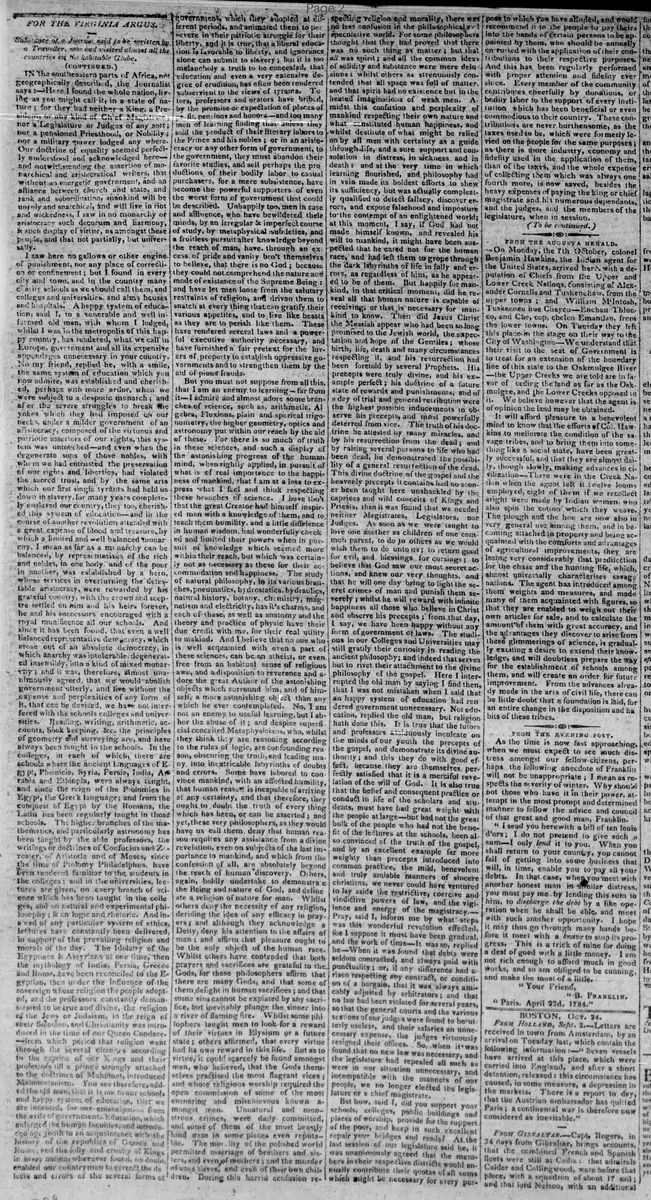
I saw here no gallows or other engine of punishment, nor any place of correction or confinement; but I found in every city and town, and in the country many charity schools as we should call them, and colleges and universities, and alms houses and hospitals. A happy system of education, said I, to a venerable and well informed old man, with whom I lodged, whilst I was in the metropolis of this happy country, has rendered, what we call in Europe, government and all its expensive appendages unnecessary in your country. No my friend, replied he, with a smile, the same system of education which you now admire, was established and cherished, perhaps with more ardor, when we were subject to a despotic monarch; 'and after the severe struggles to break the yokes which they had imposed on our necks, under a milder government of an aristocracy, composed of the virtuous and patriotic assertors of our rights, this system was untouched--and even when the degenerate sons of those nobles, with whom we had entrusted the preservation of our rights and liberties, had violated the sacred trust, and by the same arts which our first single tyrants had held us down) in slavery, for many years completely enslaved our country, they too, cherished this system of education--and in the course of another revolution attended with a great expense of blood and treasure, by which a limited and well balanced monarchy, I mean as far as a monarchy can be balanced, by representatives of the rich and nobles, in one body, and of the poor in another, was established by a hero, whose services in overturning the detestable aristocracy, were rewarded by his grateful country, with the crown and sceptre settled on him and his heirs forever, he and his successors encouraged with a royal munificence all our schools. And since it has been found, that even a well balanced representative democracy, which arose out of an absolute democracy, in which anarchy was intolerable, degenerated insensibly, into a kind of mixed monarchy; and it was, therefore, almost unanimous agreed, that we would abolish government utterly, and live without the expense and perplexities of any form of it, that can be devised, we have not interfered with the schools colleges and universities. Reading, writing, arithmetic, accounts, book keeping, &c. the principles of geometry and surveying are, and have always been taught in the schools. In the colleges, in each of which, there are schools where the ancient languages of Egypt, Phenicia, Syria, Persia, India, Arabia and Ethiopia, were always taught, and since the reign of the Ptolemies in Egypt, the Greek language; and from the conquest of Egypt by the Romans, the Latin has been regularly taught in those schools. The higher branches of the mathematics, and particularly astronomy has been taught by the able professors, the writings or doctrines of Confucius and Zoroaster, of Aristotle and of Moses, since the time of Ptolemy Philadelphus, have been rendered familiar to the students in the colleges; and in the universities, lectures are given, on every branch of science which has been taught in the colleges, and on natural and experimental philosophy; & on logic and rhetoric. And instead of any particular system of ethics, lectures have constantly been delivered, in support of the prevailing religion and morals of the day. The Idolatry of the Egyptians & Assyrians at one time, then the mythology of India, Persia, Greece and Rome, have been reconciled to the Egyptian, then under the influence of the sovereign whose religion the people adopted, and the professors constantly demonstrated to be true and divine, the religion of the Jews or Judaism, in the reign of their Solomon, and Christianity was introduced in the time of our Queen Candace.--from which period that religion went through the several changes according to the caprice of our Kings and their professors till a prince strongly attached to the doctrines of Mahomet, introduced Mahometanism. You see therefore, added the old man, that it is not to our schools and happy system of education, that we are indebted, for our emancipation from the evils of government. Education, which enlarged the human faculties; and introduced our youth to an acquaintance with the history of the republics of Greece and Rome, and the folly and cruelty of Kings in every nation, wherever found, no doubt enabled our countrymen to correct the defects and errors of the several forms of government, which they had adopted at different periods, and animated them to persevere in their patriotic struggle for their liberty, and it is true, that a liberal education is favorable to liberty, and ignorance alone can submit to slavery; but it is too melancholy a truth to be concealed, that education and even a very extensive degree of erudition, has often been rendered subservient to the views of tyrants. Tutors, professors and orators have bribed, by the promise or expectation of places of profit, pensions and honors---and too many men of learning finding that unless they sold the product of their literary labors to the Prince and his nobles; or in an aristocracy or any other form of government, to the government, they must abandon their favorite studies, and sell perhaps the productions of their bodily labor to casual purchasers, for a mere subsistence, have become the powerful supporters of even the worst form of government that could be described. Unhappily too, men in ease and affluence, who have bewildered their minds, by an irregular & imperfect course of study, by metaphysical subtleties, and a fruitless pursuit after knowledge beyond the reach of man, have, through an excess of pride and vanity bro't themselves to believe, that there is no God; because they could not comprehend the nature and mode of existence of the Supreme Being: and have let ten loose from the salutary restraints of religion, and driven them to snatch at every thing that can gratify their various appetites, and to live like beasts as they are to perish like them. These have rendered several laws and a powerful executive authority necessary, and have furnished a fair pretext for the lovers of property to establish oppressive governments and to strengthen them by the aid of pious frauds. But you must not suppose from all this, that I am an enemy to learning--far from it--I admire and almost adore some branches of science; such as, arithmetic, Algebra, Fluxions, plain and spherical trigonometry, the higher geometry, optics and astronomy put within our reach by the aid of these. For there is so much of truth in these sciences, and such a display of the astonishing progress of the human mind, when rightly applied, in pursuit of what is of real importance to the happiness of mankind, that I am at a loss to express what I feel and think respecting these branches of science. I have tho't that the great Creator had himself inspired man with a knowledge of them, and to teach them humility, and a little diffidence in human wisdom, had wonderfully checked and limited their powers when in pursuit of knowledge which seemed more within their reach, but which was certainly not as necessary as these or their accommodation and happiness. The study of natural philosophy, in its various branches, pneumatics, hydrostatics, hydraulics, natural history, botany, chemistry, magnetism and electricity, has its charms, and each of these, as well as anatomy and the theory and practice of physic have their due credit with me, or their real utility to mankind. And I believe that no one who is well acquainted with even a part of these sciences, can be an atheist, or even free from an habitual sense of religious awe, and a disposition to reverence and adore the great Author of the astonishing objects which surround him, and of himself; a more astonishing object than any which he ever contemplated. No, I am not an enemy to useful learning, but I abhor the abuse of it; and despise superficial conceited Metaphysicians, who, whilst they think they are reasoning according to the rules of logic, are confounding reason, obscuring the truth, and leading many, into inextricable labyrinths of doubts and errors. Some have labored to convince mankind, with an affected humility, that human reason is incapable of arriving at any certainty, and that therefore, they ought to doubt the truth of every thing which has been, or can be asserted; and yet, these very philosophers, as they would have us call them, deny that human reason requires any assistance from a divine revelation, even on subjects of the last importance to mankind, and which from the confession of all, are absolutely beyond the reach of human discovery. Others, again, boldly undertake to demonstrate the Being and nature of God, and delineate a religion of nature or man. Whilst others deny the necessity of any religion, deriding the idea of any efficacy in prayers; and although they acknowledge a Deity, deny his attention to the affairs of man; and affirm that pleasure ought to be the only object of the human race. Whilst others have contended that both prayers and sacrifices are grateful to the Gods, for these philosophers affirm that there are many Gods, and that some of them delight in human sacrifices; and that some sins cannot be expiated by any sacrifice, but inevitably plunge the sinner into a river of flaming fire. Whilst some philosophers taught men to look for a reward of their virtues in Elysium or a future state; others affirmed, that every virtue had its own reward in this life. But as to virtue, it could scarcely be found amongst men, who believed, that the Gods themselves practised the most flagrant vices; and whose religious worship required the open commission of some of the most ensnaring and mischievous known amongst men. Unnatural and monstrous crimes, were daily committed, and some of them of the most beastly kind were in some places even reputable. The morality of the polished world permitted marriage of brothers and sisters, and even of mothers; and the murder of one's Slaves, and even of their own children. During this horrid confusion speaking religion and morality, there was no less confusion in the philosophical and speculative world. For some philosophers thought that they had proved that there was no such thing as matter; but that all was spirit; and all the common ideas of solidity and substance were mere delusions: whilst others as strenuously contended that all space was full of matter, and that spirit had no existence but in the heated imaginations of weak men. Amidst this confusion and perplexity of mankind respecting their own nature and what constituted human happiness, and whilst destitute of what might be relied on by all men with certainty as a guide through life, and a sure support and consolation in distress, in sickness and in death: and at the very time in which learning flourished, and philosophy had in vain made its boldest efforts to shew its sufficiency, but was actually completely qualified to detect fallacy, discover errors, and expose falsehood and imposture to the contempt of an enlightened world; at this moment, I say, if God had not made himself known, and revealed his will to mankind, it might have been suspected that he cared not for the human race, and had left them to grope through the dark labyrinths of life in folly and errors, as regardless of him, as he appeared to be of them. But happily for mankind, in that critical moment, did he reveal all that human nature is capable of receiving, or that is necessary for mankind to know. Then did Jesus Christ the Messiah appear who had been so long promised to the Jewish world, the expectation and hope of the Gentiles; whose birth, life, death and many circumstances respecting it, and his resurrection had been foretold by several Prophets. His precepts were truly divine, and his example perfect; his doctrine of a future state of rewards and punishments, and of a day of trial and general retribution were the highest possible inducements to observe his precepts, and most powerfully deterred from vice. The truth of his doctrine he attested by many miracles, and by his resurrection from the dead; and by raising several persons to life who had been dead, he demonstrated the possibility of a general resurrection of the dead. This divine doctrine of the gospel and the heavenly precepts it contains had no sooner been taught here unshackled by the caprices and wild conceits of Kings and Priests, than it was found that we needed neither Magistrates, Legislators, nor Judges. As soon as we were taught to love one another as children of one common parent, to do to others as we would wish them to do unto us; to return good for evil, and blessings for cursings; to believe that God saw our most secret actions, and knew our very thoughts, and that he will one day bring to light the secret crimes of man and punish them severely; whilst he will reward with infinite happiness all those who believe in Christ and observe his precepts; from that day, I say, we have been happy without any form of government or laws. The studious in our Colleges and Universities may still gratify their curiosity in reading the ancient philosophy; and indeed that serves but to rivet their attachment to the divine philosophy of the gospel. Here I interrupted the old man by saying I find then, that I was not mistaken when I said that an happy system of education had rendered government unnecessary. Not education, replied the old man, but religion hath done this. It is true that the tutors and professors assiduously inculcate on the minds of our youth the precepts of the gospel, and demonstrate its divine authority; and this they do with good effect, because they are themselves perfectly satisfied that it is a merciful revelation of the will of God. It is also true that the belief and consequent practice or conduct in life of the scholars and students, must have had great weight with the people at large--but had not the great bulk of the people who had not the benefit of the lectures at the schools, been also convinced of the truth of the gospel, and by an excellent example far more weighty than precepts introduced into common practice, the mild, benevolent and truly amiable manners, of sincere christians, we never could have ventured to lay aside the restrictive, coercive and vindictive powers of law, and the vigilance and energy of the magistracy.--Pray, said I, inform me by what steps was this wonderful revolution effected, for I suppose it must have been gradual, and the work of time--It was so, replied he--When it was found that debts were seldom contracted, and always paid with punctuality; or, if any difference had arisen respecting any contract, or condition of a bargain, that it was always amicably adjusted by arbitrators; and that no law had been violated for several years, so that the general courts and the various sessions of our judges were found to be utterly useless, and their salaries an unnecessary expense, the judges virtuously resigned their offices. So, when it was found that no new law was necessary, and the legislature had repealed all such as were in our situation unnecessary, and incompatible with the manners of our people, we no longer elected the legislature or a chief magistrate. But how, said I, did you support your schools, colleges, public buildings and places of worship, provide for the support of the poor, and keep in such excellent repair your bridges and roads? At the last session of our legislature said he, it was unanimously agreed that the members in their respective districts would annually contribute their quotas of all sums which might be necessary for every purpose to which you have alluded, and would recommend it to the people to pay theirs into the hands of certain persons to be appointed by them, who should be annually entrusted with the application of their contributions to their respective purposes. And this has been regularly performed with proper attention and fidelity ever since. Every member of the community contributes cheerfully by donations, or bodily labor to the support of every institution which has been beneficial or even commodious to their country. These contributions are never burthensome, as the taxes used to be, which were formerly levied on the people for the same purposes; as there is more industry, economy and fidelity used in the application of them, than of the taxes, and the whole expense of collecting them which was always one fourth more, is now saved, besides the heavy expenses of paying the king or chief magistrate and his numerous dependants, and the judges, and the members of the legislature, when in session.
(To be continued.)
Substance of a Journal said to be written by a Traveller, who had visited almost all the countries on the habitable Globe.
(CONTINUED.)
IN the southeastern parts of Africa, not geographically described, the Journalist says:--Here I found the whole nation, living as you might call it, in a state of nature; for they had neither a King, a Priest, nor a Legislature or Judges of any sort; nor a pensioned Priesthood, or Nobility; nor a military power lodged any where. Our doctrine of equality seemed perfectly understood and acknowledged here--and notwithstanding the assertion of monarchical and aristocratical writers, that without an energetic government, and an alliance between church and state, and rank and subordination; mankind will be unruly and anarchical, and will live in riot and wickedness, I saw in no monarchy or aristocracy such decorum and harmony, & such display of virtue, as amongst these people, and that not partially, but universally.
I saw here no gallows or other engine of punishment, nor any place of correction or confinement; but I found in every city and town, and in the country many charity schools as we should call them, and colleges and universities, and alms houses and hospitals. A happy system of education, said I, to a venerable and well informed old man, with whom I lodged, whilst I was in the metropolis of this happy country, has rendered, what we call in Europe, government and all its expensive appendages unnecessary in your country. No my friend, replied he, with a smile, the same system of education which you now admire, was established and cherished, perhaps with more ardor, when we were subject to a despotic monarch; 'and after the severe struggles to break the yokes which they had imposed on our necks, under a milder government of an aristocracy, composed of the virtuous and patriotic assertors of our rights, this system was untouched--and even when the degenerate sons of those nobles, with whom we had entrusted the preservation of our rights and liberties, had violated the sacred trust, and by the same arts which our first single tyrants had held us down) in slavery, for many years completely enslaved our country, they too, cherished this system of education--and in the course of another revolution attended with a great expense of blood and treasure, by which a limited and well balanced monarchy, I mean as far as a monarchy can be balanced, by representatives of the rich and nobles, in one body, and of the poor in another, was established by a hero, whose services in overturning the detestable aristocracy, were rewarded by his grateful country, with the crown and sceptre settled on him and his heirs forever, he and his successors encouraged with a royal munificence all our schools. And since it has been found, that even a well balanced representative democracy, which arose out of an absolute democracy, in which anarchy was intolerable, degenerated insensibly, into a kind of mixed monarchy; and it was, therefore, almost unanimous agreed, that we would abolish government utterly, and live without the expense and perplexities of any form of it, that can be devised, we have not interfered with the schools colleges and universities. Reading, writing, arithmetic, accounts, book keeping, &c. the principles of geometry and surveying are, and have always been taught in the schools. In the colleges, in each of which, there are schools where the ancient languages of Egypt, Phenicia, Syria, Persia, India, Arabia and Ethiopia, were always taught, and since the reign of the Ptolemies in Egypt, the Greek language; and from the conquest of Egypt by the Romans, the Latin has been regularly taught in those schools. The higher branches of the mathematics, and particularly astronomy has been taught by the able professors, the writings or doctrines of Confucius and Zoroaster, of Aristotle and of Moses, since the time of Ptolemy Philadelphus, have been rendered familiar to the students in the colleges; and in the universities, lectures are given, on every branch of science which has been taught in the colleges, and on natural and experimental philosophy; & on logic and rhetoric. And instead of any particular system of ethics, lectures have constantly been delivered, in support of the prevailing religion and morals of the day. The Idolatry of the Egyptians & Assyrians at one time, then the mythology of India, Persia, Greece and Rome, have been reconciled to the Egyptian, then under the influence of the sovereign whose religion the people adopted, and the professors constantly demonstrated to be true and divine, the religion of the Jews or Judaism, in the reign of their Solomon, and Christianity was introduced in the time of our Queen Candace.--from which period that religion went through the several changes according to the caprice of our Kings and their professors till a prince strongly attached to the doctrines of Mahomet, introduced Mahometanism. You see therefore, added the old man, that it is not to our schools and happy system of education, that we are indebted, for our emancipation from the evils of government. Education, which enlarged the human faculties; and introduced our youth to an acquaintance with the history of the republics of Greece and Rome, and the folly and cruelty of Kings in every nation, wherever found, no doubt enabled our countrymen to correct the defects and errors of the several forms of government, which they had adopted at different periods, and animated them to persevere in their patriotic struggle for their liberty, and it is true, that a liberal education is favorable to liberty, and ignorance alone can submit to slavery; but it is too melancholy a truth to be concealed, that education and even a very extensive degree of erudition, has often been rendered subservient to the views of tyrants. Tutors, professors and orators have bribed, by the promise or expectation of places of profit, pensions and honors---and too many men of learning finding that unless they sold the product of their literary labors to the Prince and his nobles; or in an aristocracy or any other form of government, to the government, they must abandon their favorite studies, and sell perhaps the productions of their bodily labor to casual purchasers, for a mere subsistence, have become the powerful supporters of even the worst form of government that could be described. Unhappily too, men in ease and affluence, who have bewildered their minds, by an irregular & imperfect course of study, by metaphysical subtleties, and a fruitless pursuit after knowledge beyond the reach of man, have, through an excess of pride and vanity bro't themselves to believe, that there is no God; because they could not comprehend the nature and mode of existence of the Supreme Being: and have let ten loose from the salutary restraints of religion, and driven them to snatch at every thing that can gratify their various appetites, and to live like beasts as they are to perish like them. These have rendered several laws and a powerful executive authority necessary, and have furnished a fair pretext for the lovers of property to establish oppressive governments and to strengthen them by the aid of pious frauds. But you must not suppose from all this, that I am an enemy to learning--far from it--I admire and almost adore some branches of science; such as, arithmetic, Algebra, Fluxions, plain and spherical trigonometry, the higher geometry, optics and astronomy put within our reach by the aid of these. For there is so much of truth in these sciences, and such a display of the astonishing progress of the human mind, when rightly applied, in pursuit of what is of real importance to the happiness of mankind, that I am at a loss to express what I feel and think respecting these branches of science. I have tho't that the great Creator had himself inspired man with a knowledge of them, and to teach them humility, and a little diffidence in human wisdom, had wonderfully checked and limited their powers when in pursuit of knowledge which seemed more within their reach, but which was certainly not as necessary as these or their accommodation and happiness. The study of natural philosophy, in its various branches, pneumatics, hydrostatics, hydraulics, natural history, botany, chemistry, magnetism and electricity, has its charms, and each of these, as well as anatomy and the theory and practice of physic have their due credit with me, or their real utility to mankind. And I believe that no one who is well acquainted with even a part of these sciences, can be an atheist, or even free from an habitual sense of religious awe, and a disposition to reverence and adore the great Author of the astonishing objects which surround him, and of himself; a more astonishing object than any which he ever contemplated. No, I am not an enemy to useful learning, but I abhor the abuse of it; and despise superficial conceited Metaphysicians, who, whilst they think they are reasoning according to the rules of logic, are confounding reason, obscuring the truth, and leading many, into inextricable labyrinths of doubts and errors. Some have labored to convince mankind, with an affected humility, that human reason is incapable of arriving at any certainty, and that therefore, they ought to doubt the truth of every thing which has been, or can be asserted; and yet, these very philosophers, as they would have us call them, deny that human reason requires any assistance from a divine revelation, even on subjects of the last importance to mankind, and which from the confession of all, are absolutely beyond the reach of human discovery. Others, again, boldly undertake to demonstrate the Being and nature of God, and delineate a religion of nature or man. Whilst others deny the necessity of any religion, deriding the idea of any efficacy in prayers; and although they acknowledge a Deity, deny his attention to the affairs of man; and affirm that pleasure ought to be the only object of the human race. Whilst others have contended that both prayers and sacrifices are grateful to the Gods, for these philosophers affirm that there are many Gods, and that some of them delight in human sacrifices; and that some sins cannot be expiated by any sacrifice, but inevitably plunge the sinner into a river of flaming fire. Whilst some philosophers taught men to look for a reward of their virtues in Elysium or a future state; others affirmed, that every virtue had its own reward in this life. But as to virtue, it could scarcely be found amongst men, who believed, that the Gods themselves practised the most flagrant vices; and whose religious worship required the open commission of some of the most ensnaring and mischievous known amongst men. Unnatural and monstrous crimes, were daily committed, and some of them of the most beastly kind were in some places even reputable. The morality of the polished world permitted marriage of brothers and sisters, and even of mothers; and the murder of one's Slaves, and even of their own children. During this horrid confusion speaking religion and morality, there was no less confusion in the philosophical and speculative world. For some philosophers thought that they had proved that there was no such thing as matter; but that all was spirit; and all the common ideas of solidity and substance were mere delusions: whilst others as strenuously contended that all space was full of matter, and that spirit had no existence but in the heated imaginations of weak men. Amidst this confusion and perplexity of mankind respecting their own nature and what constituted human happiness, and whilst destitute of what might be relied on by all men with certainty as a guide through life, and a sure support and consolation in distress, in sickness and in death: and at the very time in which learning flourished, and philosophy had in vain made its boldest efforts to shew its sufficiency, but was actually completely qualified to detect fallacy, discover errors, and expose falsehood and imposture to the contempt of an enlightened world; at this moment, I say, if God had not made himself known, and revealed his will to mankind, it might have been suspected that he cared not for the human race, and had left them to grope through the dark labyrinths of life in folly and errors, as regardless of him, as he appeared to be of them. But happily for mankind, in that critical moment, did he reveal all that human nature is capable of receiving, or that is necessary for mankind to know. Then did Jesus Christ the Messiah appear who had been so long promised to the Jewish world, the expectation and hope of the Gentiles; whose birth, life, death and many circumstances respecting it, and his resurrection had been foretold by several Prophets. His precepts were truly divine, and his example perfect; his doctrine of a future state of rewards and punishments, and of a day of trial and general retribution were the highest possible inducements to observe his precepts, and most powerfully deterred from vice. The truth of his doctrine he attested by many miracles, and by his resurrection from the dead; and by raising several persons to life who had been dead, he demonstrated the possibility of a general resurrection of the dead. This divine doctrine of the gospel and the heavenly precepts it contains had no sooner been taught here unshackled by the caprices and wild conceits of Kings and Priests, than it was found that we needed neither Magistrates, Legislators, nor Judges. As soon as we were taught to love one another as children of one common parent, to do to others as we would wish them to do unto us; to return good for evil, and blessings for cursings; to believe that God saw our most secret actions, and knew our very thoughts, and that he will one day bring to light the secret crimes of man and punish them severely; whilst he will reward with infinite happiness all those who believe in Christ and observe his precepts; from that day, I say, we have been happy without any form of government or laws. The studious in our Colleges and Universities may still gratify their curiosity in reading the ancient philosophy; and indeed that serves but to rivet their attachment to the divine philosophy of the gospel. Here I interrupted the old man by saying I find then, that I was not mistaken when I said that an happy system of education had rendered government unnecessary. Not education, replied the old man, but religion hath done this. It is true that the tutors and professors assiduously inculcate on the minds of our youth the precepts of the gospel, and demonstrate its divine authority; and this they do with good effect, because they are themselves perfectly satisfied that it is a merciful revelation of the will of God. It is also true that the belief and consequent practice or conduct in life of the scholars and students, must have had great weight with the people at large--but had not the great bulk of the people who had not the benefit of the lectures at the schools, been also convinced of the truth of the gospel, and by an excellent example far more weighty than precepts introduced into common practice, the mild, benevolent and truly amiable manners, of sincere christians, we never could have ventured to lay aside the restrictive, coercive and vindictive powers of law, and the vigilance and energy of the magistracy.--Pray, said I, inform me by what steps was this wonderful revolution effected, for I suppose it must have been gradual, and the work of time--It was so, replied he--When it was found that debts were seldom contracted, and always paid with punctuality; or, if any difference had arisen respecting any contract, or condition of a bargain, that it was always amicably adjusted by arbitrators; and that no law had been violated for several years, so that the general courts and the various sessions of our judges were found to be utterly useless, and their salaries an unnecessary expense, the judges virtuously resigned their offices. So, when it was found that no new law was necessary, and the legislature had repealed all such as were in our situation unnecessary, and incompatible with the manners of our people, we no longer elected the legislature or a chief magistrate. But how, said I, did you support your schools, colleges, public buildings and places of worship, provide for the support of the poor, and keep in such excellent repair your bridges and roads? At the last session of our legislature said he, it was unanimously agreed that the members in their respective districts would annually contribute their quotas of all sums which might be necessary for every purpose to which you have alluded, and would recommend it to the people to pay theirs into the hands of certain persons to be appointed by them, who should be annually entrusted with the application of their contributions to their respective purposes. And this has been regularly performed with proper attention and fidelity ever since. Every member of the community contributes cheerfully by donations, or bodily labor to the support of every institution which has been beneficial or even commodious to their country. These contributions are never burthensome, as the taxes used to be, which were formerly levied on the people for the same purposes; as there is more industry, economy and fidelity used in the application of them, than of the taxes, and the whole expense of collecting them which was always one fourth more, is now saved, besides the heavy expenses of paying the king or chief magistrate and his numerous dependants, and the judges, and the members of the legislature, when in session.
(To be continued.)
What sub-type of article is it?
Prose Fiction
Essay
What themes does it cover?
Political
Religious
Liberty Freedom
What keywords are associated?
Utopian Society
No Government
Education System
Christian Gospel
Voluntary Contributions
African Nation
Political History
Religious Revolution
Literary Details
Title
Substance Of A Journal Said To Be Written By A Traveller, Who Had Visited Almost All The Countries On The Habitable Globe.
Subject
Description Of A Utopian Society In Southeastern Africa Without Government
Form / Style
Fictional Traveler's Journal Dialogue On Education, Religion, And Governance
Key Lines
Here I Found The Whole Nation, Living As You Might Call It, In A State Of Nature; For They Had Neither A King, A Priest, Nor A Legislature Or Judges Of Any Sort;
Not Education, Replied The Old Man, But Religion Hath Done This.
As Soon As We Were Taught To Love One Another As Children Of One Common Parent, To Do To Others As We Would Wish Them To Do Unto Us; ... From That Day, I Say, We Have Been Happy Without Any Form Of Government Or Laws.
Every Member Of The Community Contributes Cheerfully By Donations, Or Bodily Labor To The Support Of Every Institution Which Has Been Beneficial Or Even Commodious To Their Country.