Thank you for visiting SNEWPapers!
Sign up free
The Virginia Gazette
Richmond, Williamsburg, Richmond County, Virginia
What is this article about?
Lord Chatham delivers a passionate speech in the House of Lords criticizing British policy towards the American colonies, the costly war, use of German mercenaries, and risks from French involvement, urging a conciliatory motion for peace to avert national ruin.
Merged-components note: Continuation of Lord Chatham's speech across pages 1 and 2, as the text flows directly from the end of the first component to the start of the second.
Clippings
1 of 2
OCR Quality
Full Text
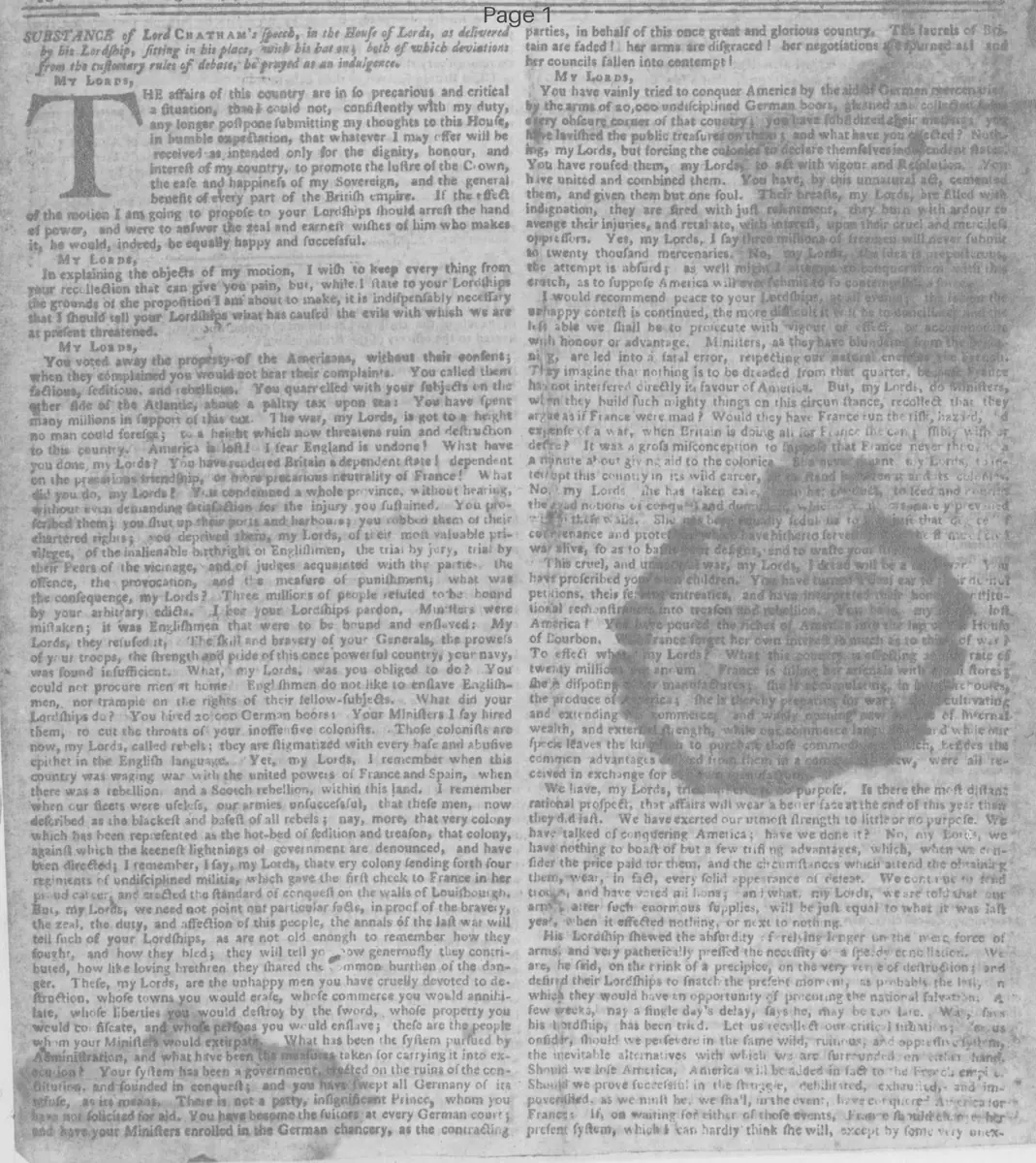
My Lords,
The affairs of this country are in so precarious and critical a situation, that I could not, consistently with my duty, any longer postpone submitting my thoughts to this House, in humble expectation, that whatever I may offer will be received—as intended only for the dignity, honour, and interest of my country, to promote the true interest of the Crown, the ease and happiness of my Sovereign, and the general benefit of every part of the British empire.
If the effect of the motion I am going to propose to your Lordships should arrest the hand of power, and were to answer the zeal and earnest wishes of him who makes it, he would, indeed, be equally happy and successful.
MY LORDS,
In explaining the objects of my motion, I wish to keep every thing from your recollection that can give you pain, but, while I state to your Lordships the grounds of the proposition I am about to make, it is indispensably necessary that I should tell your Lordships what has caused the evils with which we are at present threatened.
MY LORDS,
You voted away the property of the Americans, without their consent; when they complained you would not hear their complaints. You called them factious, seditious, and rebellious. You quarrelled with your subjects on this side of the Atlantic, about a paltry tax on tea. You have spent many millions in support of this tax. The war, my Lords, is got to a height no man could foresee; to a height which now threatens ruin and destruction to this country. America is lost! I fear England is undone! What have you done, my Lords? You have rendered Britain dependent on the precarious friendship, or more precarious neutrality of France! What did you do, my Lords? You condemned a whole province, without hearing, without even demanding satisfaction for the injury you sustained. You proscribed them; you shut up their ports and harbours; you robbed them of their chartered rights; you deprived them, my Lords, of their most valuable privileges, of the inalienable birthright of Englishmen, the trial by jury, trial by their Peers of the vicinage, and of judges acquainted with the parties, the offence, the provocation, and the measure of punishment; what was the consequence, my Lords? Three millions of people refused to be bound by your arbitrary edicts. I beg your Lordships pardon, my meaning was mistaken; it was Englishmen that were to be bound and enslaved: My Lords, they refused it. The skill and bravery of your Generals, the prowess of your troops, the strength and pride of this once powerful country, your navy, was found insufficient. What, my Lords, were you obliged to do? You could not procure men at home. Englishmen do not like to enslave Englishmen, nor trample on the rights of their fellow-subjects. What did your Lordships do? You hired 20,000 German boors. Your Ministers I say hired them, to cut the throats of your inoffensive colonists. Those colonists are now, my Lords, called rebels; they are stigmatized with every base and abusive epithet in the English language. Yet, my Lords, I remember when this country was waging war with the united powers of France and Spain, when there was a rebellion, and a Scotch rebellion, within this land. I remember when our fleets were useless, our armies unsuccessful, that those men, now described as the blackest and basest of all rebels; nay, more, that very colony which has been represented as the hot-bed of sedition and treason, that colony, against which the keenest lightnings of government have been directed; I remember, I say, my Lords, that very colony lending forth four regiments of undisciplied militia, which gave the first check to France in her proud career, and erected the standard of conquest on the walls of Louisbourg.
But, my Lords, we need not point out particular names, in proof of the bravery, the zeal, the duty, and affection of this people, the annals of the last war will tell such of your Lordships, as are not old enough to remember how they fought, and how they bled; they will tell you how generously they contributed, how like loving brethren they shared the common burthen of the danger. These, my Lords, are the unhappy men you have cruelly devoted to destruction, whose towns you would raze, whose commerce you would annihilate, whose liberties you would destroy by the sword, whose property you would confiscate, and whose persons you would enslave; these are the people.
What has been the system pursued by whom your Ministers would extirpate the measures taken for carrying it into execution?
Your system has been a government founded on the ruins of the constitution, and founded in conquest; and you have swept all Germany of its refuse, as its means. There is not a petty, insignificant Prince, whom you have not solicited for aid. You have become the suitors at every German court; and have your Ministers enrolled in the German chancery, as the contracting parties, in behalf of this once great and glorious country. The laurels of Britain are faded! her arms are disgraced! her negotiations despised and her councils fallen into contempt!
My Lords,
You have vainly tried to conquer America by the aid of German mercenaries, the arms of 20,000 undisciplined German boors, gleaned and collected from every obscure corner of that country you have subsidized; you have exhausted the public treasures on them; and what have you effected? Nothing, my Lords, but forcing the colonies to declare themselves independent States. You have roused them, my Lords, to act with vigour and resolution. You have united and combined them. You have, by this unnatural act, cemented them, and given them but one soul. Their breasts, my Lords, are filled with indignation, they are fired with resentment, they burn with ardour to avenge their injuries, and retaliate, with interest, upon their cruel and merciless oppressors. Yes, my Lords, I say three millions of freemen will never submit to twenty thousand mercenaries. No, my Lords, the idea is repugnant, the attempt is absurd; as well might you attempt to conquer the ocean with the sponge, as to suppose America will ever submit to so contemptible an enemy. I would recommend peace to your Lordships; the longer the unhappy contest is continued, the more difficult it will be to dismantle and the less able we shall be to prosecute with vigour or offer accommodation with honour or advantage. Ministers, as they have blinded us from the beginning, are led into a fatal error, respecting our natural enemies the French. They imagine that nothing is to be dreaded from that quarter, because France has not interfered directly in favour of America. But, my Lords, do Ministers, when they build such mighty things on this circumstance, recollect that they argue as if France were mad? Would they have France run the risk, hazard, extreme of a war, when Britain is doing all for France that she can wish? It was a gross misconception to suppose that France never threw a minute about giving aid to the colonies. She has connived, my Lords, in spite of this country in its wild career, and abetted its mad and dependent treaties colony. No, my Lords she has taken care, and her craft to lead and retort the mad notions of conquest and dominion which have prevailed. She daily leads us to our destruction, and that by our own means. She has countenanced and protected what has hitherto served her. She has kept the war alive, so as to debilitate, and to waste your strength. This crafty war, my Lords, I dread will be a war of the greatest calamity to this country. You have proscribed your children. You have turned their humble entreaties, and have interpreted their honest remonstrances into treason and rebellion. You have, my Lords, poured the riches of America into the lap of France! France sooner her own interest as much as to the eve of war! To effect what, my Lords? What this country is misspending at the rate of twenty millions on ruin France is filling her arsenals with arms the disposition manufactures; the last accumulating in her storehouses, the produce of America is then by preparing for war's cultivating and extending commerce and widely spreading of mental wealth, and external strength, while our commerce languishes and withers. The price leaves the kingdom to purchase those commodities which teases the common advantages ed upon them in a canes we were all re- ceived in exchange for. We have, my Lords, tried to no purpose. Is there the most distant rational prospect, that affairs will wear a better face at the end of this year than they did last. We have exerted our utmost strength to little or no purpose. We have talked of conquering America; have we done it? No, my Lords, we have nothing to boast of but a few trifling advantages, which, when we consider the price paid for them, and the circumstances which attend the ordinary them, wear, in fact, every solid appearance of retreat. We contrive to find good, and have voted millions; and what, my Lords, we are told that our army after such enormous supplies, will be just equal to what it was last year, when it effected nothing, or next to nothing. His Lordship shewed the absurdity of relying longer on the mere force of arms, and very pathetically pressed the necessity of a speedy conciliatory plan. We are, he said, on the brink of a precipice, on the very eve of destruction; and desired their Lordships to watch the present moment, as probably the last, in which they would have an opportunity preventing the national salvation. A few weeks, nay a single day's delay, says he, may be too late. War, as his Lordship, has been tried. Let us recollect: Our critical situation; let us consider, should we persevere in the same wild, ruinous, and oppressive, the inevitable alternatives with which we are surrounded on either hand. Should we lose America, America will be aided in fact to the French interest. Should we prove successful! in the hugger, chilled, exhausted, and impoverished, as we must be, we have, with the event, lost require- America for France: I, on waiting or either of those events, France anulech the high preeme system, which I can hardly think she will, except by some very onex-
expects change in her councils, then America, as a matter of course, will be
lost for ever to this country! Should this latter be the case, and that she should
make this a public avowal of her sentiments, by supporting the cause of Ame-
rica, though we had but five ships of war in the world, I should instantly be
for declaring war against her, as the only reparation that could possibly satisfy
the wounded honour of a great nation, be the event what it might. His Lord-
ship reminded the House likewise of the propositions moved by his bill and mo-
tion, early in 1775, before a drop of blood had been shed on either side;
painted out the fatal policy which caused their rejection, and the very violent and
indecent manner in which they were rejected. His Lordship spoke about fifty
minutes, and then made the motion.
What sub-type of article is it?
What keywords are associated?
What entities or persons were involved?
Where did it happen?
Foreign News Details
Primary Location
America
Key Persons
Outcome
lord chatham proposes a motion for a conciliatory plan to end the war with america, warning of potential french intervention and national ruin if delayed.
Event Details
Lord Chatham criticizes British ministers for imposing taxes on American colonies without consent, escalating to war, hiring German mercenaries, and ignoring colonial rights and past contributions. He warns of America's independence declaration, unification against Britain, and France's covert support weakening Britain. He urges immediate peace negotiations to prevent loss of America and conflict with France.