Thank you for visiting SNEWPapers!
Sign up free
Letter to Editor
April 26, 1788
The Daily Advertiser
New York, New York County, New York
What is this article about?
An unsigned letter in the Virginia Independent Chronicle defends the U.S. Federal Constitution's provisions for presidential veto and treaty-making powers against objections by Richard Henry Lee, arguing they provide necessary checks and balances similar to the British system.
Clipping
OCR Quality
95%
Excellent
Full Text
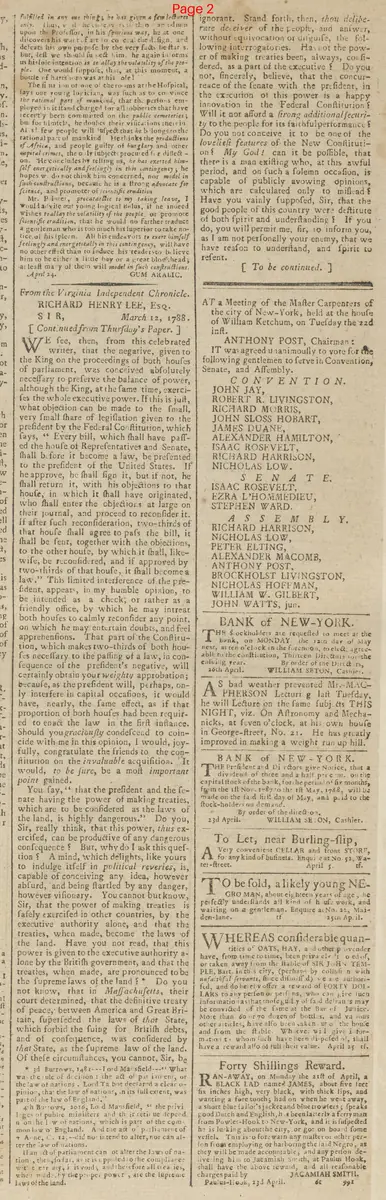
From the Virginia Independent Chronicle.
RICHARD HENRY LEE, Esq.
SIR,
March 12, 1788.
[Continued from Thursday's Paper.]
WE see, then, from this celebrated writer, that the negative, given to the King on the proceedings of both houses of parliament, was conceived absolutely necessary to preserve the balance of power, although the King, at the same time, exercises the whole executive power. If this is just, what objection can be made to the very small share of legislation given to the president by the Federal Constitution, which says, "Every bill, which shall have passed the house of Representatives and Senate, shall before it become a law, be presented to the president of the United States. If he approve, he shall sign it, but if not, he shall return it, with his objections to that house, in which it shall have originated, who shall enter the objections at large on their journal, and proceed to reconsider it. If after such reconsideration, two-thirds of that house shall agree to pass the bill, it shall be sent, together with the objections, to the other house, by which it shall, likewise, be reconsidered, and if approved by two-thirds of that house, it shall become a law." This limited interference of the president, appears, in my humble opinion, to be intended as a check, or rather as a friendly office, by which he may intreat both houses to calmly reconsider any point, on which he may entertain doubts, and feel apprehensions. That part of the Constitution, which makes two-thirds of both houses necessary to the passing of a law, in consequence of the president's negative, will certainly obtain your weighty approbation; because, as the president will, perhaps, only interfere in capital occasions, it would have, nearly, the same effect, as if that proportion of both houses had been required to enact the law in the first instance.
Should you graciously condescend to coincide with me in this opinion, I would, joyfully, congratulate the friends to the constitution on the invaluable acquisition. It would, to be sure, be a most important point gained.
You say, "that the president and the senate having the power of making treaties, which are to be considered as the laws of the land, is highly dangerous." Do you, Sir, really think, that this power, thus exercised, can be productive of any dangerous consequence? But, why do I ask this question? A mind, which delights, like yours, to indulge itself in political reveries, is, capable of conceiving any idea, however absurd, and being startled by any danger, however visionary. You cannot but know, Sir, that the power of making treaties is safely exercised in other countries, by the executive authority alone, and that the treaties, when made, become the laws of the land. Have you not read, that this power is given to the executive authority alone by the British government, and that the treaties, when made, are pronounced to be the supreme laws of the land? Do you not know, that in Massachusetts, their court determined, that the definitive treaty of peace, between America and Great Britain, superseded the laws of that State, which forbid the suing for British debts, and of consequence, was considered by that State, as the supreme law of the land.
Of these circumstances, you cannot, Sir, be ignorant. Stand forth, then, thou deliberate deceiver of the people, and answer, without equivocation or disguise, the following interrogatories. Has not the power of making treaties been, always, considered, as a part of the executive? Do you not, sincerely, believe, that the concurrence of the senate with the president, in the execution of this power is a happy innovation in the Federal Constitution? Will it not afford a strong additional security to the people for its faithful performance? Do you not conceive it to be one of the loveliest features of the New Constitution? My God! can it be possible, that there is a man existing who, at this awful period, and on such a solemn occasion, is capable of publicly avowing opinions, which are calculated only to mislead? Have you vainly supposed, Sir, that the good people of this country were destitute of both spirit and understanding? If you do, you will permit me, Sir, to inform you, as I am not personally your enemy, that we have reason to understand, and spirit to resent.
[To be continued.]
RICHARD HENRY LEE, Esq.
SIR,
March 12, 1788.
[Continued from Thursday's Paper.]
WE see, then, from this celebrated writer, that the negative, given to the King on the proceedings of both houses of parliament, was conceived absolutely necessary to preserve the balance of power, although the King, at the same time, exercises the whole executive power. If this is just, what objection can be made to the very small share of legislation given to the president by the Federal Constitution, which says, "Every bill, which shall have passed the house of Representatives and Senate, shall before it become a law, be presented to the president of the United States. If he approve, he shall sign it, but if not, he shall return it, with his objections to that house, in which it shall have originated, who shall enter the objections at large on their journal, and proceed to reconsider it. If after such reconsideration, two-thirds of that house shall agree to pass the bill, it shall be sent, together with the objections, to the other house, by which it shall, likewise, be reconsidered, and if approved by two-thirds of that house, it shall become a law." This limited interference of the president, appears, in my humble opinion, to be intended as a check, or rather as a friendly office, by which he may intreat both houses to calmly reconsider any point, on which he may entertain doubts, and feel apprehensions. That part of the Constitution, which makes two-thirds of both houses necessary to the passing of a law, in consequence of the president's negative, will certainly obtain your weighty approbation; because, as the president will, perhaps, only interfere in capital occasions, it would have, nearly, the same effect, as if that proportion of both houses had been required to enact the law in the first instance.
Should you graciously condescend to coincide with me in this opinion, I would, joyfully, congratulate the friends to the constitution on the invaluable acquisition. It would, to be sure, be a most important point gained.
You say, "that the president and the senate having the power of making treaties, which are to be considered as the laws of the land, is highly dangerous." Do you, Sir, really think, that this power, thus exercised, can be productive of any dangerous consequence? But, why do I ask this question? A mind, which delights, like yours, to indulge itself in political reveries, is, capable of conceiving any idea, however absurd, and being startled by any danger, however visionary. You cannot but know, Sir, that the power of making treaties is safely exercised in other countries, by the executive authority alone, and that the treaties, when made, become the laws of the land. Have you not read, that this power is given to the executive authority alone by the British government, and that the treaties, when made, are pronounced to be the supreme laws of the land? Do you not know, that in Massachusetts, their court determined, that the definitive treaty of peace, between America and Great Britain, superseded the laws of that State, which forbid the suing for British debts, and of consequence, was considered by that State, as the supreme law of the land.
Of these circumstances, you cannot, Sir, be ignorant. Stand forth, then, thou deliberate deceiver of the people, and answer, without equivocation or disguise, the following interrogatories. Has not the power of making treaties been, always, considered, as a part of the executive? Do you not, sincerely, believe, that the concurrence of the senate with the president, in the execution of this power is a happy innovation in the Federal Constitution? Will it not afford a strong additional security to the people for its faithful performance? Do you not conceive it to be one of the loveliest features of the New Constitution? My God! can it be possible, that there is a man existing who, at this awful period, and on such a solemn occasion, is capable of publicly avowing opinions, which are calculated only to mislead? Have you vainly supposed, Sir, that the good people of this country were destitute of both spirit and understanding? If you do, you will permit me, Sir, to inform you, as I am not personally your enemy, that we have reason to understand, and spirit to resent.
[To be continued.]
What sub-type of article is it?
Persuasive
Political
Provocative
What themes does it cover?
Constitutional Rights
Politics
What keywords are associated?
Federal Constitution
Presidential Veto
Treaty Making
Richard Henry Lee
Constitutional Checks
British Precedents
Massachusetts Court
What entities or persons were involved?
Richard Henry Lee, Esq.
Letter to Editor Details
Recipient
Richard Henry Lee, Esq.
Main Argument
the presidential veto power serves as a necessary check on legislation similar to the british monarchy, requiring two-thirds approval to override, while the president's and senate's treaty-making authority provides security and is not dangerous, as evidenced by precedents in britain and massachusetts.
Notable Details
Quotes Article I, Section 7 Of The U.S. Constitution On Bill Passage And Veto.
References British Royal Negative On Parliament.
Cites Massachusetts Court Ruling On Treaty Of Paris Superseding State Laws.
Accuses Lee Of Misleading The Public With Visionary Fears.