Thank you for visiting SNEWPapers!
Sign up free
The Daily Madisonian
Washington, District Of Columbia
What is this article about?
On June 10, 1844, President John Tyler sends a message to the House of Representatives, providing the rejected Texas annexation treaty and related documents previously shared secretly with the Senate. He urges Congress to reconsider annexation for national benefits, addresses objections regarding Mexico, and warns of potential British influence on Texas.
Clipping
OCR Quality
Full Text
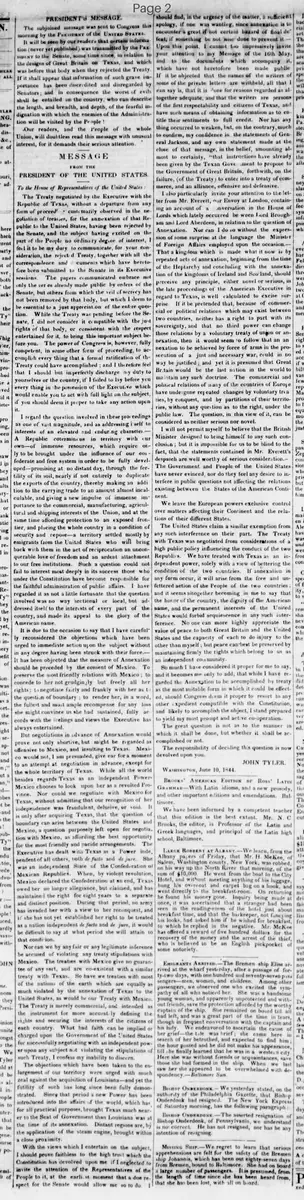
The subjoined message was sent to Congress this morning by the President of the United States.
It will be seen by our readers that certain information (never yet published) was transmitted by the President to the Senate, some time since, in relation to the designs of Great Britain on Texas, and which was before that body when they rejected the Treaty If it shall appear that information of such grave importance has been discredited and disregarded by Senators; and in consequence the worst of evils shall be entailed on the country, who can describe the length, and breadth, and depth, of the fearful indignation with which the enemies of the Administration will be visited by the People!
Our readers, and the People of the whole Union, will doubtless read this message with unusual interest, for it demands their serious attention.
MESSAGE FROM THE PRESIDENT OF THE UNITED STATES.
To the House of Representatives of the United States:
The Treaty negotiated by the Executive with the Republic of Texas, without a departure from any form of proceeding customarily observed in the negotiation of treaties, for the annexation of that Republic to the United States, having been rejected by the Senate, and the subject having excited on the part of the People no ordinary degree of interest, I feel it to be my duty to communicate, for your consideration, the rejected Treaty, together with all the correspondence and documents which have heretofore been submitted to the Senate in its Executive sessions. The papers communicated embrace not only the series already made public by orders of the Senate, but others from which the veil of secrecy has not been removed by that body, but which I deem to be essential to a just appreciation of the entire question. While the Treaty was pending before the Senate, I did not consider it compatible with the just rights of that body, or consistent with the respect entertained for it, to bring this important subject before you. The power of Congress is, however, fully competent, in some other form of proceeding, to accomplish every thing that a formal ratification of the Treaty could have accomplished; and I therefore feel that I should but imperfectly discharge my duty to yourselves or the country, if I failed to lay before you every thing in the possession of the Executive which would enable you to act with full light on the subject if you should deem it proper to take any action upon it.
I regard the question involved in these proceedings as one of vast magnitude, and as addressing itself to interests of an elevated and enduring character. A Republic coterminous in territory with our own—of immense resources, which require only to be brought under the influence of our confederate and free system in order to be fully developed—promising at no distant day, through the fertility of its soil, nearly if not entirely to duplicate the exports of the country, thereby making an addition to the carrying trade to an amount almost incalculable, and giving a new impulse of immense importance to the commercial, manufacturing, agricultural and shipping interests of the Union, and at the same time affording protection to an exposed frontier, and placing the whole country in a condition of security and repose—a territory settled mostly by emigrants from the United States who will bring back with them in the act of reciprocation an unconquerable love of freedom and an ardent attachment to our free institutions. Such a question could not fail to interest most deeply in its success those who under the Constitution have become responsible for the faithful administration of public affairs. I have regarded it as not a little fortunate that the question involved was no way sectional or local, but addressed itself to the interests of every part of the country, and made its appeal to the glory of the American name.
It is due to the occasion to say that I have carefully reconsidered the objections which have been urged to immediate action upon the subject without in any degree having been struck with their force. It has been objected that the measure of Annexation should be preceded by the consent of Mexico. To preserve the most friendly relations with Mexico; to concede to her not grudgingly but freely all her rights; to negotiate fairly and frankly with her as to the question of boundary; to render her, in a word, the fullest and most ample recompense for any loss she might convince us she had sustained, fully accords with the feelings and views the Executive has always entertained.
But negotiations in advance of Annexation would prove not only abortive, but might be regarded as offensive to Mexico, and insulting to Texas. Mexico would not, I am persuaded, give ear for a moment to an attempt at negotiation in advance, except for the whole territory of Texas. While all the world besides regards Texas as an independent Power Mexico chooses to look upon her as a revolted Province. Nor could we negotiate with Mexico for Texas, without admitting that our recognition of her independence was fraudulent, delusive, or void. It is only after acquiring Texas, that the question of boundary can arise between the United States and Mexico, a question purposely left open for negotiation with Mexico, as affording the best opportunity for the most friendly and pacific arrangements. The Executive has dealt with Texas as a Power independent of all others, both de facto and de jure. She was an independent State of the Confederation of Mexican Republics. When, by violent revolution, Mexico declared the Confederation at an end, Texas owed her no longer allegiance, but claimed, and has maintained the right for eight years to a separate and distinct position. During that period, no army has invaded her with a view to her reconquest, and if she has not yet established her right to be treated as a nation independent de facto and de jure, it would be difficult to say at what period she will attain to that condition.
Nor can we by any fair or any legitimate inference be accused of violating any treaty stipulations with Mexico. The treaties with Mexico give no guarantee of any sort, and are co-existent with a similar treaty with Texas. So have we treaties with most of the nations of the earth which are equally as much violated by the annexation of Texas to the United States, as would be our Treaty with Mexico. The Treaty is merely commercial, and intended as the instrument for more accurately defining the rights and securing the interests of the citizens of each country. What bad faith can be implied or charged upon the Government of the United States for successfully negotiating with an independent power upon any subject not violating the stipulations of such Treaty, I confess my inability to discern.
The objections which have been taken to the enlargement of our territory were urged with much zeal against the acquisition of Louisiana—and yet the futility of such has long since been fully demonstrated. Since that period a new Power has been introduced into the affairs of the world, which has for all practical purposes, brought Texas much nearer to the Seat of Government than Louisiana was at the time of its annexation. Distant regions are, by the application of the steam engine, brought within a close proximity
With the views which I entertain on the subject, I should prove faithless to the high trust which the Constitution has devolved upon me if I neglected to invite the attention of the Representatives of the People to it, at the earliest moment that a due respect for the Senate would allow me so to do. I should find, in the urgency of the matter, a sufficient apology, if one was wanting, since annexation is to encounter a great if not certain hazard of final defeat, if something be not now done to prevent it.
Upon this point, I cannot too impressively invite your attention to my Message of the 16th May and to the documents which accompany it, which have not heretofore been made public If it be objected that the names of the writers of some of the private letters are withheld, all that I can say is, that it is done for reasons regarded as altogether adequate, and that the writers are persons of the first respectability and citizens of Texas, and have such means of obtaining information as to entitle their sentiments to full credit. Nor has anything occurred to weaken, but, on the contrary, much to confirm, my confidence in the statements of General Jackson, and my own statement made at the close of that message, in the belief, amounting almost to certainty, "that instructions have already been given by the Texan Government to propose to the Government of Great Britain, forthwith, on the failure, (of the Treaty) to enter into a treaty of commerce, and an alliance, offensive and defensive."
I also particularly invite your attention to the letter from Mr. Everett, our Envoy at London, containing an account of a conversation in the House of Lords which lately occurred between Lord Brougham and Lord Aberdeen, in relation to the question of Annexation. Nor can I do so without the expression of some surprise at the language the Minister of Foreign Affairs employed upon the occasion. That a kingdom which is made what it now is by repeated acts of annexation, beginning from the time of the Heptarchy and concluding with the annexation of the kingdoms of Ireland and Scotland, should perceive any principle, either novel or serious, in the late proceedings of the American Executive in regard to Texas, is well calculated to excite surprise. If it be pretended that, because of commercial or political relations which may exist between two countries, neither has a right to part with its sovereignty, and that no third power can change those relations by a voluntary treaty of union or annexation, then it would seem to follow that an annexation to be achieved by force of arms in the prosecution of a just and necessary war, could in no way be justified; and yet it is presumed that Great Britain would be the last nation in the world to maintain any such doctrine. The commercial and political relations of many of the countries of Europe have undergone repeated changes by voluntary treaties, by conquest, and by partitions of their territories, without any question as to the right, under the public law. The question, in this view of it, can be considered as neither serious nor novel.
I will not permit myself to believe that the British Minister designed to bring himself to any such conclusion; but it is impossible for us to be blind to the fact, that the statements contained in Mr. Everett's despatch are well worthy of serious consideration.
The Government and People of the United States have never evinced, nor do they feel any desire to interfere in public questions not affecting the relations existing between the States of the American Continent. We leave the European powers exclusive control over matters affecting their Continent and the relations of their different States. The United States claim a similar exemption from any such interference on their part. The Treaty with Texas was negotiated from considerations of a high public policy influencing the conduct of the two Republics. We have treated with Texas as an independent power, solely with a view of bettering the condition of the two countries. If annexation in any form occur, it will arise from the free and unfettered action of the People of the two countries; and it seems altogether becoming in me to say that the honor of the country, the dignity of the American name, and the permanent interests of the United States would forbid acquiescence in any such interference. No one can more highly appreciate the value of peace to both Great Britain and the United States and the capacity of each to do injury to the other than myself; but peace can best be preserved by maintaining firmly the rights which belong to us as an independent community.
So much I have considered it proper for me to say, and it becomes me only to add, that while I have regarded the Annexation to be accomplished by treaty as the most suitable form in which it could be effected, should Congress deem it proper to resort to any other expedient compatible with the Constitution, and likely to accomplish the object, I stand prepared to yield my most prompt and active co-operation.
The great question is not as to the manner in which it shall be done, but whether it shall be accomplished or not. The responsibility of deciding this question is now devolved upon you.
JOHN TYLER.
Washington, June 10, 1844.
What sub-type of article is it?
What themes does it cover?
What keywords are associated?
What entities or persons were involved?
Where did it happen?
Story Details
Key Persons
Location
Washington, Texas, Mexico, Great Britain
Event Date
June 10, 1844
Story Details
President Tyler communicates the rejected Texas annexation treaty and secret documents to the House, advocating for annexation despite Senate rejection, refuting objections on Mexico relations, and warning of British designs on Texas to urge congressional action for national expansion and security.