Thank you for visiting SNEWPapers!
Sign up free
Alexandria Daily Advertiser
Alexandria, Virginia
What is this article about?
Senate debate on the Louisiana Treaty ratification in November 1803, featuring speeches by Mr. White opposing the purchase due to settlement risks and high cost, interrupted remarks by General Jackson, and Mr. Wells arguing against delegating possession verification to the President amid suspicions of French title validity.
Merged-components note: Continuation of the congressional debate on the Louisiana Treaty across columns on page 2.
Clipping
OCR Quality
Full Text
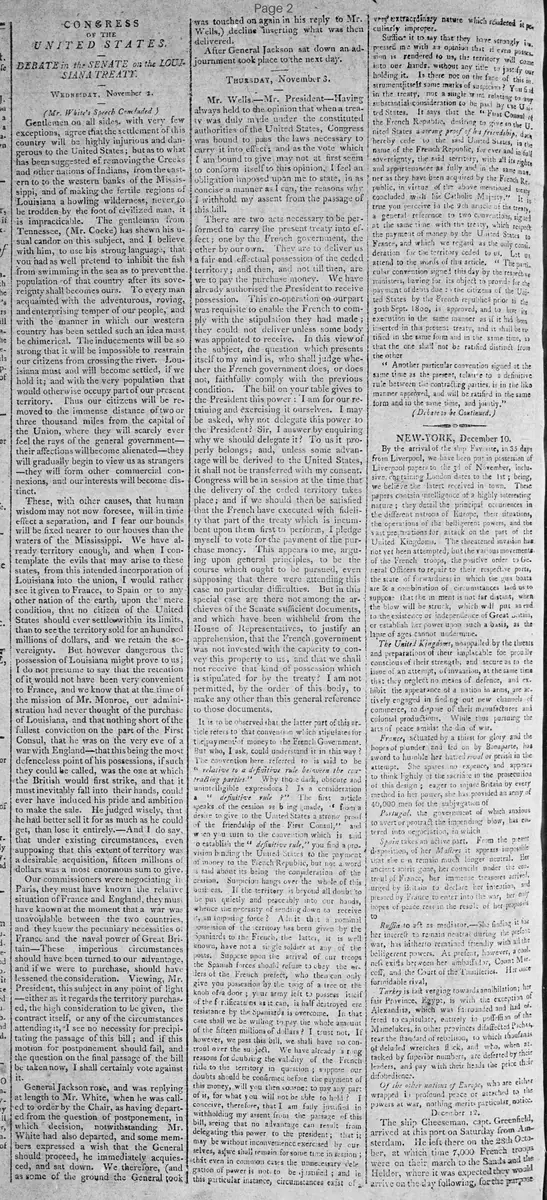
UNITED STATES.
DEBATE in the SENATE on the LOUISIANA TREATY.
WEDNESDAY, NOVEMBER 2.
(Mr. White's Speech Concluded)
Gentlemen on all sides, with very few exceptions, agree that the settlement of this country will be highly injurious and dangerous to the United States; but as to what has been suggested of removing the Creeks and other nations of Indians, from the eastern to the western banks of the Mississippi, and of making the fertile regions of Louisiana a howling wilderness, never to be trodden by the foot of civilized man, it is impracticable. The gentleman from Tennessee, (Mr. Cocke) has shewn his usual candor on this subject, and I believe with him, to use his strong language, that you had as well pretend to inhibit the fish from swimming in the sea as to prevent the population of that country after its sovereignty shall become ours. To every man acquainted with the adventurous, roving, and enterprising temper of our people, and with the manner in which our western country has been settled such an idea must be chimerical. The inducements will be so strong that it will be impossible to restrain our citizens from crossing the river. Louisiana must and will become settled, if we hold it; and with the very population that would otherwise occupy part of our present territory. Thus our citizens will be removed to the immense distance of two or three thousand miles from the capital of the Union, where they will scarcely ever feel the rays of the general government-- their affections will become alienated--they will gradually begin to view us as strangers-- they will form other commercial connexions, and our interests will become distinct.
These, with other causes, that human wisdom may not now foresee, will in time effect a separation, and I fear our bounds will be fixed nearer to our houses than the waters of the Mississippi. We have already territory enough, and when I contemplate the evils that may arise to these states, from this intended incorporation of Louisiana into the union, I would rather see it given to France, to Spain or to any other nation of the earth, upon the mere condition, that no citizen of the United States should ever settle within its limits, than to see the territory sold for an hundred millions of dollars, and we retain the sovereignty. But however dangerous the possession of Louisiana might prove to us; I do not presume to say that the retention of it would not have been very convenient to France, and we know that at the time of the mission of Mr. Monroe, our administration had never thought of the purchase of Louisiana, and that nothing short of the fullest conviction on the part of the First Consul, that he was on the very eve of a war with England--that this being the most defenceless point of his possessions, if such they could be called, was the one at which the British would first strike, and that it must inevitably fall into their hands, could ever have induced his pride and ambition to make the sale. He judged wisely, that he had better sell it for as much as he could get, than lose it entirely.--And I do say, that under existing circumstances, even supposing that this extent of territory was a desirable acquisition, fifteen millions of dollars was a most enormous sum to give. Our commissioners were negociating in Paris, they must have known the relative situation of France and England, they must have known at the moment that a war was unavoidable between the two countries, and they knew the pecuniary necessities of France and the naval power of Great Britain--These imperious circumstances should have been turned to our advantage, and if we were to purchase, should have lessened the consideration. Viewing, Mr. President, this subject in any point of light --either as it regards the territory purchased, the high consideration to be given, the contract itself, or any of the circumstances attending it, I see no necessity for precipitating the passage of this bill; and if this motion for postponement should fail, and the question on the final passage of the bill be taken now, I shall certainly vote against it.
General Jackson rose, and was replying at length to Mr. White, when he was called to order by the Chair, as having departed from the question of postponement, in which decision, notwithstanding Mr. White had also departed, and some members expressed a wish that the General should proceed, he immediately acquiesced, and sat down. We therefore, (and as some of the ground the General took was touched on again in his reply to Mr. Wells,) decline inserting what was then delivered.
After General Jackson sat down an adjournment took place to the next day:
THURSDAY, November 3.
Mr. Wells--Mr. President--Having always held to the opinion that when a treaty was duly made under the constituted authorities of the United States, Congress was bound to pass the laws necessary to carry it into effect; and as the vote which I am bound to give may not at first seem to conform itself to this opinion, I feel an obligation imposed upon me to state, in as concise a manner as I can, the reasons why I withhold my assent from the passage of this bill.
There are two acts necessary to be performed to carry the present treaty into effect; one by the French government, the other by our own. They are to deliver us a fair and effectual possession of the ceded territory; and then, and not till then, are we to pay the purchase money. We have already authorised the President to receive possession. This co-operation on our part was requisite to enable the French to comply with the stipulation they had made; they could not deliver unless some body was appointed to receive. In this view of the subject, the question which presents itself to my mind is, who shall judge whether the French government does, or does not, faithfully comply with the previous condition. The bill on your table gives to the President this power: I am for our retaining and exercising it ourselves. I may be asked, why not delegate this power to the President? Sir, I answer by enquiring why we should delegate it? To us it properly belongs; and, unless some advantage will be derived to the United States, it shall not be transferred with my consent. Congress will be in session at the time that the delivery of the ceded territory takes place; and if we should then be satisfied that the French have executed with fidelity that part of the treaty which is incumbent upon them first to perform, I pledge myself to vote for the payment of the purchase money. This appears to me, arguing upon general principles, to be the course which ought to be pursued, even supposing that there were attending this case no particular difficulties. But in this special case are there not among the archives of the Senate sufficient documents, and which have been withheld from the House of Representatives, to justify an apprehension, that the French government was not invested with the capacity to convey this property to us, and that we shall not receive that kind of possession which is stipulated for by the treaty? I am not permitted, by the order of this body, to make any other than this general reference to those documents.
It is to be observed that the latter part of this article refers to that convention which stipulates for the payment of money to the French Government. But who, I ask, could understand it in this way? The convention here referred to is said to be 'a relative to a definitive rule between the contracting parties.' Why those dark, obscure and unintelligible expressions? Is a consideration a 'definitive rule?' The first article speaks of the cession as being made, 'from a desire to give to the United States a strong proof of the friendship of the First Consul,' and when you turn to the Convention which is said to establish the 'definitive rule,' you find a provision binding the United States to the payment of money to the French Republic, but not a word is said about its being the consideration of the cession. Suspicion hangs over the whole of this business. If the territory is beyond all doubt to be put quietly and peaceably into our hands, whence the necessity of sending down to receive it, an imposing force? And is it that a nominal possession of the territory has been given by the Spaniards to the French, the latter, it is well known, have not a single soldier at any of the posts. Suppose upon the arrival of our troops the Spanish forces should refuse to obey the orders of the French prefect, who then can only give you possession by the twig of a tree or the knob of a door; your army left to possess itself of the fortifications as it can, is half destroyed ere resistance by the Spaniards is overcome. In that case shall we be willing to pay the whole amount of the fifteen millions of dollars? I trust not. If however, we pass this bill, we shall have no controul over the subject. We have already strong reasons for doubting the validity of the French title to the territory in question; suppose our doubts should be confirmed before the payment of this money, will you then consent to pay any part of it, for what you will not be able to hold? I conceive, therefore, that I am fully justified in withholding my assent from the passage of this bill, seeing that no advantage can result from delegating this power to the president; that it may be without inconvenience exercised by ourselves, as we shall remain for some time in session; that even in common cases the unnecessary delegation of power is not to be justified; and in this particular instance, circumstances exist of a
very extraordinary nature which rendered it peculiarly improper.
Suffice it to say that they have strongly impressed me with an opinion that if even possession is rendered to us, the territory will come into our hands without any title to justify our holding it. Is there not on the face of this instrument itself some marks of suspicion? You find in the treaty, not a single word relating to any substantial consideration to be paid by the United States. It says that the 'First Consul of the French Republic, desiring to give to the United States a strong proof of his friendship, doth hereby cede to the said United States in the name of the French Republic, for ever and in full sovereignty, the said territory, with all its rights and appurtenances as fully and in the same manner as they have been acquired by the French Republic, in virtue of the above mentioned treaty concluded with the Catholic Majesty.'
It is true you perceive in the 9th article of this treaty, a general reference to two conventions, signed at the same time with the treaty, which respect the payment of money by the United States to France, and which we regard as the only consideration for the territory ceded to us. Let us attend to the words of the article. 'The particular convention signed this day by the respective ministers, having for its object to provide for the payment of debts due to the citizens of the United States by the French republic prior to the 30th Sept. 1800, is approved, and to have its execution in the same manner as if it had been inserted in this present treaty, and it shall be ratified in the same form and in the same time, so that the one shall not be ratified distinct from the other.
'Another particular convention signed at the same time as the present, relative to a definitive rule between the contracting parties, is in the like manner approved, and will be ratified in the same form and in the same time, and jointly.'
(Debate to be Continued.)
What sub-type of article is it?
What themes does it cover?
What keywords are associated?
What entities or persons were involved?
Where did it happen?
Story Details
Key Persons
Location
Senate, United States
Event Date
November 2 3
Story Details
Senate debate on ratifying the Louisiana Purchase treaty, with Mr. White concluding opposition citing settlement dangers, potential union separation, excessive cost, and French motivations; General Jackson interrupted; Mr. Wells opposes bill for delegating possession judgment to President, raises suspicions on French title validity and treaty language.