Thank you for visiting SNEWPapers!
Sign up free
Phenix Gazette
Alexandria, Virginia
What is this article about?
Reports on the unsettled state of Ireland post-Catholic emancipation, with varying views from newspapers. Dr. Doyle, Bishop of Kildare and Leighlin, issues a pastoral address urging Catholics and Protestants to unite in peace and obey the law, condemning party processions that cause disorder.
Clipping
OCR Quality
Full Text
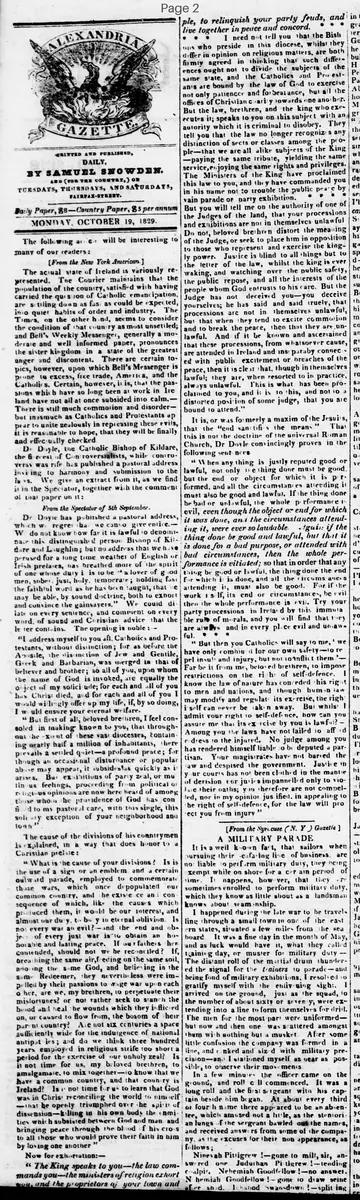
[From the New York American.]
The actual state of Ireland is variously represented. The Courier maintains that the population of the country, satisfied with having carried the question of Catholic emancipation, are settling down as fast as could be expected, into quiet habits of order and industry. The Times, on the other hand, seems to consider the condition of that country as most unsettled; and Bell's Weekly Messenger, generally a moderate and well informed paper, pronounces the sister kingdom in a state of the greatest anger and discontent. There are certain topics, however, upon which Bell's Messenger is prone to excess, free trade, America, and the Catholics. Certain, however, it is, that the passions which have so long been at work in Ireland have not all at once subsided into calm. There is still much commotion and disorder—but inasmuch as Catholics and Protestants appear to unite zealously in repressing these evils, it is reasonable to hope, that they will be finally and effectually checked.
Dr. Doyle, the Catholic Bishop of Kildare, in the arrest of Controversialists, while controversy was rife has published a pastoral address inviting to harmony and submission to the laws. We give an extract from it, as we find it in the Spectator, together with the comment of that paper on it:
From the Spectator of 5th September.
Dr. Doyle has published a pastoral address, which we regret that we cannot give entire. We do not know how far it is lawful to denominate this distinguished person Bishop of Kildare and Leighlin; but no address that we have perused for a long time whether of English or Irish prelates, has breathed more of the spirit of one whose duty it is to be "a lover of good men, sober, just, holy, temperate; holding fast the faithful word as he has been taught, that he may be able, by sound doctrine, both to exhort and convince the gainsayers." We could dilate on every sentence, and comment on every word, of sound and Christian advice that the letter contains. The opening is noble:-
"I address myself to you all, Catholics and Protestants, without distinction; for as before the Apostle, the distinction of Jew and Gentile, Greek and Barbarian, was merged in that of believer and brother; so all of you, upon whom the name of God is invoked, are equally the object of my solicitude; for each and all of you Jesus Christ died. and for each and all of you I would willingly offer up my life, if, by so doing, I would ensure your eternal welfare.
"But first of all, beloved brethren, I feel consoled in making known to you, that throughout the extent of these vast dioceses, containing nearly half a million of inhabitants, here prevails a settled quiet—a profound peace; for though an occasional disturbance or popular abuse may appear, it subsides as quickly as it arises. But exhibitions of party zeal, or mutual ill feelings, proceeding from political or religious opinions are nowhere heard of among those whom the providence of God has confided to my pastoral care, with this single, this sole exception of your neighborhood and town.
The cause of the divisions of his countrymen is explained, in a way that does honor to a Christian prelate:
"What is the cause of your divisions? Is it the use of a sign or an emblem, and a certain outward parade, employed to commemorate those wars, which once depopulated our common country, and the existence and consequence of which, like the causes which produced them, it would be our interest, and almost our duty, to bury in eternal oblivion. Is not every war an evil?—and the end and object of every just war is to obtain an honorable and lasting peace. If our fathers here contended, should not we be reconciled? If, breathing the same air, feeding on the same soil, adoring the same God, and believing in the same Redeemer, they nevertheless were impelled by their passions to wage war upon each other, are we, my brethren, to perpetuate their misfortunes? or not rather seek to staunch the blood and heal the wounds which they inflicted on, or caused to flow from, the bosom of their parent country? Are not six centuries a space sufficiently wide for the indulgence of national antipathies; and do we think three hundred years employed in religious strife too short a period for the exercise of our unholy zeal? Is it not time for us, my beloved brethren, to amalgamate, to mix together—to know that we have a common country, and that country is Ireland? Is it not time for us to learn that God was in Christ reconciling the world to himself—that he openly triumphed over the spirit of dissension—killing in his own body the enmities which subsisted between God and man and bringing peace through the blood of his cross to all those who would prove their faith in him by loving one another.
Now for exhortation:-
"The King speaks to you—the law commands you—the ministers of religion exhort you, and the proprietors of your town and people, to relinquish your party feuds, and live together in peace and concord.
I need not tell you that the Bishop and I differ in opinion on religious matters, we are both bishops who preside in this diocese, whilst they firmly agreed in thinking that such differences ought not to divide the subjects of the same state, and the Catholics and Protestants are bound by the law of God to exercise not only patience and forbearance, but all the offices of Christian charity towards one another.
But the law, brethren, and the king who executes it, speaks to you on this subject with an authority which it is criminal to disobey. They tell you that the law no longer recognizes any distinction of sects or classes among the people—that we are all alike subjects of the King service, enjoying the same rights and privileges. -paying the same tribute, yielding the same The Ministers of the King have proclaimed this law to you, and they have commanded you in his name not to trouble the public peace by vain parade or party exhibition.
But you will tell me on the authority of one of and exhibitions are not in themselves unlawful the Judges of the land, that your processions Do not, beloved brethren distort the meaning of the Judge, or seek to place him in opposition to those who represent and exercise the king- ly power. Justice is blind to all things but to the letter of the law, whilst the king is ever waking, and watching over the public safety, the public repose, and all the interests of the people whom God entrusts to his care. But the Judge has not deceived you—you deceive yourselves; he has said and said truly, that processions are not in themselves unlawful, but that when they tend to excite commotion and to break the peace, then that they are un- lawful. And if it be known and ascertained that these processions, from whatsoever cause, are attended in Ireland and ns: paraby connected with public excitement or breaches of the peace, then it is clear that, though in themselves lawful; they are, when resorted to in practice, always unlawful. This is what has been proclaimed to you, and it is to this, and not to a distorted position of some judge, that you are bound to attend."
It is, or was formerly a maxim of the Jesuits, That the "end sanctifies the means. this is not the doctrine of the universal Roman Church, Dr. Doyle convincingly proves in the following sentences
"When any thing is justly reputed good or lawful, not only the thing done must be good. but the end or object for which it is performed. and all the circumstances attending it must also be good and lawful. If the thing done be bad or unlawful, the whole performance is evil, even though the object or end for which it was done, and the circumstances attending it, were ever so laudable. Again: if the thing done be good and lawful, but that it is done for a bad purpose, or attended with bad circumstances, then the whole performance is vitiated; so that in order that any thing be good or lawful. the thing done the end f.r which it is done, and all the circumstances attending it, must also be good. For, if the work is If, its end or circumstances, be evil then the whole performance is evil. Try your party processions in Ireland by this immutable rule of morals, and you will find that they are always and in every place evil and unlawful.
"But then you Catholics will say to me, 'we have only combined for our own safety—to repel insult and injury, but not to inflict them' - Far be it from me, beloved brethren, to impose restrictions on the right of self-defence. I know the law of nature has conceded this right to men and nations, and though human law may modify and regulate its exercise, the right itself can never be taken away. But whilst I admit your right to self-defence, how can you assure me that its exercise by you is lawful?- Among you the laws have not failed to afford redress to the injured. No judge among you has rendered himself liable to be deputed a partisan. Your magistrates have not buried the law and despised the government. Justice in your courts has not been clothed in the mantle of derision nor juries impaneled only to violate their oaths; you therefore are not compelled, nor in my opinion justified. in appealing to the right of self-defence, for the law will protect you from injury."
What sub-type of article is it?
What keywords are associated?
What entities or persons were involved?
Where did it happen?
Foreign News Details
Primary Location
Ireland
Event Date
As Of 5th September
Key Persons
Outcome
hope for lasting peace through unity of catholics and protestants in repressing disorder; pastoral address promotes harmony and submission to laws, condemning party processions as unlawful when causing commotion.
Event Details
Post-Catholic emancipation, Ireland experiences ongoing commotion and disorder despite some newspapers claiming settlement into order. Dr. Doyle's pastoral address to Catholics and Protestants urges reconciliation, forgetting past wars and religious strife, obedience to the King and law, and avoidance of party processions that breach peace. The Spectator praises the address for its Christian spirit.