Thank you for visiting SNEWPapers!
Sign up free
Story
February 23, 1962
Toledo Union Journal
Toledo, Lucas County, Ohio
What is this article about?
1962 consumer guide by Sidney Margolius praises automatic washers as top value starting at $115, details features of low, medium, deluxe models, compares top vs. front loaders, and advises on repairs vs. new purchases.
Clipping
OCR Quality
98%
Excellent
Full Text
How To Buy
Automatic Washers
Called
Top
Consumer Buy
in
1962
By SIDNEY MARGOLIUS
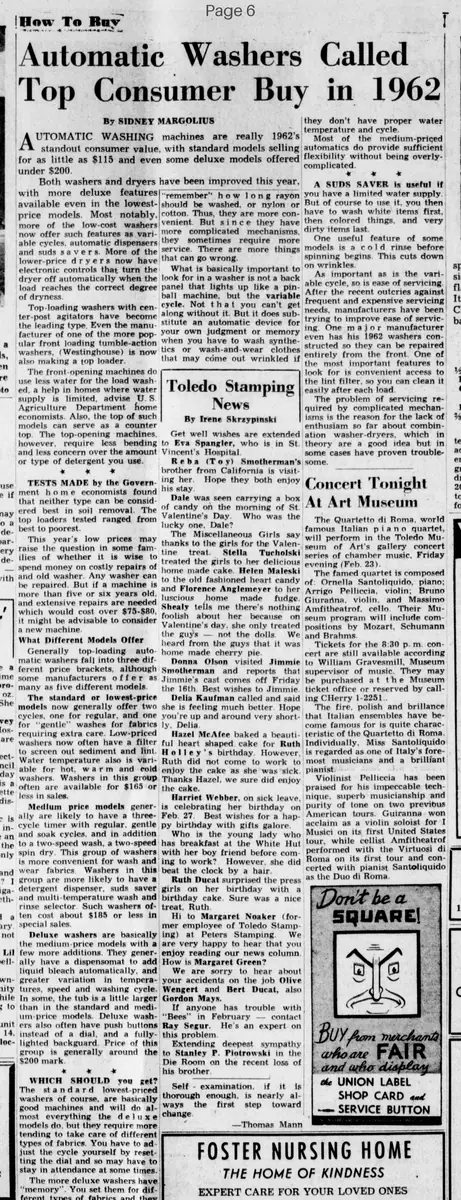
AUTOMATIC WASHING machines are really 1962's standout consumer value, with standard models selling for as little as $115 and even some deluxe models offered under $200.
Both washers and dryers with more deluxe features available even in the lowest-price models. Most notably, more of the low-cost washers now offer such features as variable cycles, automatic dispensers and suds savers. More of the lower-price dryers now have electronic controls that turn the dryer off automatically when the load reaches the correct degree of dryness.
Top-loading washers with center-post agitators have become the leading type. Even the manufacturer of one of the more popular front loading tumble-action washers, (Westinghouse) is now also making a top loader.
The front-opening machines do use less water for the load washed, a help in homes where water supply is limited, advise U. S. Agriculture Department home economists. Also, the top of such models can serve as a counter top. The top-opening machines, however, require less bending and less concern over the amount or type of detergent you use.
TESTS MADE by the Government home economists found that neither type can be considered best in soil removal. The top loaders tested ranged from best to poorest.
This year's low prices may raise the question in some families of whether it is wise to spend money on costly repairs of an old washer. Any washer can be repaired. But if a machine is more than five or six years old, and extensive repairs are needed which would cost over $75-$80, it might be advisable to consider a new machine.
What Different Models Offer
Generally top-loading automatic washers fall into three different price brackets, although some manufacturers offer as many as five different models.
The standard or lowest-price models now generally offer two cycles, one for regular, and one for "gentle" washes for fabrics requiring extra care. Low-priced washers now often have a filter to screen out sediment and lint.
Water temperature also is variable for hot, warm and cold washers. Washers in this group often are available for $165 or less in sales.
Medium price models generally are likely to have a three-cycle timer with regular, gentle and soak cycles, and in addition to a two-speed wash, a two-speed spin dry. This group of washers is more convenient for wash and wear fabrics.
Washers in this group are more likely to have a detergent dispenser, suds saver and multi-temperature wash and rinse selector. Such washers often cost about $185 or less in special sales.
Deluxe washers are basically the medium-price models with a few more additions. They generally have a dispensomat to add liquid bleach automatically, and greater variation in temperatures, speed and washing cycle.
In some, the tub is a little larger than in the standard and medium-price models. Deluxe washers also often have push buttons instead of a dial, and a fully-lighted backguard. Price of this group is generally around the $200 mark.
WHICH SHOULD YOU get?
The standard lowest-priced washers of course, are basically good machines and will do almost everything the deluxe models do, but they require more tending to take care of different types of fabrics. You have to adjust the cycle yourself by resetting the dial and so may have to stay in attendance at some times.
The more deluxe washers have "remember" how long rayon should be washed, or nylon or cotton. Thus, they are more convenient. But since they have more complicated mechanisms, they sometimes require more service. There are more things that can go wrong.
What is basically important to look for in a washer is not a back panel that lights up like a pinball machine, but the variable cycle. Not that you can't get along without it. But it does substitute an automatic device for your own judgment or memory when you have to wash synthetics or wash-and-wear clothes that may come out wrinkled if they don't have proper water temperature and cycle.
Most of the medium-priced automatics do provide sufficient flexibility without being overly-complicated.
A SUDSSAVER is useful if you have a limited water supply. But of course to use it, you then have to wash white items first, then colored things, and very dirty items last.
One useful feature of some models is a cold rinse before spinning begins. This cuts down on wrinkles.
As important as is the variable cycle, so is ease of servicing. After the recent outcries against frequent and expensive servicing needs, manufacturers have been trying to improve ease of servicing. One major manufacturer even has his 1962 washers constructed so they can be repaired entirely from the front. One of the most important features to look for is convenient access to the lint filter, so you can clean it easily after each load.
The problem of servicing required by complicated mechanisms is the reason for the lack of enthusiasm so far about combination washer-dryers, which in theory are a good idea but in some cases have proven troublesome.
Automatic Washers
Called
Top
Consumer Buy
in
1962
By SIDNEY MARGOLIUS
AUTOMATIC WASHING machines are really 1962's standout consumer value, with standard models selling for as little as $115 and even some deluxe models offered under $200.
Both washers and dryers with more deluxe features available even in the lowest-price models. Most notably, more of the low-cost washers now offer such features as variable cycles, automatic dispensers and suds savers. More of the lower-price dryers now have electronic controls that turn the dryer off automatically when the load reaches the correct degree of dryness.
Top-loading washers with center-post agitators have become the leading type. Even the manufacturer of one of the more popular front loading tumble-action washers, (Westinghouse) is now also making a top loader.
The front-opening machines do use less water for the load washed, a help in homes where water supply is limited, advise U. S. Agriculture Department home economists. Also, the top of such models can serve as a counter top. The top-opening machines, however, require less bending and less concern over the amount or type of detergent you use.
TESTS MADE by the Government home economists found that neither type can be considered best in soil removal. The top loaders tested ranged from best to poorest.
This year's low prices may raise the question in some families of whether it is wise to spend money on costly repairs of an old washer. Any washer can be repaired. But if a machine is more than five or six years old, and extensive repairs are needed which would cost over $75-$80, it might be advisable to consider a new machine.
What Different Models Offer
Generally top-loading automatic washers fall into three different price brackets, although some manufacturers offer as many as five different models.
The standard or lowest-price models now generally offer two cycles, one for regular, and one for "gentle" washes for fabrics requiring extra care. Low-priced washers now often have a filter to screen out sediment and lint.
Water temperature also is variable for hot, warm and cold washers. Washers in this group often are available for $165 or less in sales.
Medium price models generally are likely to have a three-cycle timer with regular, gentle and soak cycles, and in addition to a two-speed wash, a two-speed spin dry. This group of washers is more convenient for wash and wear fabrics.
Washers in this group are more likely to have a detergent dispenser, suds saver and multi-temperature wash and rinse selector. Such washers often cost about $185 or less in special sales.
Deluxe washers are basically the medium-price models with a few more additions. They generally have a dispensomat to add liquid bleach automatically, and greater variation in temperatures, speed and washing cycle.
In some, the tub is a little larger than in the standard and medium-price models. Deluxe washers also often have push buttons instead of a dial, and a fully-lighted backguard. Price of this group is generally around the $200 mark.
WHICH SHOULD YOU get?
The standard lowest-priced washers of course, are basically good machines and will do almost everything the deluxe models do, but they require more tending to take care of different types of fabrics. You have to adjust the cycle yourself by resetting the dial and so may have to stay in attendance at some times.
The more deluxe washers have "remember" how long rayon should be washed, or nylon or cotton. Thus, they are more convenient. But since they have more complicated mechanisms, they sometimes require more service. There are more things that can go wrong.
What is basically important to look for in a washer is not a back panel that lights up like a pinball machine, but the variable cycle. Not that you can't get along without it. But it does substitute an automatic device for your own judgment or memory when you have to wash synthetics or wash-and-wear clothes that may come out wrinkled if they don't have proper water temperature and cycle.
Most of the medium-priced automatics do provide sufficient flexibility without being overly-complicated.
A SUDSSAVER is useful if you have a limited water supply. But of course to use it, you then have to wash white items first, then colored things, and very dirty items last.
One useful feature of some models is a cold rinse before spinning begins. This cuts down on wrinkles.
As important as is the variable cycle, so is ease of servicing. After the recent outcries against frequent and expensive servicing needs, manufacturers have been trying to improve ease of servicing. One major manufacturer even has his 1962 washers constructed so they can be repaired entirely from the front. One of the most important features to look for is convenient access to the lint filter, so you can clean it easily after each load.
The problem of servicing required by complicated mechanisms is the reason for the lack of enthusiasm so far about combination washer-dryers, which in theory are a good idea but in some cases have proven troublesome.
What sub-type of article is it?
Consumer Guide
Product Review
What keywords are associated?
Automatic Washers
Consumer Value
Top Loading
Front Loading
Deluxe Features
Servicing
What entities or persons were involved?
Sidney Margolius
U. S. Agriculture Department Home Economists
Westinghouse
Story Details
Key Persons
Sidney Margolius
U. S. Agriculture Department Home Economists
Westinghouse
Event Date
1962
Story Details
Article advises on purchasing automatic washing machines as top consumer value in 1962, comparing top-loading and front-loading types, features across price brackets, and considerations for repairs versus new buys.