Thank you for visiting SNEWPapers!
Sign up free
Editorial
June 20, 1854
The Camden Weekly Journal
Camden, Kershaw County, South Carolina
What is this article about?
The Richmond Examiner criticizes Thomas Hart Benton's book for subtly maligning John C. Calhoun through innuendos and misrepresentations, despite praising Henry Clay and Daniel Webster. It portrays Benton as envious and hypocritical, contrasting Calhoun's noble demeanor with Benton's persistent hatred.
Clipping
OCR Quality
98%
Excellent
Full Text
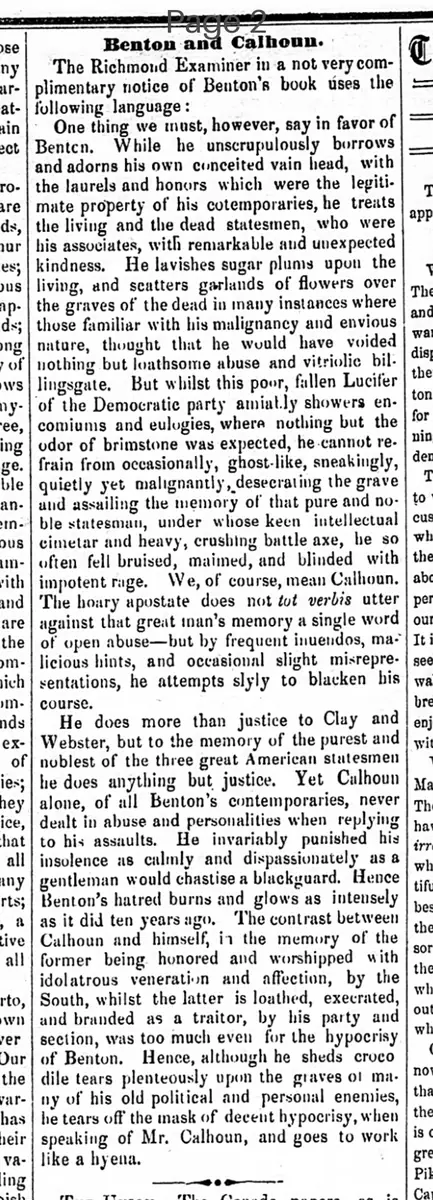
Benton and Calhoun.
The Richmond Examiner in a not very complimentary notice of Benton's book uses the following language:
One thing we must, however, say in favor of Benton, While he unscrupulously borrows and adorns his own conceited vain head, with the laurels and honors which were the legitimate property of his cotemporaries, he treats the living and the dead statesmen, who were his associates, with remarkable and unexpected kindness. He lavishes sugar plums upon the living, and scatters garlands of flowers over the graves of the dead in many instances where those familiar with his malignancy and envious nature, thought that he would have voided nothing but loathsome abuse and vitriolic billingsgate. But whilst this poor, fallen Lucifer of the Democratic party amiably showers encomiums and eulogies, where nothing but the odor of brimstone was expected, he cannot refrain from occasionally, ghost-like, sneakingly, quietly yet malignantly, desecrating the grave and assailing the memory of that pure and noble statesman, under whose keen intellectual scimetar and heavy, crushing battle axe, he so often fell bruised, maimed, and blinded with impotent rage. We, of course, mean Calhoun.
The hoary apostate does not tot verbis utter against that great man's memory a single word of open abuse—but by frequent innuendos, malicious hints, and occasional slight misrepresentations, he attempts slyly to blacken his course.
He does more than justice to Clay and Webster, but to the memory of the purest and noblest of the three great American statesmen he does anything but justice. Yet Calhoun alone, of all Benton's cotemporaries, never dealt in abuse and personalities when replying to his assaults. He invariably punished his insolence as calmly and dispassionately as a gentleman would chastise a blackguard. Hence Benton's hatred burns and glows as intensely as it did ten years ago. The contrast between Calhoun and himself, in the memory of the former being honored and worshipped with idolatrous veneration and affection, by the South, whilst the latter is loathed, execrated, and branded as a traitor, by his party and section, was too much even for the hypocrisy of Benton. Hence, although he sheds crocodile tears plenteously upon the graves of many of his old political and personal enemies, he tears off the mask of decent hypocrisy, when speaking of Mr. Calhoun, and goes to work like a hyena.
The Richmond Examiner in a not very complimentary notice of Benton's book uses the following language:
One thing we must, however, say in favor of Benton, While he unscrupulously borrows and adorns his own conceited vain head, with the laurels and honors which were the legitimate property of his cotemporaries, he treats the living and the dead statesmen, who were his associates, with remarkable and unexpected kindness. He lavishes sugar plums upon the living, and scatters garlands of flowers over the graves of the dead in many instances where those familiar with his malignancy and envious nature, thought that he would have voided nothing but loathsome abuse and vitriolic billingsgate. But whilst this poor, fallen Lucifer of the Democratic party amiably showers encomiums and eulogies, where nothing but the odor of brimstone was expected, he cannot refrain from occasionally, ghost-like, sneakingly, quietly yet malignantly, desecrating the grave and assailing the memory of that pure and noble statesman, under whose keen intellectual scimetar and heavy, crushing battle axe, he so often fell bruised, maimed, and blinded with impotent rage. We, of course, mean Calhoun.
The hoary apostate does not tot verbis utter against that great man's memory a single word of open abuse—but by frequent innuendos, malicious hints, and occasional slight misrepresentations, he attempts slyly to blacken his course.
He does more than justice to Clay and Webster, but to the memory of the purest and noblest of the three great American statesmen he does anything but justice. Yet Calhoun alone, of all Benton's cotemporaries, never dealt in abuse and personalities when replying to his assaults. He invariably punished his insolence as calmly and dispassionately as a gentleman would chastise a blackguard. Hence Benton's hatred burns and glows as intensely as it did ten years ago. The contrast between Calhoun and himself, in the memory of the former being honored and worshipped with idolatrous veneration and affection, by the South, whilst the latter is loathed, execrated, and branded as a traitor, by his party and section, was too much even for the hypocrisy of Benton. Hence, although he sheds crocodile tears plenteously upon the graves of many of his old political and personal enemies, he tears off the mask of decent hypocrisy, when speaking of Mr. Calhoun, and goes to work like a hyena.
What sub-type of article is it?
Partisan Politics
What keywords are associated?
Benton
Calhoun
Political Rivalry
Book Criticism
Democratic Party
Southern Veneration
What entities or persons were involved?
Benton
Calhoun
Clay
Webster
Richmond Examiner
Democratic Party
South
Editorial Details
Primary Topic
Criticism Of Benton's Portrayal Of Calhoun
Stance / Tone
Strongly Pro Calhoun And Anti Benton
Key Figures
Benton
Calhoun
Clay
Webster
Richmond Examiner
Democratic Party
South
Key Arguments
Benton Treats Other Statesmen Kindly But Maligns Calhoun Subtly Through Innuendos
Calhoun Was Noble And Never Abusive In Responses
Benton's Hatred Towards Calhoun Persists Intensely
Contrast In Legacies: Calhoun Revered In The South, Benton Loathed As Traitor