Thank you for visiting SNEWPapers!
Sign up free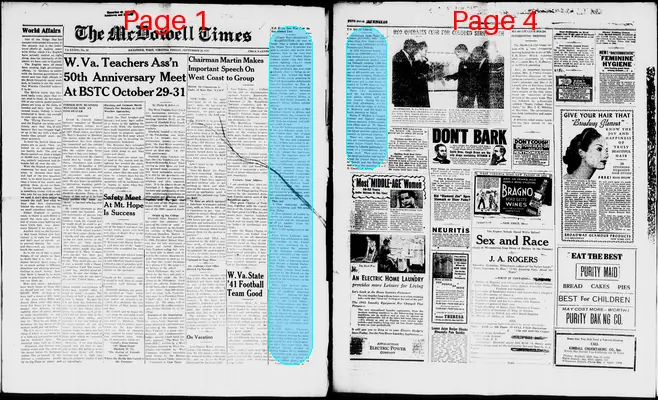
The Mcdowell Times
Keystone, Mcdowell County, West Virginia
What is this article about?
The U.S. is establishing military bases and rubber plantations in Liberia, granting Pan American Airways a franchise for a Miami-to-Africa airline route, signaling active economic and military involvement in Africa amid WWII, with historical U.S.-Liberia ties and concerns for African American citizens.
Merged-components note: Merged continuation of U.S. entry into Liberia article from page 1 to page 4.
Clippings

1 of 2
OCR Quality
Full Text
(Negro News Syndicate)
WASHINGTON.--It was no more than a month ago when the Negro News Syndicate was able to predict. from inside news sources. that in the very near future colored United States soldiers might soon find themselves fighting their blood brothers on African soils.
That prediction has now come perilously close to being an actuality. For behind the headlines. in the recent granting by the Civil Aeronautics Administration of a franchise to Pan American Airways for operating a commercial airline between Miami. Florida. and a "point or points" in southwest Africa, is a story that deeply concerns America's fifteen million colored citizens.
The gist of that story is that America's interest in Africa and African affairs. has ceased to be academic. and become active- both from an economic and military point of view.
From the well-concealed story of the new Liberian deals. it is now evident that the United States has entered Africa for keeps. The war and commerce of the air have succeeded in doing what the war and commerce of the sea have heretofore failed to do-plunge the American flag into the imperial maze of Africa's eleven nations.
The comprehensive nature of American-Liberian negotiations were not apparent when the President returned from the Roosevelt-Churchill conference at. sea and announced plans for flying American planes to the British Middle Eastern front. via Africa. behind this move. and Pan American's subsequent application for a franchise, were two considerations. which only now have come to light.
They are:
1. New American defense bases in Liberia. only 700 miles from Dakar.
2. New plantings of rubber in Liberia to answer defense purposes needs and the threatened cut-off of supplies from the Dutch East Indies.
Here is the background of the story.
Even before Liberian independence was proclaimed in 1847 the warships of the United States were welcomed to Liberia to protect the interests of the American colonization Society, originator of the settlement of free. colored immigrants. Visits of American naval ships became a regular feature of a Yankee big-stick policy. preventing Liberia from being squeezed by the British on the North. in Sierra Leone. and the French on the Southeast. on the Ivory Coast.
Thus. until modern times. Monrovia Liberia's capital. has been an unofficial American naval "base." During the past critical months. skillful diplomacy by the United States's Envoy Extraordinary and Minister Plenipotentiary to Liberia. Lester A. Walton has negotiated a reciprocal air treaty: has extended the unofficial naval base into rights that include military. naval and submarine base privileges.
In 1922. Harvey Firestone. Senior head of the giant tire and rubber company bearing his name ordered his technicians to scour the world for new rubber-growing sites. Two years later. they returned having decided on Liberia because of its traditional friendship with this country. its ready supply of labor. its superior rubber plants and its
Continued on Page 4
U.S. Enters Liberia
(Continued from Page 1)
relative proximity, only 4,400 miles from New York compared to more than 7,000 miles to Java. Sumatra and Malaya.
In 1925 Firestone bought an option on 1,000,000 acres. Planting started a year later. In a few years production started coming through, yielding 1,000 lbs. of the finest bud-grafted rubber per acre compared to the average of 400 pounds per acre in Malaya and Sumatra. Production was pushed to the limit on 200,000 acres and is now being extended to 75,000 more to meet the increasing shortage here.
These two considerations spell the big story behind the new airline which will link this country during the war, and long afterwards. It is believed, with the bulge of Africa at Monrovia and the bulge of South America at Natal.
Walter F. Walker is Counsel-General and highest ranking Liberian emissary in this country with offices here at 25 Beaver street. He was enthusiastic about the future possible appeal of his country to American tourists.
There are others, however, who are understandably dubious about future United States relations in Liberia particularly in event of a United States' naval base there. They point out the racial prejudice that has followed the United States forces to Hawaii and the Philippines, and fear a like situation in a U.S. Controlled Africa.
What sub-type of article is it?
What keywords are associated?
What entities or persons were involved?
Where did it happen?
Foreign News Details
Primary Location
Liberia
Key Persons
Outcome
new american defense bases in liberia; expanded rubber plantations yielding 1,000 lbs per acre on 200,000 acres, extending to 75,000 more; pan american airways franchise for miami to southwest africa airline; reciprocal air treaty; extended military, naval, and submarine base privileges.
Event Details
The U.S. has negotiated deals with Liberia for defense bases 700 miles from Dakar and new rubber plantings to counter shortages from Dutch East Indies. This follows historical U.S. protection of Liberia since 1847 and recent diplomacy by Lester A. Walton. Pan American Airways granted franchise for commercial airline to southwest Africa, linking U.S. to Africa and South America via Monrovia and Natal. Concerns raised about racial prejudice in U.S.-controlled areas.