Thank you for visiting SNEWPapers!
Sign up free
The National Intelligencer And Washington Advertiser
Washington, District Of Columbia
What is this article about?
In the U.S. House of Representatives on April 7, 1808 (continued June 6), members debated a bill to raise additional military regiments for defense amid foreign threats. Speakers like Key, Dana, and Clopton supported it with amendments suggested, rejecting recommittal (29-?); focused on policy without war declaration.
Merged-components note: Merged sequential reading order components on page 1 that form a single coherent congressional debate on the military force bill.
Clipping
OCR Quality
Full Text
HOUSE OF REPRESENTATIVES.
Thursday, April 7.
Debate on the passage of the bill for raising an additional military force.
(CONTINUED.)
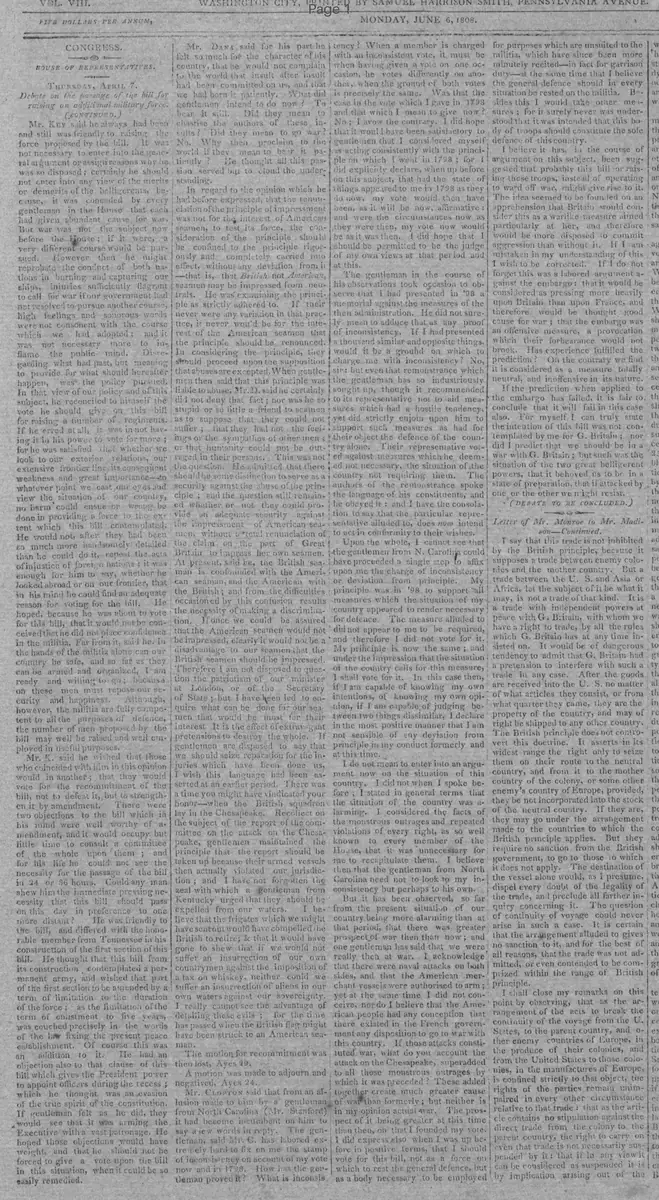
Mr. Key said he always had been and still was friendly to raising the force proposed by the bill. It was not necessary to enter into the general argument or assign reasons why he was so disposed; certainly he should not enter into any view of the merits or demerits of the belligerents, because it was conceded by every gentleman in the House that each had given abundant cause for war. But war was not the subject now before the House; if it were, a very different course would be pursued. However then he might reprobate the conduct of both nations in burning and capturing our ships, injuries sufficiently flagrant to call for war if our government had not resolved to pursue another course, high feelings and sonorous words were not consonant with the course which we had adopted; and it was not necessary more to inflame the public mind. Disregarding what had past, but meaning to provide for what should hereafter happen, was the policy pursued. In that view of our policy and of this subject, he reconciled to himself the vote he should give on this bill for raising a number of regiments. If he erred at all, it was in not having it in his power to vote for more; for he was satisfied that whether we look to our exterior relations, our extensive frontier line, its consequent weakness and great importance--to whatever point we cast our eyes and view the situation of our country, no harm could ensue or wrong be done in providing a force to the extent which this bill contemplated. He would not, after they had been so much more handsomely detailed than he could do it, repeat the acts of injustice of foreign nations; it was enough for him to say, whether he looked abroad or on our frontier, that in his mind he could find an adequate reason for voting for the bill. He hoped, because he was about to vote for this bill, that it would not be conceived that he did not place confidence in the militia. Far from it, said he. In the hands of the militia alone can our country be safe, and so far as they can be armed and organized, I am ready and willing to go; because on these men must repose our security and happiness. Although, however, the militia are fully competent to all the purposes of defence, the number of men proposed by the bill may well be raised and well employed in useful purposes.
Mr. K. said he wished that those who coincided with him in this opinion would in another; that they would vote for the recommittal of the bill, not to defeat it, but to strengthen it by amendment. There were two objections to the bill which in his mind were well worthy of amendment, and it would occupy but little time to consult a committee of the whole upon them; and for his life he could not see the necessity for the passage of the bill in 24 or 36 hours. Could any man shew him the immediate pressing necessity that this bill should pass on this day in preference to one more distant? He was friendly to the bill, and differed with the honorable member from Tennessee in his construction of the first section of this bill. He thought that this bill from its construction contemplated a permanent army, and wished that part of the first section to be amended by a term of limitation to the duration of the force; as the limitation of the term of enlistment to five years, was couched precisely in the words of the law fixing the present peace establishment. Of course this was an addition to it. He had an objection also to that clause of this bill which gives the President power to appoint officers during the recess; which he thought was an evasion of the true spirit of the constitution. If gentlemen felt as he did, they would see that it was arming the Executive with a vast patronage. He hoped those objections would have weight, and that he should not be forced to give a vote upon the bill in this situation, when it could be so easily remedied.
Mr. Dana said for his part he felt so much for the character of his country, that he would not complain to the world that insult after insult had been committed on us, and that we had borne it patiently. What did gentlemen intend to do now? To bear it still. Did they mean to chastise the authors of these insults? Did they mean to go to war? No. Why then proclaim to the world if they mean to bear it patiently? He thought all this passion served but to cloud the understanding.
In regard to the opinion which he had before expressed, that the renunciation of the principle of impressment was not for the interest of American seamen, to test its force, the consideration of the principle should be confined to the principle rigorously and completely carried into effect, without any deviation from it—that is, that British not American, seamen may be impressed from neutrals. He was examining the principle as strictly adhered to. If there never were any variation in that practice, it never would be for the interest of the American seamen that the principle should be renounced. In considering the principle, they should proceed upon the supposition that abuses are excepted. When gentlemen then said that this principle was liable to abuse, Mr. D. said he certainly did not deny that fact; nor was he so stupid or so little a friend to seamen as to suppose that they could not suffer; that they had not the feelings or the sympathies of other men; or that humanity could not be outraged in their persons. This was not the question. He admitted that there should be some distinction to serve as a security against the abuse of the principle; and the question still remained whether or not they could provide an adequate security against the impressment of American seamen, without a total renunciation of the claim on the part of Great Britain to impress her own seamen. At present, said he, the British seaman is confounded with the American seaman, and the American with the British; and from the difficulties occasioned by this confusion results the necessity of making a discrimination. Thence we could be assured that the American seamen would not be impressed, clearly it would not be a disadvantage to our seamen that the British seamen should be impressed. Therefore I am not disposed to question the patriotism of our minister at London, or of the Secretary of State: but I have been led to enquire what can be done for our seamen that would be most for their interest. It is the effect of extravagant pretensions to destroy the whole. If gentlemen are disposed to say that we should seize reparation for the injuries which have been done us, I wish this language had been asserted at an earlier period. There was a time you might have vindicated your honor—when the British squadron lay in the Chesapeake. Recollect on the subject of the report of the committee on the attack on the Chesapeake, gentlemen maintained the principle that the report should be taken up because their armed vessels then actually violated our jurisdiction; and I have not forgotten the zeal with which a gentleman from Kentucky urged that they should be expelled from our waters. I believe that the frigates which we might have sent out would have compelled the British to retire; & that it would have gone to shew that if we would not suffer an insurrection of our own countrymen against the imposition of a tax on whiskey, neither could we suffer an insurrection of aliens in our own waters against our sovereignty. I really cannot see the advantage of detailing these evils; for the time has passed when the British flag might have been struck to an American seaman.
The motion of recommittal was then lost, Ayes 29.
A motion was made to adjourn and negatived, Ayes 24.
Mr. Clopton said that from an allusion made to him by a gentleman from North Carolina (Mr. Stanford) it had become incumbent on him to say a few words in reply. The gentleman, said Mr. C. has labored extremely hard to fix on me the stamp of inconsistency on account of my vote now and in 1798. How has the gentleman proved it? What is inconsistent
Monday, June 6, 1808.
tency? When a member is charged with an inconsistent vote, it must be when having given a vote on one occasion, he votes differently on another, when the ground of both votes is precisely the same. Was that the case in the vote which I gave in 1798 and that which I mean to give now? No; I avow the contrary. I did hope that it would have been satisfactory to gentlemen that I considered myself as acting consistently with the principle on which I went in 1798; or I did explicitly declare, when up before on this subject, that had the state of things appeared to me in 1798 as they do now, my vote would then have been, as it will be now, affirmative: and were the circumstances now as they were then, my vote now would be as it was then. I did hope that I should be permitted to be the judge of my own views at that period and at this.
The gentleman in the course of his observations took occasion to observe that I had presented in '98 a memorial against the measures of the then administration. He did not surely mean to adduce that as any proof of inconsistency. If I had presented a thousand similar and opposite things, would it be a ground on which to charge me with inconsistency? No, sir: but even that remonstrance which the gentleman has so industriously sought up, though it recommended to its representative not to aid measures which had a hostile tendency, yet did strictly enjoin upon him to support such measures as had for their object the defence of the country alone. Their representative voted against measures which he deemed not necessary, the situation of the country not requiring them. The authors of the remonstrance spoke the language of his constituents, and he obeyed it: and I have the consolation to say that the particular representative alluded to, does now intend to act in conformity to their wishes.
Upon the whole, I cannot see that the gentleman from N. Carolina could have proceeded a single step to affix upon me the charge of inconsistency or deviation from principle. My principle was in '98 to support all measures which the situation of my country appeared to render necessary for defence. The measure alluded to did not appear to me to be required, and therefore I did not vote for it. My principle is now the same; and under the impression that the situation of the country calls for this measure, I shall vote for it. In this case then, if I am capable of knowing my own intentions, of knowing my own opinion, if I am capable of judging between two things dissimilar, I declare in the most positive manner that I am not sensible of any deviation from principle in my conduct formerly and at this time.
I do not mean to enter into an argument now on the situation of this country. I did not when I spoke before; I stated in general terms that the situation of the country was alarming. I considered the facts of the monstrous outrages and repeated violations of every right, as so well known to every member of the House, that it was unnecessary for me to recapitulate them. I believe then that the gentleman from North Carolina need not to look to my inconsistency but perhaps to his own. But it has been observed, so far from the present situation of our country being more alarming than at that period, that there was greater prospect of war then than now; and one gentleman has said that we were really then at war. I acknowledge that there were naval attacks on both sides, and that the American merchant vessels were authorised to arm; yet at the same time I did not conceive, nor do I believe that the American people had any conception that there existed in the French government any disposition to go to war with this country. If those attacks constituted war, what do you account the attack on the Chesapeake, superadded to all those monstrous outrages by which it was preceded? These added together create much greater cause of war than formerly; but neither is in my opinion actual war. The prospect of it being greater at this time than then, on that I founded my vote. I did express also when I was up before in positive terms, that I should vote for this bill, not as a force on which to rest the general defence, but as a body necessary to be employed
for purposes which are unsuited to the militia, which have since been more minutely recited—in fact for garrison duty—at the same time that I believe the general defence should in every situation be rested on the militia. Besides this I would take other measures; for it surely never was understood that it was intended that this body of troops should constitute the sole defence of this country.
I believe it has, in the course of argument on this subject, been suggested that probably this bill of raising these troops, instead of operating to ward off war, might give rise to it. The idea seemed to be founded on an apprehension that Britain would consider this as a warlike measure aimed particularly at her, and therefore would be more disposed to commit aggression than without it. If I am mistaken in my understanding of this I wish to be corrected. If I do not forget this was a labored argument against the embargo: that it would be considered as pressing more heavily upon Britain than upon France, and therefore would be thought good cause for war: that the embargo was an offensive measure, a provocation which their forbearance would not brook. Has experience fulfilled the prediction? On the contrary we find it is considered as a measure totally neutral, and inoffensive in its nature. If the prediction when applied to the embargo has failed, it is fair to conclude that it will fail in this case also. For myself I can truly state the intention of this bill was not contemplated by me for G. Britain; nor did I predict that we should be in a war with G. Britain; but such was the situation of the two great belligerent powers, that it behoved us to be in a state of preparation, that if attacked by one or the other we might resist.
(DEBATE TO BE CONCLUDED.)
What sub-type of article is it?
What keywords are associated?
What entities or persons were involved?
Where did it happen?
Domestic News Details
Primary Location
United States House Of Representatives
Event Date
Thursday, April 7, 1808; Monday, June 6, 1808
Key Persons
Outcome
motion of recommittal lost, ayes 29. motion to adjourn negatived, ayes 24. debate to be concluded.
Event Details
Debate in the House of Representatives on a bill to raise an additional military force. Mr. Key supports the bill for defense purposes without entering into war merits. Mr. K. (likely Key) urges recommittal for amendments on permanent army and presidential appointment powers. Mr. Dana discusses impressment and past opportunities for action. Mr. Clopton defends his consistent voting principles from 1798 to now, emphasizing the alarming situation justifying the bill for garrison duty alongside militia defense.