Thank you for visiting SNEWPapers!
Sign up free
Editorial
September 12, 1839
Virginia Free Press
Charles Town, Jefferson County, West Virginia
What is this article about?
An extract from Jonathan Chapman's address critiques 'modern patent Democracy' as a fraudulent abuse by demagogues inciting class animosity against the property-owning middling class, defending true republicanism, banks, and virtuous governance. Published in N.Y. Gazette.
Clipping
OCR Quality
95%
Excellent
Full Text
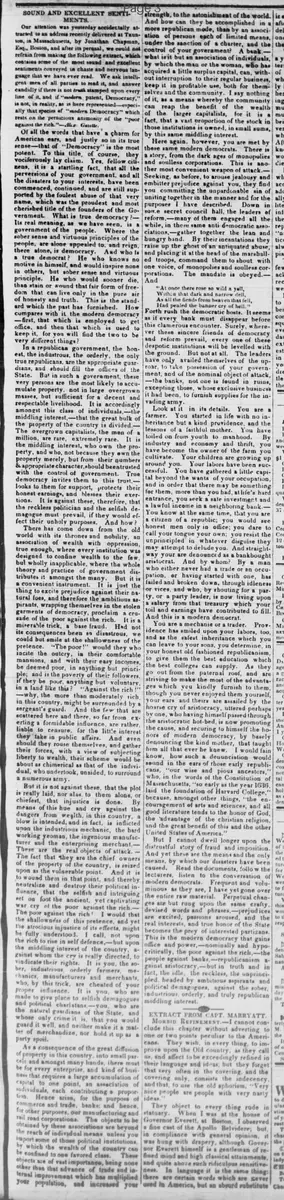
Our attention was yesterday accidentally attracted to an address recently delivered at Taunton, in Massachusetts, by Jonathan Chapman, Esq., Boston, and after its perusal, we could not refrain from making the following extract, which contains some of the most sound and excellent sentiments conveyed in chaste and nervous language that we have ever read. We ask intelligent men of all parties to read it, and answer candidly if there is not truth stamped upon every line of it, and if "modern patent Democracy," is not, in reality, as is here represented—especially that species of "modern Democracy" which rests on the pernicious animosity of the "poor against the rich."—N. Y. Gazette.
Of all the words that have a charm for American ears, and justly so in its true sense—that of "Democracy" is the most potent. To this title, of course, they vociferously lay claim. Yes, fellow citizens, it is a startling fact, that all the perversions of your government, and all the disasters to your interests, have been commenced, continued, and are still supported by the foulest abuse of that very name, which was the proudest and most cherished title of the founders of the Government. What is true democracy?-
Its real meaning, as we have seen, is a government of the people. Where the sober sense and virtuous principles of the people, are alone appealed to, and reign, there alone, is democracy. And who is a true democrat? He who knows no motive in himself, and would inspire none in others, but sober sense and virtuous principle. He who would sooner die, than stain or wound that fair form of freedom that can live only in the pure air of honesty and truth. This is the standard which the past has furnished. How compares with it the modern democracy—first, that which is employed to get office, and then that which is used to keep it, for you will find the two to be very different things?
In a republican government, the honest, the industrious, the orderly, the only true republicans, are the appropriate guardians, and should fill the offices of the State. But in such a government, these very persons are the most likely to accumulate property, not in large overgrown masses, but sufficient for a decent and respectable livelihood. It is accordingly amongst this class of individuals—the middling interest, that the great bulk of the property of the country is divided.—
The overgrown capitalists, the men of a million, are rare, extremely rare. It is the middling interest, who own the property, and who, not because they own the property merely, but from their numbers & appropriate character, should be entrusted with the control of government. True democracy invites them to this trust.—looks to them for support, protects their honest earnings, and blesses their exertions. It is against these, therefore, that the reckless politician and the selfish demagogue must prevail, if they would effect their unholy purposes. And how?
There has come down from the old world with its thrones and nobility, an association of wealth with oppression, true enough, where every institution was designed to confine wealth to the few. But wholly inapplicable, where the whole theory and practice of government distributes it amongst the many. But it is a convenient instrument. It is just the thing to excite prejudice against their natural foes, and therefore the ambitious aspirants, wrapping themselves in the stolen garments of democracy, proclaim a crusade of the poor against the rich. It is a miserable trick, a base fraud. Had not its consequences been so disastrous, we could but smile at the shallowness of the pretence. "The poor!" would they who incite the outcry, in their comfortable mansions, and with their easy incomes, be deemed poor, in anything but principle; and is the poverty of their followers, if they be poor, anything but voluntary, in a land like this? "Against the rich!"—why, the more than moderately rich in this country, might be surrounded by a sergeant's guard. And the few that are scattered here and there, so far from exerting a formidable influence, are rather liable to censure, for the little interest they take in public affairs. And even should they rouse themselves, and gather their forces, with a view of subjecting liberty to wealth, their scheme would be about as chimerical as that of the individual who undertook, unaided, to surround a numerous army.
But it is not against these, that the plot is really laid, nor alas, to them alone, or chiefest, that injustice is done. By means of this hue and cry against the dangers from wealth in this country, a blow is intended, and in fact, is inflicted upon the industrious mechanic, the hard working yeoman, the ingenious manufacturer and the enterprising merchant,—
These are the real objects of attack.—The fact that they are the chief owners of the property of the country, is seized upon as the vulnerable point. And it is to wound them in that point, and thereby neutralize and destroy their political influence, that the selfish and intriguing set on foot the ancient, yet captivating war cry of the poor against the rich.—
The poor against the rich! I would that the shallowness of this pretence, and yet the atrocious injustice of its effects, might be fully understood. I call, not upon the rich to rise in self defence.—but upon the middling interest of the country, against whom the cry is really directed, to vindicate their rights. It is you, the sober, industrious orderly farmers, mechanics, manufacturers and merchants, who, by this trick, are cheated of your proper influence. It is you, who are made to give place to selfish demagogues and political charlatans—you, who are the natural guardians of the State, and whose only crime it is, that you would guard it well, and neither make it a matter of merchandise, nor hold it up as a party spoil.
As a consequence of the great diffusion of property in this country, into small parcels and amongst many hands, there must be for every enterprise, and kind of business that requires large accumulation of capital to one point, an association of individuals, each contributing proportionately. Hence arise, for the purpose of commerce and trade, banks: and hence, for other purposes, our manufacturing and rail road corporations. The objects to be obtained by these associations are beyond the reach of individual means unless you import some of those political institutions, by which the wealth of the country can be confined to one favored class. These objects are of vast importance, being none other than that advance of trade and internal improvement which has multiplied your population, and increased your strength, to the astonishment of the world.
And how can they be accomplished in a more republican mode, than by an association of persons, each of limited means, under the sanction of a charter, and the control of your government? A bank,—what is it but an association of individuals, by which the man or the woman, who has acquired a little surplus capital, can, without interruption to their regular business, keep it in profitable use, both for themselves and the community. I say nothing of it, as a means whereby the community can reap the benefit of the wealth of the "larger capitalists, for it is a fact, that a vast proportion of the stock in those institutions is owned, in small sums, by this same middling interest.
Here again, however, you are met by these same modern democrats. There is a story, from the dark ages of monopolies and soulless corporations. This is another most convenient weapon of attack.—Seeking, as before, to arouse jealousy and embitter prejudice against you, they find you committing the unpardonable sin of uniting together in the manner and for the purposes I have described. Down in some secret council hall, the leaders of reform,—many of them engaged all the while, in these same anti-democratic associations,—gather together the lean and hungry band. By their incantations they raise up the ghost of an antiquated abuse, and placing it at the head of the marshalled troops, command them to shout with one voice, of monopolies and soulless corporations.
The mandate is obeyed.—
And
"At once there rose so wild a yell,
Within that dark and narrow dell,
As all the fiends from heaven that fell,
Had pealed the banner cry of hell."
Forth rush the democratic hosts. It seems as if every bank must disappear before this clamorous encounter. Surely, wherever these sincere friends of democracy and reform prevail, every one of these despotic institutions will be levelled with the ground. But not at all. The leaders have only availed themselves of the uproar, to take possession of your government, and of the nominal object of attack,—the banks. not one is found in ruins, excepting those, whose exclusive business it had been, to furnish supplies for the invading army.
Look at it in its details. You are a farmer. You started in life with no inheritance but a kind providence, and the lessons of a faithful mother. You have toiled on from youth to manhood. By industry and economy and thrift, you have become the owner of the farm you cultivate. Your children are growing up around you. Your labors have been successful. You have gathered a little capital beyond the wants of your occupation, and in order that there may be something for them, more than you had, at life's hard entrance, you seek a safe investment and a lawful income in a neighboring bank.—You know at the same time, that you are a citizen of a republic; you would see honest men only in office; you dare to call your tongue your own; you resist the unprincipled in whatever disguise they may attempt to delude you. And straightway you are denounced as a bank-bought aristocrat. And by whom? By a man who either never had a trade or an occupation, or having started with one, has failed and broken down, through idleness or vices, and who, by shouting for a party, or a party leader, is now living upon a salary from that treasury which your toil and earnings have contributed to fill. And this is a modern democrat.
You are a mechanic or a trader. Providence has smiled upon your labors, too, and as the safest inheritance which you can leave to your sons, you determine, in your honest old fashioned republicanism, to give them the best education which the best colleges can supply. As they go out from the paternal roof, and are striving to make the most of the advantages which you kindly furnish to them, though you never enjoyed them yourself, your ears and theirs are assailed by the hoarse cry of aristocracy, uttered perhaps by one, who having himself passed through the aristocratic hot-bed, is now promoting the cause, and securing to himself the honors of modern democracy, by basely denouncing the kind mother, that taught him all that ever he knew. I would fain know, how such a denunciation would sound in the ears of those early republicans, "our wise and pious ancestors," who, in the words of the Constitution of Massachusetts, "so early as the year 1636, laid the foundation of Harvard College," because, amongst other things, 'the encouragement of arts and sciences, and all good literature tends to the honor of God, the advantage of the christian religion, and the great benefit of this and the other United States of America."
But I cannot dwell longer upon the distrustful story of fraud and imposition. And yet these are the means and the only means, by which our disasters have been caused. Read the documents, follow the lecturers, listen to the conversation of modern democrats. Frequent and voluminous as they are, I have yet gone over the entire raw material. Perpetual changes are but rung upon the same crafty, devised words and phrases,—prejudices are excited, passions aroused, and the real interests, and true honor of the State becomes the prey of interested partisans.
This is the modern democracy that gains office and power,—nominally and hypocritically, the poor against the rich, the people against banks, republicanism against aristocracy, but in truth and in fact, the idle, the reckless, the unprincipled, headed by ambitious aspirants and political demagogues, against the sober, industrious, orderly, and truly republican middling interest.
Of all the words that have a charm for American ears, and justly so in its true sense—that of "Democracy" is the most potent. To this title, of course, they vociferously lay claim. Yes, fellow citizens, it is a startling fact, that all the perversions of your government, and all the disasters to your interests, have been commenced, continued, and are still supported by the foulest abuse of that very name, which was the proudest and most cherished title of the founders of the Government. What is true democracy?-
Its real meaning, as we have seen, is a government of the people. Where the sober sense and virtuous principles of the people, are alone appealed to, and reign, there alone, is democracy. And who is a true democrat? He who knows no motive in himself, and would inspire none in others, but sober sense and virtuous principle. He who would sooner die, than stain or wound that fair form of freedom that can live only in the pure air of honesty and truth. This is the standard which the past has furnished. How compares with it the modern democracy—first, that which is employed to get office, and then that which is used to keep it, for you will find the two to be very different things?
In a republican government, the honest, the industrious, the orderly, the only true republicans, are the appropriate guardians, and should fill the offices of the State. But in such a government, these very persons are the most likely to accumulate property, not in large overgrown masses, but sufficient for a decent and respectable livelihood. It is accordingly amongst this class of individuals—the middling interest, that the great bulk of the property of the country is divided.—
The overgrown capitalists, the men of a million, are rare, extremely rare. It is the middling interest, who own the property, and who, not because they own the property merely, but from their numbers & appropriate character, should be entrusted with the control of government. True democracy invites them to this trust.—looks to them for support, protects their honest earnings, and blesses their exertions. It is against these, therefore, that the reckless politician and the selfish demagogue must prevail, if they would effect their unholy purposes. And how?
There has come down from the old world with its thrones and nobility, an association of wealth with oppression, true enough, where every institution was designed to confine wealth to the few. But wholly inapplicable, where the whole theory and practice of government distributes it amongst the many. But it is a convenient instrument. It is just the thing to excite prejudice against their natural foes, and therefore the ambitious aspirants, wrapping themselves in the stolen garments of democracy, proclaim a crusade of the poor against the rich. It is a miserable trick, a base fraud. Had not its consequences been so disastrous, we could but smile at the shallowness of the pretence. "The poor!" would they who incite the outcry, in their comfortable mansions, and with their easy incomes, be deemed poor, in anything but principle; and is the poverty of their followers, if they be poor, anything but voluntary, in a land like this? "Against the rich!"—why, the more than moderately rich in this country, might be surrounded by a sergeant's guard. And the few that are scattered here and there, so far from exerting a formidable influence, are rather liable to censure, for the little interest they take in public affairs. And even should they rouse themselves, and gather their forces, with a view of subjecting liberty to wealth, their scheme would be about as chimerical as that of the individual who undertook, unaided, to surround a numerous army.
But it is not against these, that the plot is really laid, nor alas, to them alone, or chiefest, that injustice is done. By means of this hue and cry against the dangers from wealth in this country, a blow is intended, and in fact, is inflicted upon the industrious mechanic, the hard working yeoman, the ingenious manufacturer and the enterprising merchant,—
These are the real objects of attack.—The fact that they are the chief owners of the property of the country, is seized upon as the vulnerable point. And it is to wound them in that point, and thereby neutralize and destroy their political influence, that the selfish and intriguing set on foot the ancient, yet captivating war cry of the poor against the rich.—
The poor against the rich! I would that the shallowness of this pretence, and yet the atrocious injustice of its effects, might be fully understood. I call, not upon the rich to rise in self defence.—but upon the middling interest of the country, against whom the cry is really directed, to vindicate their rights. It is you, the sober, industrious orderly farmers, mechanics, manufacturers and merchants, who, by this trick, are cheated of your proper influence. It is you, who are made to give place to selfish demagogues and political charlatans—you, who are the natural guardians of the State, and whose only crime it is, that you would guard it well, and neither make it a matter of merchandise, nor hold it up as a party spoil.
As a consequence of the great diffusion of property in this country, into small parcels and amongst many hands, there must be for every enterprise, and kind of business that requires large accumulation of capital to one point, an association of individuals, each contributing proportionately. Hence arise, for the purpose of commerce and trade, banks: and hence, for other purposes, our manufacturing and rail road corporations. The objects to be obtained by these associations are beyond the reach of individual means unless you import some of those political institutions, by which the wealth of the country can be confined to one favored class. These objects are of vast importance, being none other than that advance of trade and internal improvement which has multiplied your population, and increased your strength, to the astonishment of the world.
And how can they be accomplished in a more republican mode, than by an association of persons, each of limited means, under the sanction of a charter, and the control of your government? A bank,—what is it but an association of individuals, by which the man or the woman, who has acquired a little surplus capital, can, without interruption to their regular business, keep it in profitable use, both for themselves and the community. I say nothing of it, as a means whereby the community can reap the benefit of the wealth of the "larger capitalists, for it is a fact, that a vast proportion of the stock in those institutions is owned, in small sums, by this same middling interest.
Here again, however, you are met by these same modern democrats. There is a story, from the dark ages of monopolies and soulless corporations. This is another most convenient weapon of attack.—Seeking, as before, to arouse jealousy and embitter prejudice against you, they find you committing the unpardonable sin of uniting together in the manner and for the purposes I have described. Down in some secret council hall, the leaders of reform,—many of them engaged all the while, in these same anti-democratic associations,—gather together the lean and hungry band. By their incantations they raise up the ghost of an antiquated abuse, and placing it at the head of the marshalled troops, command them to shout with one voice, of monopolies and soulless corporations.
The mandate is obeyed.—
And
"At once there rose so wild a yell,
Within that dark and narrow dell,
As all the fiends from heaven that fell,
Had pealed the banner cry of hell."
Forth rush the democratic hosts. It seems as if every bank must disappear before this clamorous encounter. Surely, wherever these sincere friends of democracy and reform prevail, every one of these despotic institutions will be levelled with the ground. But not at all. The leaders have only availed themselves of the uproar, to take possession of your government, and of the nominal object of attack,—the banks. not one is found in ruins, excepting those, whose exclusive business it had been, to furnish supplies for the invading army.
Look at it in its details. You are a farmer. You started in life with no inheritance but a kind providence, and the lessons of a faithful mother. You have toiled on from youth to manhood. By industry and economy and thrift, you have become the owner of the farm you cultivate. Your children are growing up around you. Your labors have been successful. You have gathered a little capital beyond the wants of your occupation, and in order that there may be something for them, more than you had, at life's hard entrance, you seek a safe investment and a lawful income in a neighboring bank.—You know at the same time, that you are a citizen of a republic; you would see honest men only in office; you dare to call your tongue your own; you resist the unprincipled in whatever disguise they may attempt to delude you. And straightway you are denounced as a bank-bought aristocrat. And by whom? By a man who either never had a trade or an occupation, or having started with one, has failed and broken down, through idleness or vices, and who, by shouting for a party, or a party leader, is now living upon a salary from that treasury which your toil and earnings have contributed to fill. And this is a modern democrat.
You are a mechanic or a trader. Providence has smiled upon your labors, too, and as the safest inheritance which you can leave to your sons, you determine, in your honest old fashioned republicanism, to give them the best education which the best colleges can supply. As they go out from the paternal roof, and are striving to make the most of the advantages which you kindly furnish to them, though you never enjoyed them yourself, your ears and theirs are assailed by the hoarse cry of aristocracy, uttered perhaps by one, who having himself passed through the aristocratic hot-bed, is now promoting the cause, and securing to himself the honors of modern democracy, by basely denouncing the kind mother, that taught him all that ever he knew. I would fain know, how such a denunciation would sound in the ears of those early republicans, "our wise and pious ancestors," who, in the words of the Constitution of Massachusetts, "so early as the year 1636, laid the foundation of Harvard College," because, amongst other things, 'the encouragement of arts and sciences, and all good literature tends to the honor of God, the advantage of the christian religion, and the great benefit of this and the other United States of America."
But I cannot dwell longer upon the distrustful story of fraud and imposition. And yet these are the means and the only means, by which our disasters have been caused. Read the documents, follow the lecturers, listen to the conversation of modern democrats. Frequent and voluminous as they are, I have yet gone over the entire raw material. Perpetual changes are but rung upon the same crafty, devised words and phrases,—prejudices are excited, passions aroused, and the real interests, and true honor of the State becomes the prey of interested partisans.
This is the modern democracy that gains office and power,—nominally and hypocritically, the poor against the rich, the people against banks, republicanism against aristocracy, but in truth and in fact, the idle, the reckless, the unprincipled, headed by ambitious aspirants and political demagogues, against the sober, industrious, orderly, and truly republican middling interest.
What sub-type of article is it?
Partisan Politics
Economic Policy
Moral Or Religious
What keywords are associated?
Modern Democracy
Demagoguery
Middling Interest
Poor Against Rich
Banks
Republicanism
Political Intrigue
Virtuous Principles
What entities or persons were involved?
Jonathan Chapman
N.Y. Gazette
Modern Democrats
Demagogues
Middling Interest
Banks
Editorial Details
Primary Topic
Critique Of Modern Democracy As Demagoguery Against The Middling Interest
Stance / Tone
Strongly Critical Of Modern Democracy And Supportive Of True Republicanism
Key Figures
Jonathan Chapman
N.Y. Gazette
Modern Democrats
Demagogues
Middling Interest
Banks
Key Arguments
True Democracy Appeals To Sober Sense And Virtuous Principles.
Modern Democracy Abuses The Name To Incite Poor Against Rich For Political Gain.
The Middling Interest, Owners Of Most Property, Are The True Guardians Of The Republic.
Demagogues Use Old World Prejudices To Attack Property Owners And Institutions Like Banks.
Associations Like Banks Enable Small Capitalists To Contribute To Commerce And Improvement.
Attacks On Banks And Corporations Are Hypocritical Tools To Seize Power.
The Real Victims Are Industrious Farmers, Mechanics, And Merchants Cheated Of Influence.
Modern Democrats Are Idle And Unprincipled, Denouncing Honest Citizens As Aristocrats.