Thank you for visiting SNEWPapers!
Sign up free
Story
July 25, 1833
Phenix Gazette
Alexandria, Virginia
What is this article about?
Correspondence between Virginia politicians Mr. Rives and Mr. Gilmer, former allies, reveals a falling out over the Force Bill and Proclamation, leading to mutual distrust and a personal confrontation. Published in Charlottesville, the editor regrets the affair.
Clipping
OCR Quality
98%
Excellent
Full Text
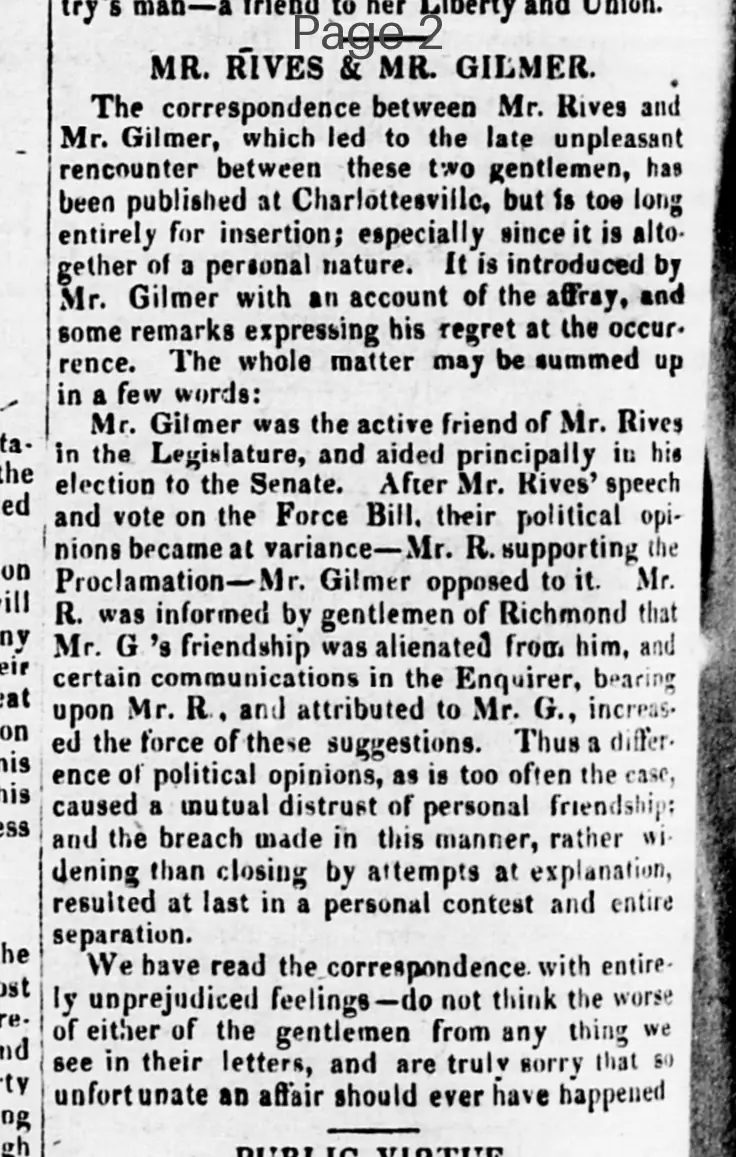
MR. RIVES & MR. GILMER.
The correspondence between Mr. Rives and Mr. Gilmer, which led to the late unpleasant rencounter between these two gentlemen, has been published at Charlottesville, but is too long entirely for insertion; especially since it is altogether of a personal nature. It is introduced by Mr. Gilmer with an account of the affray, and some remarks expressing his regret at the occurrence. The whole matter may be summed up in a few words:
Mr. Gilmer was the active friend of Mr. Rives in the Legislature, and aided principally in his election to the Senate. After Mr. Rives's speech and vote on the Force Bill, their political opinions became at variance—Mr. R. supporting the Proclamation—Mr. Gilmer opposed to it. Mr. R. was informed by gentlemen of Richmond that Mr. G's friendship was alienated from him, and certain communications in the Enquirer, bearing upon Mr. R., and attributed to Mr. G., increased the force of these suggestions. Thus a difference of political opinions, as is too often the case, caused a mutual distrust of personal friendship: and the breach made in this manner, rather widening than closing by attempts at explanation, resulted at last in a personal contest and entire separation.
We have read the correspondence with entirely unprejudiced feelings—do not think the worse of either of the gentlemen from any thing we see in their letters, and are truly sorry that so unfortunate an affair should ever have happened.
The correspondence between Mr. Rives and Mr. Gilmer, which led to the late unpleasant rencounter between these two gentlemen, has been published at Charlottesville, but is too long entirely for insertion; especially since it is altogether of a personal nature. It is introduced by Mr. Gilmer with an account of the affray, and some remarks expressing his regret at the occurrence. The whole matter may be summed up in a few words:
Mr. Gilmer was the active friend of Mr. Rives in the Legislature, and aided principally in his election to the Senate. After Mr. Rives's speech and vote on the Force Bill, their political opinions became at variance—Mr. R. supporting the Proclamation—Mr. Gilmer opposed to it. Mr. R. was informed by gentlemen of Richmond that Mr. G's friendship was alienated from him, and certain communications in the Enquirer, bearing upon Mr. R., and attributed to Mr. G., increased the force of these suggestions. Thus a difference of political opinions, as is too often the case, caused a mutual distrust of personal friendship: and the breach made in this manner, rather widening than closing by attempts at explanation, resulted at last in a personal contest and entire separation.
We have read the correspondence with entirely unprejudiced feelings—do not think the worse of either of the gentlemen from any thing we see in their letters, and are truly sorry that so unfortunate an affair should ever have happened.
What sub-type of article is it?
Historical Event
Biography
What themes does it cover?
Betrayal
Misfortune
Social Manners
What keywords are associated?
Political Disagreement
Friendship Alienation
Force Bill
Personal Rencounter
Virginia Politics
What entities or persons were involved?
Mr. Rives
Mr. Gilmer
Where did it happen?
Charlottesville
Story Details
Key Persons
Mr. Rives
Mr. Gilmer
Location
Charlottesville
Story Details
Former political allies Mr. Gilmer and Mr. Rives diverge over the Force Bill and Proclamation, leading to alienated friendship, failed explanations, and a personal contest.