Thank you for visiting SNEWPapers!
Sign up free
Wilmington Journal
Wilmington, New Hanover County, North Carolina
What is this article about?
Proceedings of the North Carolina Legislature on February 7, 1866, covering Senate and House sessions: qualifications of new members, committee reports, bills on state printing, crime suppression, distillation prohibition, university trustees, state bonds interest, and a joint committee report declaring state banks defunct due to the Civil War conquest.
Clipping
OCR Quality
Full Text
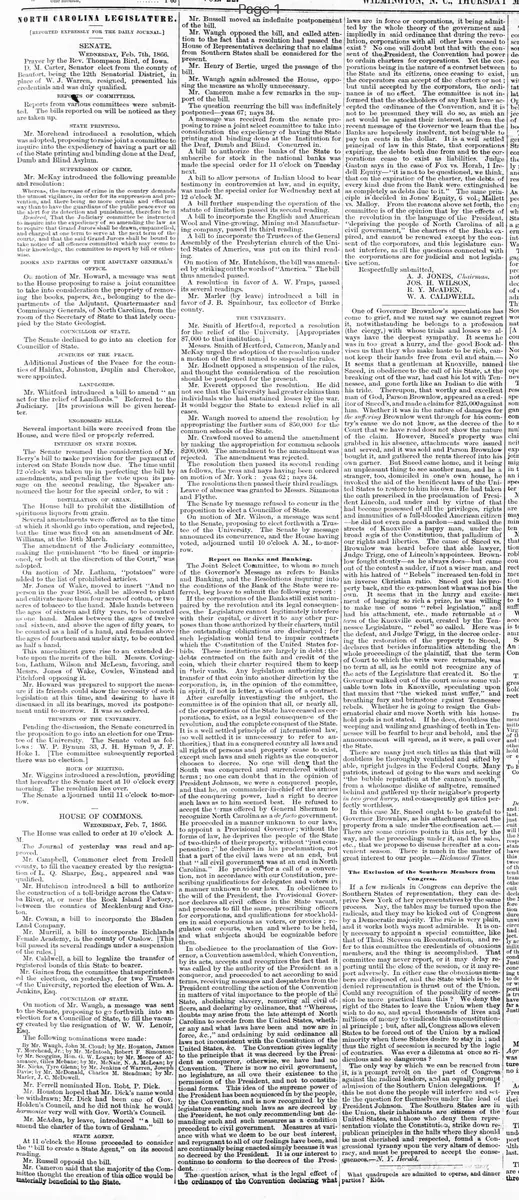
[REPORTED EXPRESSLY FOR THE DAILY JOURNAL.]
SENATE.
Wednesday, Feb. 7th, 1866.
Prayer by the Rev. Thompson Bird, of Iowa.
D. M. Carter, Senator elect from the county of Beaufort, being the 12th Senatorial District, in place of W. J. Warren, resigned, presented his credentials and was duly qualified.
REPORTS OF COMMITTEES.
Reports from various committees were submitted. The bills reported on will be noticed as they are taken up.
STATE PRINTING.
Mr. Morehead introduced a resolution, which was adopted, proposing to raise a joint committee to inquire into the expediency of having a part or all of the State printing and binding done at the Deaf Dumb and Blind Asylum.
SUPPRESSION OF CRIME.
Mr. McKay introduced the following preamble and resolution:
Whereas, the increase of crime in the country demands the utmost vigilance, in order for its suppression and prevention, and there being no more certain and effectual way than to have the guardians of the public peace ever on the alert for its detection and punishment, therefore be it
Resolved, That the Judiciary committee be instructed to inquire into the expediency of so amending the law as to require that Grand Jurors shall be drawn, empannelled, and charged at one term to serve at the next term of the court, and that the said Grand Jurors shall be bound to take notice of all offences committed which may come to their knowledge, the committee to report by bill or otherwise.
BOOKS AND PAPERS OF THE ADJUTANT GENERAL'S OFFICE.
On motion of Mr. Howard, a message was sent to the House proposing to raise a joint committee to take into consideration the propriety of removing the books, papers, &c., belonging to the departments of the Adjutant, Quartermaster and Commissary Generals, of North Carolina, from the room of the Secretary of State to that lately occupied by the State Geologist.
COUNCILLOR OF STATE
The Senate declined to go into an election for Councillor of State.
JUSTICES OF THE PEACE.
Additional Justices of the Peace for the counties of Halifax, Johnston, Duplin and Cherokee were appointed.
LANDLORDS.
Mr. Whitford introduced a bill to amend 'an act for the relief of Landlords.' Referred to the Judiciary. Its provisions will be given hereafter.
ENGROSSED BILLS.
Several important bills were received from the House, and were filed or properly referred.
INTEREST ON STATE BONDS
The Senate resumed the consideration of Mr Berry's bill to make provision for the payment of interest on State Bonds now due. The time until 12 o'clock was taken up in perfecting the bill by amendments, and pending the vote upon its passage on the second reading, the Speaker announced the hour for the special order, to wit:
DISTILLATION OF GRAIN.
The House bill to prohibit the distillation of spirituous liquors from grain.
Several amendments were offered as to the time at which it should go into operation, and rejected but the time was fixed on an amendment of Mr Williams, at the 1st March.
The amendment of the Judiciary committee, making the punishment 'to be fined or imprisoned, or both at the discretion of the Court,' was adopted.
On motion of Mr. Latham, 'potatoes' were added to the list of prohibited articles
Mr. Jones of Wake, moved to insert 'And no person in the year 1866, shall be allowed to plant and cultivate more than four acres of cotton, or two acres of tobacco to the hand. Male hands between the ages of sixteen and fifty years, to be counted as one hand, Males between the ages of twelve and sixteen, and above the ages of fifty years, to be counted as a half of a hand and females above the ages of fourteen and under sixty, to be counted as half a hand.'
This amendment gave rise to an extended debate upon the merits of the bill. Messrs. Covington, Latham, Wilson and McLean, favoring, and Messrs. Jones of Wake, Cowles, Winstead and Pitchford opposing it.
Mr. Howard was prepared to support the measure if its friends could show the necessity of such legislation at this time, and desiring to have it discussed in all its bearings, moved its postponement until to-morrow. It was so ordered.
TRUSTEES OF THE UNIVERSITY.
Pending the discussion, the Senate concurred in the proposition to go into an election for one Trustee of the University. The Senate voted as follows: W. P. Bynum 33. J. H. Hyman 9. J. F. Hoke 1. [The committee subsequently reported there was no election.]
HOUR OF MEETING.
Mr. Wiggins introduced a resolution, providing that hereafter the Senate meet at 10 o'clock every morning. The resolution lies over.
The Senate adjourned until 11 o'clock to-morrow.
HOUSE OF COMMONS
Wednesday. Feb. 7, 1866.
The House was called to order at 10 o'clock A. M.
The Journal of yesterday was read and approved.
Mr. Campbell, Commoner elect from Iredell county, to fill the vacancy created by the resignation of L. Q. Sharpe, Esq., appeared and was qualified.
Mr. Hutchison introduced a bill to authorize the construction of a toll-bridge across the Catawba River, at, or near the Rock Island Factory, between the counties of Mecklenburg and Gaston.
Mr. Cowan, a bill to incorporate the Bladen Land Company.
Mr. Murrill. a bill to incorporate Richlands Female Academy, in the county of Onslow. [This bill passed its several readings under a suspension of the rules.]
Mr. Caldwell. a bill to legalize the transfer of registered bonds of this State to bearer.
Mr. Gaines from the committee that superintended the election, on yesterday, for two Trustees of the University, reported the election of Wm. A. Jenkins, Esq.
COUNCILLOR OF STATE.
On motion of Mr. Waugh, a message was sent to the Senate, proposing to go forthwith into an election for a Councillor of State. to fill the vacancy created by the resignation of W. W. Lenoir Esq
The following nominations were made:
By Mr. Waugh, John M. Cloud; by Mr. Houston, James T. Morehead, Jr.; by Mr. McIntosh, Robert F. Simonton; by Mr. Scoggins, Hon. G. W. Logan; by Mr. Moore of Alamance, Giles Mebane; by Mr. McNair, N. A. McLean; by Mr. Nicks, Tyre Glenn; by Mr. Jenkins of Warren, Joseph Davis; by Mr. McDonald, Charles M. Steadman; by Mr. Marler, J. C. McDowell.
Mr. Ferrell nominated Hon. Robt. P. Dick.
Mr. Houston hoped that Mr. Dick's name would be withdrawn: Mr. Dick had been one of Gov. Holden's Council, and he did not think he would harmonize very well with Gov. Worth's Council.
Mr. McAden, by leave, introduced 'a bill to amend the charter of the town of Graham.'
STATE AGENT
At 11 o'clock the House proceeded to consider the 'bill to create a State Agent,' on its second reading.
Mr. Russell opposed the bill
Mr. Cameron said that the majority of the Committee thought the creation of this office would be materially beneficial to the State.
Mr. Russell moved an indefinite postponement of the bill.
Mr. Waugh opposed the bill, and called attention to the fact that a resolution had passed the House of Representatives declaring that no claims from Southern States shall be considered for the present.
Mr. Henry of Bertie, urged the passage of the bill.
Mr. Waugh again addressed the House, opposing the measure as wholly unnecessary.
Mr. Cameron made a few remarks in support of the bill.
The question recurring the bill was indefinitely postponed-yeas 67; nays 34.
A message was received from the senate proposing to raise a joint select committee to take into consideration the expediency of having the State printing and binding done at the Institution for the Deaf. Dumb and Blind. Concurred in.
A bill to authorize the banks of the State to subscribe for stock in the national banks was made the special order for 11 o'clock on Tuesday next.
A bill to allow persons of Indian blood to bear testimony in controversies at law, and in equity, was made the special order for Wednesday next at 12 o'clock M.
A bill further suspending the operation of the statute of limitation passed its second reading.
A bill to incorporate the English and American Wool and Vine-growing, Mining and Manufacturing company, passed its third reading.
A bill to incorporate the Trustees of the General Assembly of the Presbyterian church of the United States of America, was put on its third reading.
On motion of Mr. Hutchison, the bill was amended by striking out the words of 'America.' The bill thus amended passed.
A resolution in favor of A. W. Fraps, passed its several readings.
Mr. Marler (by leave) introduced a bill in favor of J. B. Spainhour, tax collector of Burke county.
THE UNIVERSITY.
Mr. Smith of Hertford, reported a resolution for the relief of the University. [Appropriates $7,000 to that institution.]
Messrs. Smith of Hertford, Cameron, Manly and McKay urged the adoption of the resolution under a motion of the first named to suspend the rules.
Mr. Hodnett opposed a suspension of the rules, and thought the consideration of the resolution should be postponed for the present.
Mr. Everett opposed the resolution. He did not see that the University had greater claims than individuals who had sustained losses by the war.
It would beggar the State to extend relief in all cases.
Mr. Waugh moved to amend the resolution by appropriating the further sum of $50,000 for the common schools of the State.
Mr. Crawford moved to amend the amendment by making the appropriation for common schools $200,000. The amendment to the amendment was rejected. The amendment was rejected.
The resolution then passed its second reading as follows, the yeas and nays having been ordered on motion of Mr. York: yeas 62; nays 34
The resolutions then passed their third readings.
Leave of absence was granted to Messrs. Simmons and Flythe.
The Senate by message refused to concur in the proposition to elect a Councillor of State.
On motion of Mr. Wilson, a message was sent to the Senate, proposing to elect forthwith a Trustee of the University. The Senate by message announced its concurrence, and the House having voted, adjourned until 10 o'clock A. M., to-morrow.
Report on Banks and Banking.
The Joint Select Committee, to whom so much of the Governor's Message as refers to Banks and Banking, and the Resolutions inquiring into the conditions of the Bank of the State were referred, beg leave to submit the following report:
If the corporations of the Banks still exist unimpaired by the revolution and its legal consequences, the Legislature cannot legitimately interfere with their capital, or divert it to any other purposes than those authorized by their charters, until the outstanding obligations are discharged: for such legislation would tend to impair contracts which the Constitution of the United States forbids. These institutions are largely in debt; the debts contracted on the faith and credit of the coin, which their charter required them to keep in their vaults. Any legislation authorizing the transfer of that coin into another direction by the corporation, is, in the opinion of the committee, in spirit, if not in letter, a violation of a contract.
After carefully investigating the subject, the committee is of the opinion that all, or nearly all, of the corporations of the State have ceased as corporations, to exist, as a legal consequence of the revolution, and the complete conquest of the State.
It is a well settled principle of international law, (so well settled it is unnecessary to refer to authorities,) that in a conquered country all laws and all rights of persons and property cease to exist, except such laws and such rights as the conqueror chooses to decree. No one will deny that the South was conquered and surrendered without terms; no one can doubt that in the opinion of President Johnson, we were a conquered people, and that he, as commander-in-chief of the armies of the conquering power, had a right to decree such laws as to him seemed best. He refused to accept the terms offered by General Sherman to recognize North Carolina as a de facto government.
He proceeded in a manner unknown to our laws, to appoint a Provisional Governor; without the forms of law, he deprives the people of the State of two-thirds of their property, without 'just compensation;' he declares in his proclamation, not that a part of the civil laws were at an end, but that 'all civil government was at an end in North Carolina.' He provided for a call of a convention, not in accordance with our Constitution, prescribing qualifications for delegates and voters in a manner unknown to our laws. In obedience to the will of the President, the Provisional Governor declares all civil offices in the State vacant, and proceeds to fill the same, prescribing officers for corporations, and qualifications for stockholders in said corporations as voters, or proxies; regulates our courts, when and where to be held, and what subjects should be cognizable before them.
In obedience to the proclamation of the Governor, a Convention assembled, which Convention, by its acts, accepts and recognizes the fact that it was called by the authority of the President as a conqueror, and proceeded to act according to said terms, receiving messages and despatches from the President controlling the action of the Convention in matters of vital importance to the people of the State, abolishing slavery, removing all civil officers, and declaring by ordinance, that 'Whereas, doubts may arise from the late attempt of North Carolina to secede from the United States, whether any and what laws have been and now are in force, &c.,' and ordaining by said ordinance all laws not inconsistent with the Constitution of the United States, &c. The Convention gives legality to the principle that it was decreed by the President as conqueror, otherwise, we have had no Convention. There is now no civil government, no legislature, as all owe their existence to the permission of the President. and not to constitutional forms. This idea of the supreme power of the President has been acquiesced in by the people, by the Convention, and is now recognized by the legislature enacting such laws as are decreed by the President, he not only recommending but demanding such and such measures as a condition precedent to civil government. Measures at variance with what we deem to be our best interest, and repugnant to all of our feelings have been, and are continually being enacted simply because it was so decreed by the President. It is our interest to continue to conform to the decrees of the President.
The question arises, what is the legal effect of the ordinance of the Convention declaring what laws are in force or corporations, it being admitted by the whole theory of the government and impliedly in said ordinance that during the revolution, corporations with all other laws ceased to exist? No one will doubt but that with the consent of the President, the Convention had power to ordain charters for corporations. Yet the corporations being in the nature of a contract between the State and its citizens, once ceasing to exist, the corporators can accept of the charters or not; but until accepted by the corporators, the ordinance is of no effect. The committee is not informed that the stockholders of any Bank have accepted the ordinance of the Convention, and it is not to be presumed they will do so, as such an act would be against their interest, as from the recent message of the Governor we learn that the Banks are hopelessly insolvent, not being able to pay ten cents in the dollar. It is a well settled principal of law in this State, that corporations expiring, the debts both due from and to the corporations cease to exist as liabilities. Judge Gaston says in the case of Fox vs. Horah, 1 Iredell Equity—'it is not to be questioned, we think, that on the expiration of the charter, the debts of every kind due from the Bank were extinguished as completely as debts due to it.' The same principle is decided in Jones' Equity, 6 vol.; Mallett vs. Malloy. From the reasons above set forth, the committee is of the opinion that by the effects of the revolution in the language of the President, 'depriving the people of North Carolina of all civil government,' the charters of the Banks expired, and cannot be renewed except by the consent of the corporators, and this legislature can not interfere, as all the questions connected with the corporations are for judicial and not legislative action.
Respectfully submitted.
A. J. JONES, Chairman.
JOS. H. WILSON.
R. Y. McADEN.
W. A. CALDWELL.
What sub-type of article is it?
What keywords are associated?
What entities or persons were involved?
Where did it happen?
Domestic News Details
Primary Location
North Carolina
Event Date
Wednesday, Feb. 7th, 1866.
Key Persons
Event Details
The North Carolina Senate and House of Commons met on February 7, 1866. Key actions included qualifying new members D. M. Carter and Mr. Campbell; adopting resolutions for joint committees on state printing at the Deaf Dumb and Blind Asylum and removing Adjutant General's office books; introducing bills on crime suppression, relief of landlords, interest on state bonds, and prohibiting grain distillation (amended to include potatoes and debated with a proposed cotton/tobacco limit postponed); appointing justices of the peace; considering engrossed bills; electing university trustees (W. P. Bynum received 33 votes, no election); setting meeting hour at 10 AM; in the House, introducing incorporation bills, legalizing bond transfers, reporting university trustee election (Wm. A. Jenkins), nominations for Councillor of State (election declined by Senate), debating and postponing State Agent bill, passing bills on banks subscribing to national banks, Indian testimony, statute of limitations suspension, incorporations, and university relief ($7,000 appropriation); submitting Joint Select Committee report on banks, concluding they ceased to exist due to the revolution and conquest, with debts extinguished.