Thank you for visiting SNEWPapers!
Sign up free
Story
May 25, 1953
Trainman News
Indianapolis, Marion County, Indiana
What is this article about?
Article discusses complexities of U.S. labor-management laws, focusing on the Taft-Hartley Act's revival of outdated provisions like injunctions and free speech doctrines. Highlights a new Public Affairs Institute study by John Shott evaluating key issues for congressional review.
Clipping
OCR Quality
98%
Excellent
Full Text
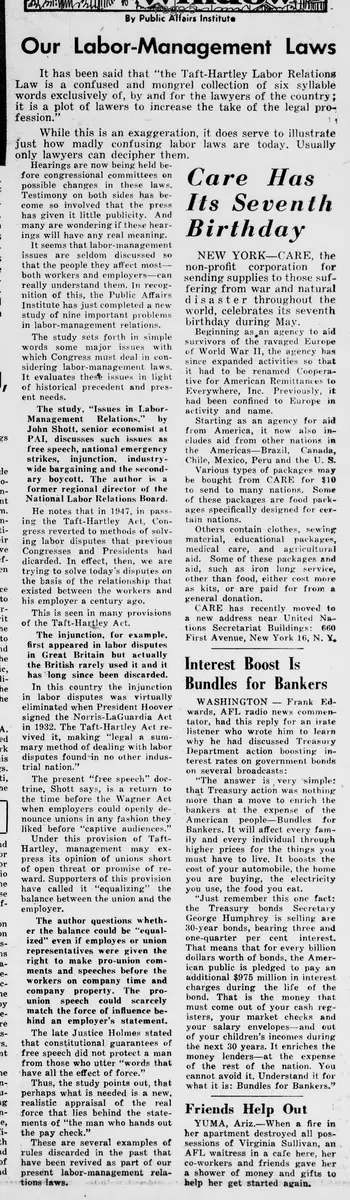
Our Labor-Management Laws
By Public Affairs Institute
It has been said that "the Taft-Hartley Labor Relations Law is a confused and mongrel collection of six syllable words exclusively of, by and for the lawyers of the country; it is a plot of lawyers to increase the take of the legal profession."
While this is an exaggeration, it does serve to illustrate just how madly confusing labor laws are today. Usually only lawyers can decipher them.
Hearings are now being held before congressional committees on possible changes in these laws.
Testimony on both sides has become so involved that the press has given it little publicity. And many are wondering if these hearings will have any real meaning.
It seems that labor-management issues are seldom discussed so that the people they affect most—both workers and employers—can really understand them. In recognition of this, the Public Affairs Institute has just completed a new study of nine important problems in labor-management relations.
The study sets forth in simple words some major issues with which Congress must deal in considering labor-management laws.
It evaluates these issues in light of historical precedent and present needs.
The study, "Issues in Labor-Management Relations," by John Shott, senior economist at PAI, discusses such issues as free speech, national emergency strikes, injunction, industry-wide bargaining and the secondary boycott. The author is a former regional director of the National Labor Relations Board.
He notes that in 1947, in passing the Taft-Hartley Act, Congress reverted to methods of solving labor disputes that previous Congresses and Presidents had discarded. In effect, then, we are trying to solve today's disputes on the basis of the relationship that existed between the workers and his employer a century ago.
This is seen in many provisions of the Taft-Hartley Act.
The injunction, for example, first appeared in labor disputes in Great Britain but actually the British rarely used it and it has long since been discarded.
In this country the injunction in labor disputes was virtually eliminated when President Hoover signed the Norris-LaGuardia Act in 1932. The Taft-Hartley Act revived it, making "legal a summary method of dealing with labor disputes found in no other industrial nation."
The present "free speech" doctrine, Shott says, is a return to the time before the Wagner Act when employers could openly denounce unions in any fashion they liked before "captive audiences."
Under this provision of Taft-Hartley, management may express its opinion of unions short of open threat or promise of reward. Supporters of this provision have called it "equalizing" the balance between the union and the employer.
The author questions whether the balance could be "equalized" even if employees or union representatives were given the right to make pro-union comments and speeches before the workers on company time and company property. The pro-union speech could scarcely match the force of influence behind an employer's statement.
The late Justice Holmes stated that constitutional guarantees of free speech did not protect a man from those who utter "words that have all the effect of force."
Thus, the study points out, that perhaps what is needed is a new, realistic appraisal of the real force that lies behind the statements of "the man who hands out the pay check."
These are several examples of rules discarded in the past that have been revived as part of our present labor-management relations laws.
By Public Affairs Institute
It has been said that "the Taft-Hartley Labor Relations Law is a confused and mongrel collection of six syllable words exclusively of, by and for the lawyers of the country; it is a plot of lawyers to increase the take of the legal profession."
While this is an exaggeration, it does serve to illustrate just how madly confusing labor laws are today. Usually only lawyers can decipher them.
Hearings are now being held before congressional committees on possible changes in these laws.
Testimony on both sides has become so involved that the press has given it little publicity. And many are wondering if these hearings will have any real meaning.
It seems that labor-management issues are seldom discussed so that the people they affect most—both workers and employers—can really understand them. In recognition of this, the Public Affairs Institute has just completed a new study of nine important problems in labor-management relations.
The study sets forth in simple words some major issues with which Congress must deal in considering labor-management laws.
It evaluates these issues in light of historical precedent and present needs.
The study, "Issues in Labor-Management Relations," by John Shott, senior economist at PAI, discusses such issues as free speech, national emergency strikes, injunction, industry-wide bargaining and the secondary boycott. The author is a former regional director of the National Labor Relations Board.
He notes that in 1947, in passing the Taft-Hartley Act, Congress reverted to methods of solving labor disputes that previous Congresses and Presidents had discarded. In effect, then, we are trying to solve today's disputes on the basis of the relationship that existed between the workers and his employer a century ago.
This is seen in many provisions of the Taft-Hartley Act.
The injunction, for example, first appeared in labor disputes in Great Britain but actually the British rarely used it and it has long since been discarded.
In this country the injunction in labor disputes was virtually eliminated when President Hoover signed the Norris-LaGuardia Act in 1932. The Taft-Hartley Act revived it, making "legal a summary method of dealing with labor disputes found in no other industrial nation."
The present "free speech" doctrine, Shott says, is a return to the time before the Wagner Act when employers could openly denounce unions in any fashion they liked before "captive audiences."
Under this provision of Taft-Hartley, management may express its opinion of unions short of open threat or promise of reward. Supporters of this provision have called it "equalizing" the balance between the union and the employer.
The author questions whether the balance could be "equalized" even if employees or union representatives were given the right to make pro-union comments and speeches before the workers on company time and company property. The pro-union speech could scarcely match the force of influence behind an employer's statement.
The late Justice Holmes stated that constitutional guarantees of free speech did not protect a man from those who utter "words that have all the effect of force."
Thus, the study points out, that perhaps what is needed is a new, realistic appraisal of the real force that lies behind the statements of "the man who hands out the pay check."
These are several examples of rules discarded in the past that have been revived as part of our present labor-management relations laws.
What sub-type of article is it?
Historical Event
What themes does it cover?
Justice
Social Manners
What keywords are associated?
Taft Hartley Act
Labor Management Relations
Norris Laguardia Act
Free Speech Doctrine
Injunctions
Public Affairs Institute
John Shott
What entities or persons were involved?
John Shott
Public Affairs Institute
Story Details
Key Persons
John Shott
Public Affairs Institute
Event Date
1947
Story Details
The Public Affairs Institute's study by John Shott critiques the Taft-Hartley Act for reviving outdated labor dispute methods, such as injunctions eliminated by the 1932 Norris-LaGuardia Act and pre-Wagner free speech doctrines, arguing for a realistic appraisal of employer influence in labor-management relations.