Thank you for visiting SNEWPapers!
Sign up free
The Daily Worker
Chicago, Cook County, Illinois
What is this article about?
Article by Grace Hutchins reports 1930 Census data showing 11 million women workers in the US, up from 5.3 million in 1900, comprising 22.1% of women over 10. Discusses sectors, replacement of men by cheaper women labor, low unionization, and Communist Party demands for equal pay and protections.
Clipping
OCR Quality
Full Text
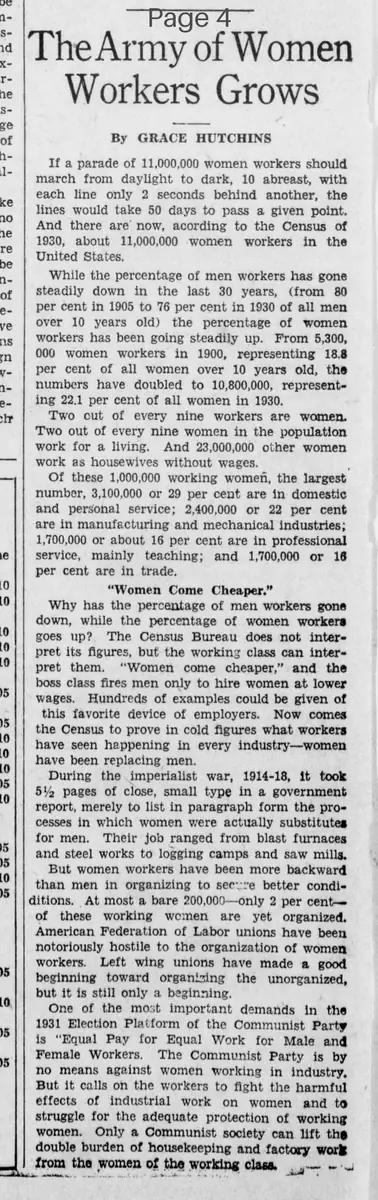
By GRACE HUTCHINS
If a parade of 11,000,000 women workers should march from daylight to dark, 10 abreast, with each line only 2 seconds behind another, the lines would take 50 days to pass a given point.
And there are now, according to the Census of 1930, about 11,000,000 women workers in the United States.
While the percentage of men workers has gone steadily down in the last 30 years, (from 80 per cent in 1900 to 76 per cent in 1930 of all men over 10 years old) the percentage of women workers has been going steadily up. From 5,300,000 women workers in 1900, representing 18.8 per cent of all women over 10 years old, the numbers have doubled to 10,800,000, representing 22.1 per cent of all women in 1930.
Two out of every nine workers are women.
Two out of every nine women in the population work for a living. And 23,000,000 other women work as housewives without wages.
Of these 11,000,000 working women, the largest number, 3,100,000 or 29 per cent are in domestic and personal service: 2,400,000 or 22 per cent are in manufacturing and mechanical industries; 1,700,000 or about 16 per cent are in professional service, mainly teaching: and 1,700,000 or 16 per cent are in trade.
"Women Come Cheaper."
Why has the percentage of men workers gone down, while the percentage of women workers goes up? The Census Bureau does not interpret its figures, but the working class can interpret them. "Women come cheaper," and the boss class fires men only to hire women at lower wages. Hundreds of examples could be given of this favorite device of employers. Now comes the Census to prove in cold figures what workers have seen happening in every industry-women have been replacing men.
During the imperialist war, 1914-18, it took 51/2 pages of close, small type in a government report, merely to list in paragraph form the processes in which women were actually substitutes for men. Their job ranged from blast furnaces and steel works to logging camps and saw mills.
But women workers have been more backward than men in organizing to secure better conditions. At most a bare 200,000-only 2 per cent of these working women are yet organized.
American Federation of Labor unions have been notoriously hostile to the organization of women workers. Left wing unions have made a good beginning toward organizing the unorganized, but it is still only a beginning.
One of the most important demands in the 1931 Election Platform of the Communist Party is "Equal Pay for Equal Work for Male and Female Workers. The Communist Party is by no means against women working in industry.
But it calls on the workers to fight the harmful effects of industrial work on women and to struggle for the adequate protection of working women. Only a Communist society can lift the double burden of housekeeping and factory work from the women of the working class.
What sub-type of article is it?
What keywords are associated?
What entities or persons were involved?
Where did it happen?
Domestic News Details
Primary Location
United States
Event Date
1930
Key Persons
Outcome
women workers increased to 11,000,000 (22.1% of women over 10); men decreased to 76%; low unionization at 2%; communist party demands equal pay and protections.
Event Details
Census of 1930 shows growth in women workers from 5,300,000 in 1900, replacing men due to lower wages; sectors include domestic service (29%), manufacturing (22%), professional (16%), trade (16%); historical substitution during 1914-18 war; calls for organization and Communist solutions.