Thank you for visiting SNEWPapers!
Sign up free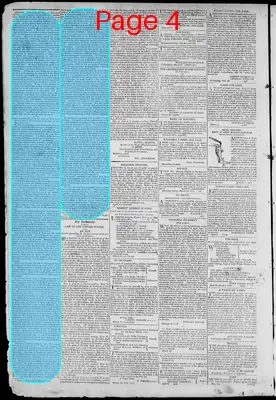
Literary
April 9, 1805
The Enquirer
Richmond, Henrico County, Virginia
What is this article about?
Biographical introduction to Joseph Gerrald, Irish-born advocate for parliamentary reform, exiled to New South Wales in 1795, who died en route. Excerpts from his 1794 pamphlet 'A Convention, the only means of saving us from ruin,' praising American republicanism, equality, and peace, while critiquing British tyranny, war, unjust laws, and lack of representation.
Clipping
OCR Quality
95%
Excellent
Full Text
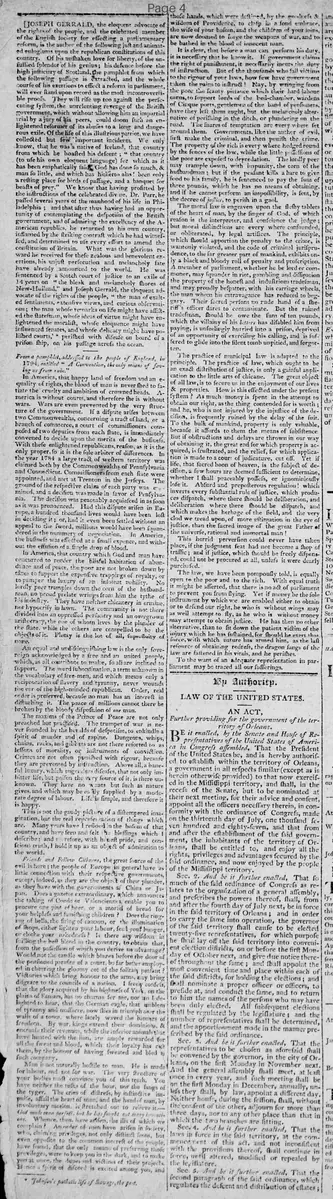
JOSEPH GERRALD, the eloquent advocate of the rights of the people, and the celebrated member of the English society for effecting a parliamentary reform, is the author of the following just and animated eulogiums upon the republican constitutions of this country. Of his unshaken love for liberty, of the unsullied splendor of his genius: his defence before the high justiciary of Scotland, the pamphlet from which the following passage is extracted, and the whole course of his exertions to effect a reform in parliament will ever stand upon record as the most incontrovertible proofs. They will rise up too against the persecuting system, the unrelenting revenge of the British government, which without allowing him an impartial trial by a jury of his peers, could doom such an enlightened reformer of its abuses to a long and dangerous exile. Of the life of this illustrious patriot, we have collected but few important incidents. We only know, that he was a native of Ireland, that country from which he boasted his descent: "that country (to use his own eloquent language) for which as it has been emphatically said God has done so much, & man so little, and which has hitherto alas! been only a resting place for birds of passage, and a banquet for beasts of prey." We know that having profited by the instructions of the celebrated divine, Dr. Parr, he passed several years of the manhood of his life in Philadelphia; and that after thus having had an opportunity of contemplating the despotism of the British government, and of admiring the excellency of the American republics, he returned to his own country, inflamed by the striking contrast which he had witnessed, and determined to use every effort to amend the constitution of Britain. What was the glorious reward he received for these zealous and benevolent exertions, his unjust persecution and melancholy fate have already announced to the world. He was sentenced by a Scotch court of justice to an exile of 14 years on "the bleak and melancholy shores of New-Holland," and Joseph Gerrald, the eloquent advocate of the rights of the people, "the man of exalted sentiments, extensive views, and curious observations; the man whose remarks on life might have assisted the statesman, whose ideas of virtue might have enlightened the moralist, whose eloquence might have influenced senates, and whose delicacy might have polished courts," * perished with disease on board of a prison ship, on his passage across the ocean.
From a pamphlet, addressed to the people of England, in 1794, entitled "A Convention, the only means of saving us from ruin."
In America, that happy land of freedom and an equality of rights, the blood of man is never shed to satiate the cruelty and ambition of crowned heads. America is without courts, and therefore she is without wars. Wars are even prevented by the very structure of the government. If a dispute arises between two Commonwealths, concerning a tract of land, or a branch of commerce, a court of commissioners composed of two deputies from each state, is immediately convened to decide upon the merits of the business. With these enlightened republicans, reason, as it is the only proper, so it is the sole arbiter of differences. In the year 1784 a large tract of western territory was claimed both by the Commonwealths of Pennsylvania and Connecticut. Commissioners from each state were appointed, and met at Trenton in the Jerseys. The ground of the respective claim of each party was examined, and a decision was made in favor of Pennsylvania. The decision was peaceably acquiesced in as soon as it was pronounced. Had this dispute arisen in Europe, a hundred thousand lives would have been lost in deciding it; or, had it even been settled without an appeal to the sword, millions would have been squandered in the mummery of negotiation. In America, the business was effected at a small expense, and without the effusion of a single drop of blood.
In America, that country which God and man have concurred to render the blissful habitation of abundance and of peace, the poor are not broken down by taxes to support the expensive trappings of royalty, or to pamper the luxury of an insolent nobility. No lordly peer tramples down the corn of the husbandman, no proud prelate wrings from him the tithe of his industry. They have neither chicanery in ermine, nor hypocrisy in lawn. The community is not there divided into an oppressed peasantry and an overgrown aristocracy, the one of whom lives by the plunder of the state, while the others are compelled to be the objects of it. Plenty is the lot of all, superfluity of none.
An equal and undistinguishing law is the only sovereign acknowledged by a free and an united people, which, as all contribute to make, so all are inclined to support. The word subordination, a term unknown in the vocabulary of free-men, and which means only a reciprocation of slavery and tyranny, never wounds the ear of the high-minded republican. Order, real order is preserved, because no man has an interest in disturbing it. The peace of millions cannot there be broken by the bloody disposition of one man.
The maxims of the Prince of Peace are not only preached but practised. The trumpet of war is never sounded by the heralds of despotism, to enkindle a spirit of murder and of rapine. Dungeons, whips, chains, racks, and gibbets are not there resorted to as lessons of morality, or instruments of conviction. Crimes are not often punished with rigour, because they are prevented by instruction. Above all, a baneful luxury, which engenders diseases, that not only embitter life, but poison the very source of it, is there unknown. They have no wants but such as nature gives, and which may be easily supplied by a moderate degree of labour. Life is simple, and therefore it is happy.
This is not the gaudy picture of a distempered imagination, but the real representation of things which are. Many years have I resided in the bosom of that country, and have seen and felt the blessings which I describe; and therefore, with honest pride, and conscious truth, I hold it up as an object of admiration to the world.
Friends and Fellow Citizens, the great source of the evil is here; the people of Europe in general have as little connection with their respective governments, except, indeed, as they are the object of their plunder, as they have with the governments of China or Japan. Does a gazette extraordinary, which announces the taking of Conde or Valenciennes, enable you to procure one pint of beer, or a morsel of bread for your helpless and famishing children? Does the ringing of bells, the firing of cannon, or the illumination of shops, either lighten your labour, feed your hunger, or clothe your nakedness? Is there any wisdom in spilling the best blood in the country, to obtain that from the possession of which you derive no advantage? Would not the candle which blazes before the door of the pensioned parasite of a court, be far better employed in cheering the gloomy cot of the solitary peasant? Victories which bring honour to the arms, may bring disgrace to the councils of a nation. I freely confess, that the glory acquired by his highness of York, on the plains of Famars, has no charms for me, nor am I delighted to hear, that the German eagle, that emblem of tyranny and massacre, now flies in triumph over the walls of a town, where lately waved the banners of freedom. By war, kings extend their dominion, & increase their revenues, while the inferior animals that have hunted with the lion, are amply rewarded for all the sweat and blood, which their loyalty has cost them, by the honour of having sweated and bled in such company.
Man is not naturally hostile to man. He is made for labour, and not for war. The very structure of your bodies must convince you of this truth. You have neither the tusks of the boar, nor the fangs of the tiger. The cries of distress, by instinctive impulse, assail the heart of man, and the hand of man, by involuntary motion, is stretched out to relieve it. God made man perfect, but he has sought out many inventions. Whence, then, have arisen, the ills of which we complain? An order of men have arisen in society, who, claiming privileges, not only distinct from, but even opposite to the common interest of the people, have found, that the only means of preserving those privileges, were to keep you in the dark, and to make you at once, the dupes and victims of their projects. Hence a spirit of discord is excited among you, and those hands, which were destined, by the goodness & wisdom of Providence, to clasp in a fond embrace the wife of your bosom, and the children of your loins, are now doomed to forge the weapons of war, and to be bathed in the blood of innocent man.
It is clear, that before a man can perform his duty, it is necessary that he know it. If government claims the right of punishment, it necessarily incurs the duty of instruction. But of the thousands who fall victims to the rigour of your laws, how few have government taken the pains to instruct! Nay, by wringing from the poor the scanty pittance which their hard labour earns, to support lords of the bed-chamber, wardens of Cinque ports, gentlemen of the band of pensioners, have they left them aught, but the melancholy alternative of perishing in the ditch, or plundering on the road. The snares of temptation are every where set around them. Governments, like the author of evil, first make the criminal, and then punish the crime. The property of the rich is every where hedged round by the fences of the law, while the little possessions of the poor are exposed to depredation. The lordly peer may trample down, with impunity, the corn of the husbandman; but if the peasant kills a hare to give food to his family, he is sentenced to pay the sum of three pounds, which he has no means of obtaining, and if he cannot perform an impossibility, is sent, by the decree of justice, to perish in a gaol.
The moral law is engraven upon the fleshy tablets of the heart of man, by the finger of God, of which reason is the interpreter, and conscience the judge; but moral distinctions are every where confounded, or obliterated, by legal artifices. The principle, which should apportion the penalty to the crime, is wantonly violated, and the code of criminal jurisprudence, to the far greater part of mankind, exhibits only a black and bloody roll of penalty and proscription. A member of parliament, whether he be lord or commoner, may squander in riot, gambling and dissipation the property of the honest and industrious tradesman, and may proudly bespatter, with his carriage wheels, the man whom his extravagance has reduced to beggary. Their sacred persons no rude hand of a sheriff's officer dares to contaminate. But the ruined tradesman, should he owe the sum of ten pounds, which the villainy of his betters has disabled him from paying, is unfeelingly hurried into a prison, deprived of an opportunity of exercising his calling, and is suffered to glide into the silent tomb unpitied, and forgotten.
The practice of municipal law is adapted to the principle. The practice of law, which ought to be an exact distribution of justice, is only a gainful application to the little arts of chicane. The great object of all law, is to secure us in the enjoyment of our lives & properties. How is this effected under the present system? As much money is spent in the attempt to obtain our right, as the thing contended for is worth; and he, who is not injured by the injustice of the decision, is frequently ruined by the delay of the suit. To the bulk of mankind, property is only valuable, because it affords to them the means of subsistence. But if obstructions and delays are thrown in our way of obtaining it, the great end for which property is acquired, is frustrated, and the relief, for which application is made to a court of judicature, cut off. Yet if life, that sacred boon of heaven, is the subject of decision, a few hours are deemed sufficient to determine, whether I shall peaceably possess, or ignominiously lose it. Absurd and preposterous regulation! which inverts every substantial rule of justice, which produces dispatch, where there should be deliberation, and deliberation where there should be dispatch, and which makes the herbage of the field, and the very clod we tread upon, of more estimation in the eye of justice, than the sacred image of the great Father of the universe, rational and immortal man!
This horrid perversion could never have taken place, if the judgment seat had not become a shop of traffic; and if justice, which should be freely dispensed, could not be procured at all, unless it were dearly purchased.
The law, we have been pompously told, is equally open to the poor and to the rich. With equal truth it might be asserted, that there is no act of parliament to prevent you from flying. Yet if money be the sole instrument by which we are enabled either to obtain or to defend our right, he who is without wings may as well attempt to fly, as he who is without money may attempt to obtain justice. He has then no other alternative, than to sit down the patient victim of the injury which he has sustained, for should he exert that force, with which nature has armed him, as the last resource of obtaining redress, the dragon fangs of the law are fastened in his vitals, and he perishes.
To the want of an adequate representation in parliament may be traced all our sufferings.
* Johnson's pathetic life of Savage, the poet.
From a pamphlet, addressed to the people of England, in 1794, entitled "A Convention, the only means of saving us from ruin."
In America, that happy land of freedom and an equality of rights, the blood of man is never shed to satiate the cruelty and ambition of crowned heads. America is without courts, and therefore she is without wars. Wars are even prevented by the very structure of the government. If a dispute arises between two Commonwealths, concerning a tract of land, or a branch of commerce, a court of commissioners composed of two deputies from each state, is immediately convened to decide upon the merits of the business. With these enlightened republicans, reason, as it is the only proper, so it is the sole arbiter of differences. In the year 1784 a large tract of western territory was claimed both by the Commonwealths of Pennsylvania and Connecticut. Commissioners from each state were appointed, and met at Trenton in the Jerseys. The ground of the respective claim of each party was examined, and a decision was made in favor of Pennsylvania. The decision was peaceably acquiesced in as soon as it was pronounced. Had this dispute arisen in Europe, a hundred thousand lives would have been lost in deciding it; or, had it even been settled without an appeal to the sword, millions would have been squandered in the mummery of negotiation. In America, the business was effected at a small expense, and without the effusion of a single drop of blood.
In America, that country which God and man have concurred to render the blissful habitation of abundance and of peace, the poor are not broken down by taxes to support the expensive trappings of royalty, or to pamper the luxury of an insolent nobility. No lordly peer tramples down the corn of the husbandman, no proud prelate wrings from him the tithe of his industry. They have neither chicanery in ermine, nor hypocrisy in lawn. The community is not there divided into an oppressed peasantry and an overgrown aristocracy, the one of whom lives by the plunder of the state, while the others are compelled to be the objects of it. Plenty is the lot of all, superfluity of none.
An equal and undistinguishing law is the only sovereign acknowledged by a free and an united people, which, as all contribute to make, so all are inclined to support. The word subordination, a term unknown in the vocabulary of free-men, and which means only a reciprocation of slavery and tyranny, never wounds the ear of the high-minded republican. Order, real order is preserved, because no man has an interest in disturbing it. The peace of millions cannot there be broken by the bloody disposition of one man.
The maxims of the Prince of Peace are not only preached but practised. The trumpet of war is never sounded by the heralds of despotism, to enkindle a spirit of murder and of rapine. Dungeons, whips, chains, racks, and gibbets are not there resorted to as lessons of morality, or instruments of conviction. Crimes are not often punished with rigour, because they are prevented by instruction. Above all, a baneful luxury, which engenders diseases, that not only embitter life, but poison the very source of it, is there unknown. They have no wants but such as nature gives, and which may be easily supplied by a moderate degree of labour. Life is simple, and therefore it is happy.
This is not the gaudy picture of a distempered imagination, but the real representation of things which are. Many years have I resided in the bosom of that country, and have seen and felt the blessings which I describe; and therefore, with honest pride, and conscious truth, I hold it up as an object of admiration to the world.
Friends and Fellow Citizens, the great source of the evil is here; the people of Europe in general have as little connection with their respective governments, except, indeed, as they are the object of their plunder, as they have with the governments of China or Japan. Does a gazette extraordinary, which announces the taking of Conde or Valenciennes, enable you to procure one pint of beer, or a morsel of bread for your helpless and famishing children? Does the ringing of bells, the firing of cannon, or the illumination of shops, either lighten your labour, feed your hunger, or clothe your nakedness? Is there any wisdom in spilling the best blood in the country, to obtain that from the possession of which you derive no advantage? Would not the candle which blazes before the door of the pensioned parasite of a court, be far better employed in cheering the gloomy cot of the solitary peasant? Victories which bring honour to the arms, may bring disgrace to the councils of a nation. I freely confess, that the glory acquired by his highness of York, on the plains of Famars, has no charms for me, nor am I delighted to hear, that the German eagle, that emblem of tyranny and massacre, now flies in triumph over the walls of a town, where lately waved the banners of freedom. By war, kings extend their dominion, & increase their revenues, while the inferior animals that have hunted with the lion, are amply rewarded for all the sweat and blood, which their loyalty has cost them, by the honour of having sweated and bled in such company.
Man is not naturally hostile to man. He is made for labour, and not for war. The very structure of your bodies must convince you of this truth. You have neither the tusks of the boar, nor the fangs of the tiger. The cries of distress, by instinctive impulse, assail the heart of man, and the hand of man, by involuntary motion, is stretched out to relieve it. God made man perfect, but he has sought out many inventions. Whence, then, have arisen, the ills of which we complain? An order of men have arisen in society, who, claiming privileges, not only distinct from, but even opposite to the common interest of the people, have found, that the only means of preserving those privileges, were to keep you in the dark, and to make you at once, the dupes and victims of their projects. Hence a spirit of discord is excited among you, and those hands, which were destined, by the goodness & wisdom of Providence, to clasp in a fond embrace the wife of your bosom, and the children of your loins, are now doomed to forge the weapons of war, and to be bathed in the blood of innocent man.
It is clear, that before a man can perform his duty, it is necessary that he know it. If government claims the right of punishment, it necessarily incurs the duty of instruction. But of the thousands who fall victims to the rigour of your laws, how few have government taken the pains to instruct! Nay, by wringing from the poor the scanty pittance which their hard labour earns, to support lords of the bed-chamber, wardens of Cinque ports, gentlemen of the band of pensioners, have they left them aught, but the melancholy alternative of perishing in the ditch, or plundering on the road. The snares of temptation are every where set around them. Governments, like the author of evil, first make the criminal, and then punish the crime. The property of the rich is every where hedged round by the fences of the law, while the little possessions of the poor are exposed to depredation. The lordly peer may trample down, with impunity, the corn of the husbandman; but if the peasant kills a hare to give food to his family, he is sentenced to pay the sum of three pounds, which he has no means of obtaining, and if he cannot perform an impossibility, is sent, by the decree of justice, to perish in a gaol.
The moral law is engraven upon the fleshy tablets of the heart of man, by the finger of God, of which reason is the interpreter, and conscience the judge; but moral distinctions are every where confounded, or obliterated, by legal artifices. The principle, which should apportion the penalty to the crime, is wantonly violated, and the code of criminal jurisprudence, to the far greater part of mankind, exhibits only a black and bloody roll of penalty and proscription. A member of parliament, whether he be lord or commoner, may squander in riot, gambling and dissipation the property of the honest and industrious tradesman, and may proudly bespatter, with his carriage wheels, the man whom his extravagance has reduced to beggary. Their sacred persons no rude hand of a sheriff's officer dares to contaminate. But the ruined tradesman, should he owe the sum of ten pounds, which the villainy of his betters has disabled him from paying, is unfeelingly hurried into a prison, deprived of an opportunity of exercising his calling, and is suffered to glide into the silent tomb unpitied, and forgotten.
The practice of municipal law is adapted to the principle. The practice of law, which ought to be an exact distribution of justice, is only a gainful application to the little arts of chicane. The great object of all law, is to secure us in the enjoyment of our lives & properties. How is this effected under the present system? As much money is spent in the attempt to obtain our right, as the thing contended for is worth; and he, who is not injured by the injustice of the decision, is frequently ruined by the delay of the suit. To the bulk of mankind, property is only valuable, because it affords to them the means of subsistence. But if obstructions and delays are thrown in our way of obtaining it, the great end for which property is acquired, is frustrated, and the relief, for which application is made to a court of judicature, cut off. Yet if life, that sacred boon of heaven, is the subject of decision, a few hours are deemed sufficient to determine, whether I shall peaceably possess, or ignominiously lose it. Absurd and preposterous regulation! which inverts every substantial rule of justice, which produces dispatch, where there should be deliberation, and deliberation where there should be dispatch, and which makes the herbage of the field, and the very clod we tread upon, of more estimation in the eye of justice, than the sacred image of the great Father of the universe, rational and immortal man!
This horrid perversion could never have taken place, if the judgment seat had not become a shop of traffic; and if justice, which should be freely dispensed, could not be procured at all, unless it were dearly purchased.
The law, we have been pompously told, is equally open to the poor and to the rich. With equal truth it might be asserted, that there is no act of parliament to prevent you from flying. Yet if money be the sole instrument by which we are enabled either to obtain or to defend our right, he who is without wings may as well attempt to fly, as he who is without money may attempt to obtain justice. He has then no other alternative, than to sit down the patient victim of the injury which he has sustained, for should he exert that force, with which nature has armed him, as the last resource of obtaining redress, the dragon fangs of the law are fastened in his vitals, and he perishes.
To the want of an adequate representation in parliament may be traced all our sufferings.
* Johnson's pathetic life of Savage, the poet.
What sub-type of article is it?
Essay
Satire
What themes does it cover?
Liberty Freedom
Political
War Peace
What keywords are associated?
Parliamentary Reform
American Republic
British Tyranny
Liberty
War Critique
Unjust Laws
Equality Of Rights
What entities or persons were involved?
Joseph Gerrald
Literary Details
Title
A Convention, The Only Means Of Saving Us From Ruin.
Author
Joseph Gerrald
Subject
Addressed To The People Of England, Praising American Republicanism And Critiquing British Government
Key Lines
In America, That Happy Land Of Freedom And An Equality Of Rights, The Blood Of Man Is Never Shed To Satiate The Cruelty And Ambition Of Crowned Heads.
The Maxims Of The Prince Of Peace Are Not Only Preached But Practised.
Man Is Not Naturally Hostile To Man. He Is Made For Labour, And Not For War.
Governments, Like The Author Of Evil, First Make The Criminal, And Then Punish The Crime.
To The Want Of An Adequate Representation In Parliament May Be Traced All Our Sufferings.