Thank you for visiting SNEWPapers!
Sign up free
Morning Republican
Little Rock, Pulaski County, Arkansas
What is this article about?
An editorial extolling the transformative economic, political, and civilizational benefits of Pacific railroads, drawing parallels to historical trade routes like Vasco da Gama's voyage, predicting global commerce centering on the US and advancement for Asia and laborers.
Merged-components note: These two components are sequential in reading order (11 and 12) and continue the same story on the political and economic effects of Pacific railroads, forming a single coherent narrative.
Clipping
OCR Quality
Full Text
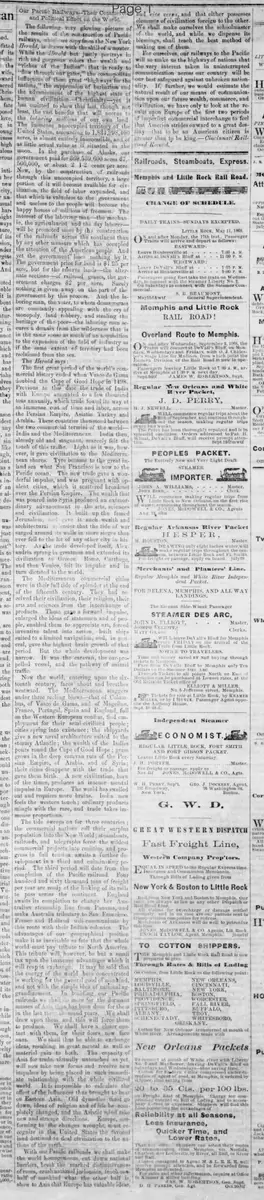
The following very glowing picture of the results of the construction of Pacific railways, which we copy from the New York Herald, is drawn with the skill of a master. While the Herald but justly portrays in rich and gorgeous colors the wealth and "riches of the Indies" that is ready to "flow through our gates," the cosmopolitan influences of these great "highways for the nations," the suppression of barbarism and the advancement of the highest state of human civilization—Christianity—yet it has omitted to show that last, though not least, the vast benefits that will accrue to the laboring millions of our own land
The immense unoccupied territory of the United States, amounting to 1,831,908,100 acres, is almost entirely inaccessible, and of as little actual value as if situated in the moon. In the purchase of Alaska, our government paid for 369,539,600 acres $7,500,000, or about 2 1-2 cents per acre
Now, by the construction of railroads through this unoccupied territory, a large portion of it will become available for civilization, the field of labor expanded, and that which is valueless to the government and useless to the people will become the happy homes of millions of freemen. The interest of the laboring man—the mechanic, the agriculturist and the day laborer—will be promoted more by the construction of the railroads across the continent than by any other measure which has occupied the attention of the American people. And yet the government loses nothing by it.
The government price for land is $1.25 per acre; but for the reserve lands—the alternate sections—of railroad grants, the government charges $2 per acre. Surely nothing is given away on the part of the government by this process. And the laboring man, the voter, to whom demagogues are constantly appealing with the cry of monopoly, land robbery, and stealing the heritage of the poor—the laboring man secures a domain from the wilderness that is in the same sense as much of an acquisition to the expansion of the field of industry as if the same extent of territory had been reclaimed from the sea.
The Herald says:
The first great period of the world's commercial history ended when Vasco de Gama doubled the Cape of Good Hope in 1498. Previous to this date the trade of India with Europe amounted to a few thousand tons annually, which trade found its way at an immense cost of time and labor, across the Persian Empire, Asiatic Turkey and Arabia. These countries then stood between the two commercial termini of the world—India and the Mediterranean. India then already old and stagnant, scarcely felt the touch of this trade. Light as it was, however, it gave civilization to the Mediterranean shores. Tyre became to the great inland sea what San Francisco is now to the Pacific ocean. The new trade gave a wonderful impulse, and was pregnant with opulent cities, which it scattered broadcast over the Persian Empire. The wealth that was poured into Syria produced an extraordinary advancement in the arts, sciences and civilization. It built up the famed Jerusalem, and gave it such wealth and architectural splendor that the tide of war surged around its walls in more sieges than ever fell to the lot of any other city in history. As the trade developed itself, Alexandria sprang in greatness and extended its civilization to Greece. Rome, Carthage and then Venice, felt its impulse and in turn dictated to the world.
The Mediterranean commercial cities were in their full tide of splendor at the end of the fifteenth century. They had received their civilization, their religion, their arts and sciences from the interchange of products. These gave a forward impulse, enlarged the ideas of statesmen and of people, enabled them to appreciate art, forced inventive talent into action, built ships suited to a limited navigation, and, in general, gave the highest brain growth of that period. But the whole development was narrow. It was the caravan, the oar-propelled vessel, and the pathway of animal traffic
Now the world, entering upon the sixteenth century, faces about and breathes westward. The Mediterranean staggers under three reeling blows—that of Columbus, of Vasco de Gama, and of Magellan. France, Portugal, Spain and England, full on the Western European confine, find employment for their semi-civilized people; cities spring into existence; the shipyards give a new naval architecture suited to the stormy Atlantic; the wealth of the Indies pours round the Cape of Good Hope; grass grows in the deep caravan ruts of the Persian Empire, of Arabia, and of Syria; their cities disappear with the trade that gave them birth. A new civilization, born of the times, produces an intense mental impulse in Europe. The world has swelled out and requires more brains. India now feels the western touch; ordinary products mingle with the rare, and trade takes immense proportions.
The tide sweeps on for three centuries; the commercial nations roll their surplus population into the New World; steamboats, railroads, and telegraphs force the wildest commercial projects into realities, and progress in full tension awaits a further development in a third and culminating period. The third period will date from the completion of the Pacific railroad. Four hundred and sixty thousand tons of freight per year are ready at the linking of its rails to pass across the continent. England awaits its completion to change her Australian steamship line from Panama, and make Australia tributary to San Francisco. France and Holland will communicate by this route with their Indian colonies. The advantages of our geographical position make it as inevitable as fate that the whole world must pay tribute to North America
This tribute will however, be but a small tax upon the immense advantages which it will reap in exchange. It may be said that the energy of the world here concentrated is working for the general good of mankind, and not with the simple idea of national aggrandizement. In building our Pacific railroads we help the more for the dormant masses of Asia than has been done for them in the last three thousand years. We shall draw upon them and this will force them to produce. We shall have a closer contact with them, for their doors now face ours. We shall thus be able to exchange ideas, resulting in great mental as well as material gain to both. The capacity of Asia for trade, virtually untouched as yet will now take new forms and receive new impulses by being placed in such immediate relationship with the whole civilized world. It is impossible to calculate the effect of the influences thus brought to bear on Eastern Asia. Old dynasties must go down, ideas of religion and of life be completely changed, and the Asiatic mind take new and strange directions. Europe, conforming to the changes wrought, must recognize in the United States the favored land destined to deal civilization to the nations of the earth
With our Pacific railroads we shall make the world homogeneous, cut down national barriers, break the marked distinctiveness of races, crush national jealousies, teach one half of mankind what the other half is, show to Asia that Europe has valuable ideas.
and rice versa, and that either possesses elements of civilization foreign to the other.
We shall make ourselves the schoolmaster of the world, and while we dispense its blessings, shall teach the best method of making use of them.
For ourselves, our railways to the Pacific will so make us the highway of nations that the very interest taken in uninterrupted communication across our country will be our best safeguard against unbroken nationality. If, further, we would estimate the natural result of our means of communication upon our future wealth, commerce, and civilization, we have only to look at the results upon Europe of the first two periods of imperfect commercial interchange to feel that America strides onward to a great destiny—that to be an American citizen is greater than to be king.—Cincinnati Railroad Record.
What sub-type of article is it?
What themes does it cover?
What keywords are associated?
What entities or persons were involved?
Where did it happen?
Story Details
Key Persons
Location
United States
Event Date
1498
Story Details
The article promotes Pacific railroads as opening vast US lands to settlement, benefiting laborers, and initiating a new era of global commerce akin to historical trade shifts from Mediterranean to Atlantic routes, fostering civilization in Asia and worldwide homogenization.