Thank you for visiting SNEWPapers!
Sign up free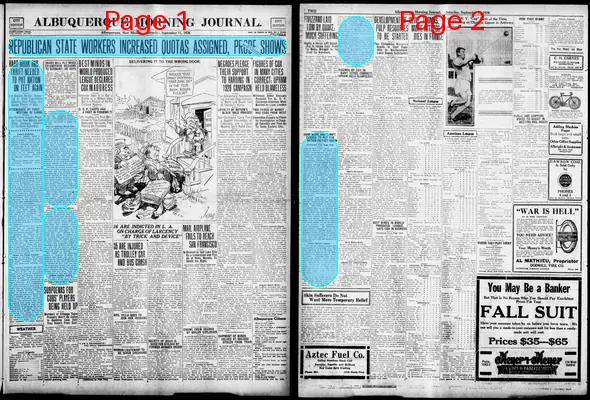
Albuquerque Morning Journal
Albuquerque, Bernalillo County, New Mexico
What is this article about?
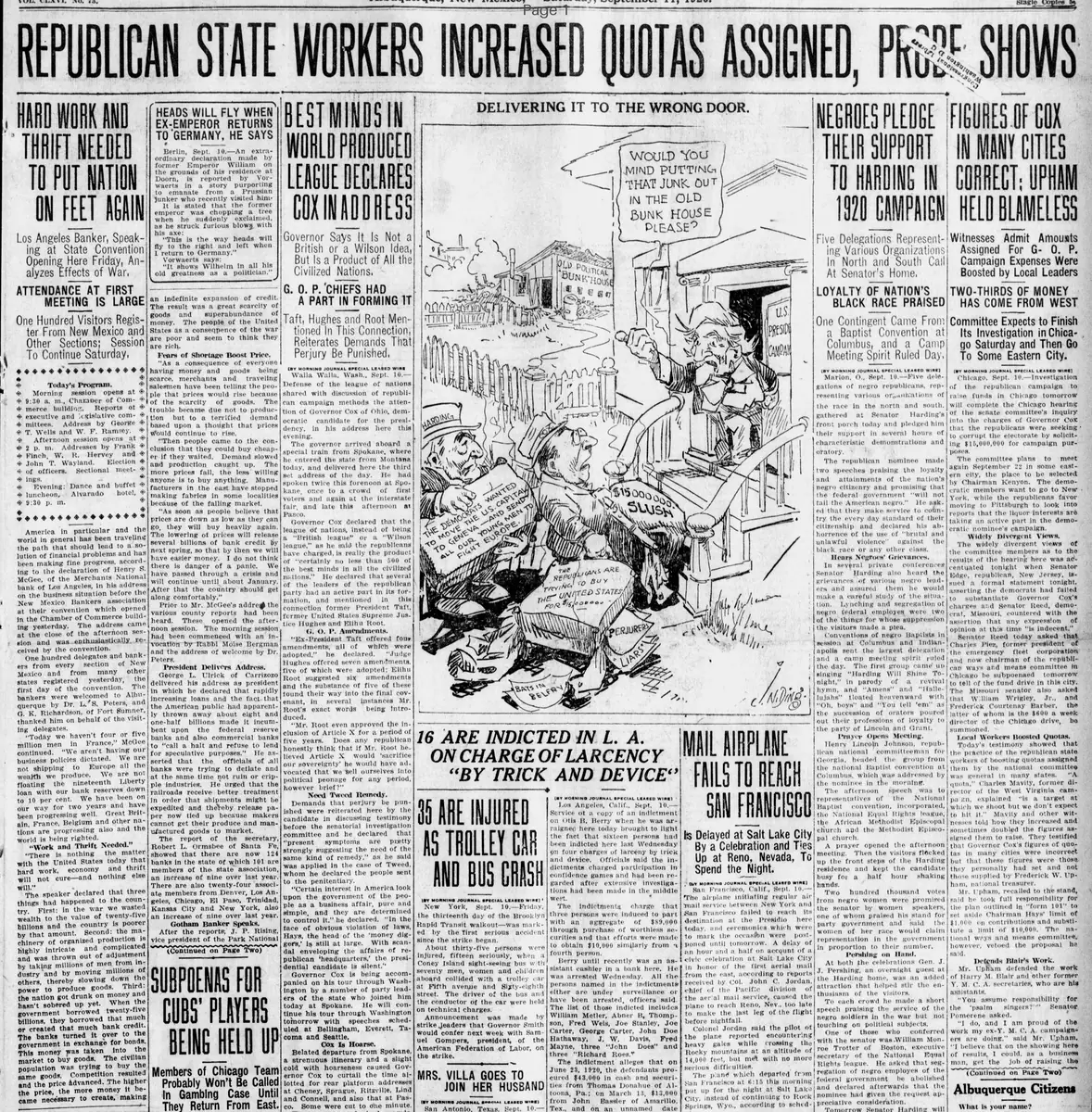
Report on the New Mexico Bankers Association convention in Albuquerque, featuring speeches by Henry S. McGee and others on post-WWI economic challenges, the need for thrift and hard work, and praise for the federal reserve system amid recovery efforts.
Merged-components note: Continuation of the Republican State Workers and bankers convention story across pages; relabeled from 'commercial' to 'story' as it is narrative news content.
Clippings
1 of 2
OCR Quality
Full Text
PROBE SHOWS
HARD WORK AND
THRIFT NEEDED
TO PUT NATION
ON FEET AGAIN
Los Angeles Banker, Speaking
at State Convention
Opening Here Friday, Analyzes Effects of War.
ATTENDANCE AT FIRST
MEETING IS LARGE
One Hundred Visitors Register
From New Mexico and
Other Sections: Session
To Continue Saturday.
Today's Program.
Morning session opens at
9:30 a. m., Chamber of Commerce
building.
Reports of
executive and legislative committees.
Address by George
T. Wells and W. F. Ramsey.
Afternoon session opens at
2 p. m.
Addresses by Frank
Finch, W. R. Hervey
and
John T. Wayland.
Election
of officers.
Sectional meetings.
Evening: Dance and buffet
luncheon.
Alvarado
hotel,
9:30 p. m.
America in particular and the
world in general has been traveling
the path that should lead to a solution of financial problems and has
been making fine progress, according
to the declaration of Henry S.
McGee, of the Merchants National
bank of Los Angeles, in his address
on the business situation before the
New Mexico Bankers association
at their convention which opened
in the Chamber of Commerce building yesterday. The address came
at the close of the afternoon session and was enthusiastically received by the convention.
One hundred delegates and bankers from every section of New
Mexico and from
many other
states registered yesterday,
the
first day of the convention.
The
bankers were welcomed to Albuquerque by Dr. L. S. Peters, and
G. K. Richardson, of Fort Sumner,
thanked him on behalf of the visiting delegates.
"Today we haven't four or five
million men in France," McGee
continued. "We aren't having our
business policies dictated. We are
not shipping to Europe all the
wealth we produce. We are not
floating the nineteenth Liberty
loan with our bank reserves down
to 10 per cent. We have been on
our way for two years and have
been progressing well. Great Britain, France, Belgium and other nations are progressing also and the
world is being righted.
"Hard work, economy and thrift
with the United States today that
"There is nothing the matter
"Work and Thrift Needed."
will not cure—and nothing else
will."
The speaker declared that three
things had happened to the country. First: in the war we wasted
wealth to the value of twenty-five
billions and the country is poorer
by that amount. Second: the machinery of organized production is
highly intricate and complicated
and was thrown out of adjustment
by taking millions of men from industry and by moving millions of
others, thereby slowing down the
power to produce goods. Third:
the nation got drunk on money and
government borrowed twenty-five
When the
billions, they borrowed that much
or created that much bank credit.
The banks turned it over to the
government in exchange for bonds.
This money was taken into the
market to buy goods. The civilian
population was trying to buy the
same goods. Competition resulted
and the price advanced. The higher
the price, the more money it became necessary to create, making
an indefinite expansion of credit.
The result was a great scarcity of
goods and
superabundance of
money. The people of the United
States as a consequence of the war
are poor and seem to think they
are rich.
Fears of Shortage Boost Price.
"As a consequence of everyone
having money and goods being
scarce, merchants and traveling
salesmen have been telling the people that prices would rise because
of the scarcity of goods. The
trouble became due not to production but to a terrified demand
based upon a thought that prices
would continue to rise.
"Then people came to the conclusion that they could buy cheaper if they waited. Demand slowed
and production caught up. The
more prices fall, the less willing
anyone is to buy anything. Manufacturers in the east have stopped
making fabrics in some localities
because of the falling market.
"As soon as people believe that
prices are down as low as they can
go, they will buy heavily again.
The lowering of prices will release
several billions of bank credit by
next spring, so that by then we will
have easier money. I do not think
there is danger of a panic. We
have passed through a crisis and
will continue until about January.
After that the country should get
along comfortably."
Prior to Mr. McGee's address the
various county reports had been
heard. These opened the after-
noon session. The morning session
had been commenced with an invocation by Rabbi Moise Bergman
and the address of welcome by Dr.
Peters.
President Delivers Address.
George L. Ulrick of Carrizozo
delivered his address as president
in which he declared that rapidly
increasing loans and the fact that
the American public had apparently thrown away about eight and
one-half billions made it incumbent upon the federal reserve
banks and also commercial banks
to "call a halt and refuse to lend
for speculative purposes." He asserted that the officials of all
banks were trying to deflate and
at the same time not ruin or crip-
ple industries. He urged that the
railroads receive better treatment
in order that shipments might be
expedited and thereby release pa-
per now tied up because makers
cannot get their produce and manufactured goods to market.
The report of the secretary,
Robert L. Ormsbee of Santa Fe,
showed that there are now 124
banks in the state of which 101 are
members of the state association,
an increase of nine over last year.
There are also twenty-four associate members from Denver, Los Angeles, Chicago, El Paso, Trinidad
Kansas City and New York, also
an increase of nine over last year.
Gotham Banker Speaks,
After the reports, J. P. Rising,
vice president of the Park National
(Continued on Page Two)
HARD WORK AND THRIFT NEEDED TO PUT THE NATION ON FEET AGAIN
(Continued from Page One)
bank of New York, made an address on "Service." He stated that several requirements of a community which were requisite to its continued prosperity were industry, thrift, public improvement, co-operation, education and financial advice. He amplified the need for each, placing strong emphasis on education and pointing out evils of our present school system, which must be met quickly "else the damage cannot be repaired in a generation." He asserted that financial advice was the most important item of good banking service.
"Open and frank discussions with customers as to financial conditions surrounding each respective industry and careful analysis of facts will both serve to aid the customer and strengthen the grasp of the banker upon the financial pulse of his section."
"Let me state that your banks are public institutions," said Mr. Rising, "chartered as such and existing by permission of your body politic. Therefore, it is pertinent to observe that you as bankers are public servants. Your profits are for the most part derived from the earnings on your deposits or from the other fellow's money. Therefore your money profits derived from your operations as a public institution should not be the index of your interest and concern in your community. Be developing the personal equation and by unselfish purpose together with a responsible service to your customers your alertness will bring to you and your bank the tribute of a loyal patronage and your full measure of prosperity."
Praises Reserve System.
"The federal reserve system has accomplished everything that has been expected of it," declared W. C. Weiss, manager of the El Paso branch of the federal reserve bank of Dallas. "Although only in its infancy the federal reserve banks carried the burden of financing the war. Because of the federal reserve, circulation expands when money is needed. The depressions and failures of former years were due largely to the old banking system. There are some faults with the federal reserve but when compared to the faults of the old system, they sink into oblivion."
Mr. Weiss' address came at the close of the morning session. He declared that the federal reserve bank of Dallas opened for business on November 16, 1914, with a force of twenty employees. Today, including its El Paso and Houston branches, it has over 500 employees. Over the country, there are twenty-two branches, and the total loans outstanding in all federal reserve banks and branches approximates $3,000,000,000.
Mr. Weiss pointed out that the El Paso branch had on August 31, outstanding loans amounting to $850,000 and during the time of its existence had rediscounted paper and accepted collateral notes to the amount of $140,000,000. It has handled four and a half million items, representing almost one billion dollars. He asserted that the federal reserve banks were meeting the need for which they were created and instanced their splendid financing of the war loans.
What sub-type of article is it?
What themes does it cover?
What keywords are associated?
What entities or persons were involved?
Where did it happen?
Story Details
Key Persons
Location
Albuquerque, New Mexico
Story Details
The New Mexico Bankers Association convention opened in Albuquerque with speeches emphasizing hard work, thrift, and economic recovery post-World War I. Key addresses covered war's financial impacts, the federal reserve system's successes, and the need for deflation without crippling industries. Reports showed increased bank memberships.