Thank you for visiting SNEWPapers!
Sign up free
Virginia Argus
Richmond, Virginia
What is this article about?
William Dunbar reports on his presidentially sponsored voyage up the Washita River to explore hot springs near 34°31'N, detailing geography, spring temperatures (130-150°F), composition, and microscopic life forms; corrects longitude to 6h 10m 5s W of Greenwich.
Clipping
OCR Quality
Full Text
Extracts of Letters from William Dunbar,
Esquire, to Gen. Wilkinson.
"Natchez, Feb. 8, 1805
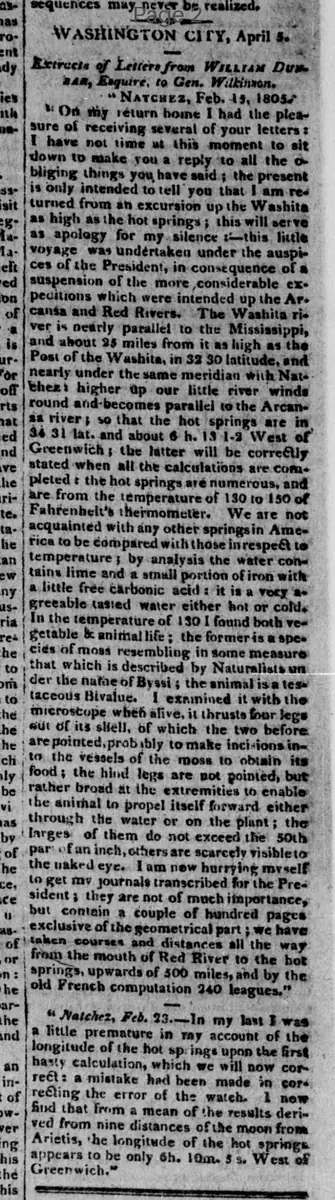
"On my return home I had the pleasure of receiving several of your letters: I have not time at this moment to sit down to make you a reply to all the obliging things you have said; the present is only intended to tell you that I am returned from an excursion up the Washita as high as the hot springs; this will serve as apology for my silence: this little voyage was undertaken under the auspices of the President, in consequence of a suspension of the more considerable expeditions which were intended up the Arkansas and Red Rivers. The Washita river is nearly parallel to the Mississippi, and about 250 miles from it as high as the Post of the Washita, in 32°30' latitude, and nearly under the same meridian with Natchez: higher up our little river winds round and becomes parallel to the Arkansas river; so that the hot springs are in 34°31' lat. and about 6 h. 13 1-2 West of Greenwich; the latter will be correctly stated when all the calculations are completed: the hot springs are numerous, and are from the temperature of 130 to 150 of Fahrenheit's thermometer. We are not acquainted with any other springs in America to be compared with those in respect to temperature; by analysis the water contains lime and a small portion of iron with a little free carbonic acid: it is a very agreeable tasted water either hot or cold. In the temperature of 150 I found both vegetable & animal life: the former is a species of moss resembling in some measure that which is described by Naturalists under the name of Byssus: the animal is a testaceous Bivalve. I examined it with the microscope when alive, it thrusts out legs out of its shell, of which the two before are pointed, probably to make incisions into the vessels of the moss to obtain its food; the hind legs are not pointed, but rather broad at the extremities to enable the animal to propel itself forward either through the water or on the plant; the largest of them do not exceed the 50th part of an inch, others are scarcely visible to the naked eye. I am now hurrying myself to get my journals transcribed for the President; they are not of much importance, but contain a couple of hundred pages exclusive of the geometrical part; we have taken courses and distances all the way from the mouth of Red River to the hot springs, upwards of 500 miles, and by the old French computation 240 leagues."
"Natchez, Feb. 23.--In my last I was a little premature in my account of the longitude of the hot springs upon the first hasty calculation, which we will now correct: a mistake had been made in correcting the error of the watch. I now find that from a mean of the results derived from nine distances of the moon from Arietis, the longitude of the hot springs appears to be only 6h. 10m. 5s. West of Greenwich."
What sub-type of article is it?
What keywords are associated?
What entities or persons were involved?
Where did it happen?
Domestic News Details
Primary Location
Washita River, Hot Springs
Event Date
Feb. 8, 1805
Key Persons
Event Details
William Dunbar returned from an excursion up the Washita River to the hot springs, undertaken under the auspices of the President. The river is described geographically, with the hot springs at 34°31' lat. and initially 6h. 13m. 30s. West of Greenwich, corrected to 6h. 10m. 5s. West. Springs temperature 130-150°F, containing lime, iron, carbonic acid; observations of moss and testaceous bivalve life.