Thank you for visiting SNEWPapers!
Sign up free
Martinsburgh Gazette
Martinsburg, Berkeley County, West Virginia
What is this article about?
Article from London Monthly Magazine reports drastic reduction in British Navy since 1814 peace, with 969 vessels disposed of by 1823, leaving 71 ships. Ship-building declined sharply from 1818 (1059 ships, 104,366 tons) to 1822 (723 ships, 62,534 tons), but merchant tonnage stable, indicating colonial expansion.
Clipping
OCR Quality
Full Text
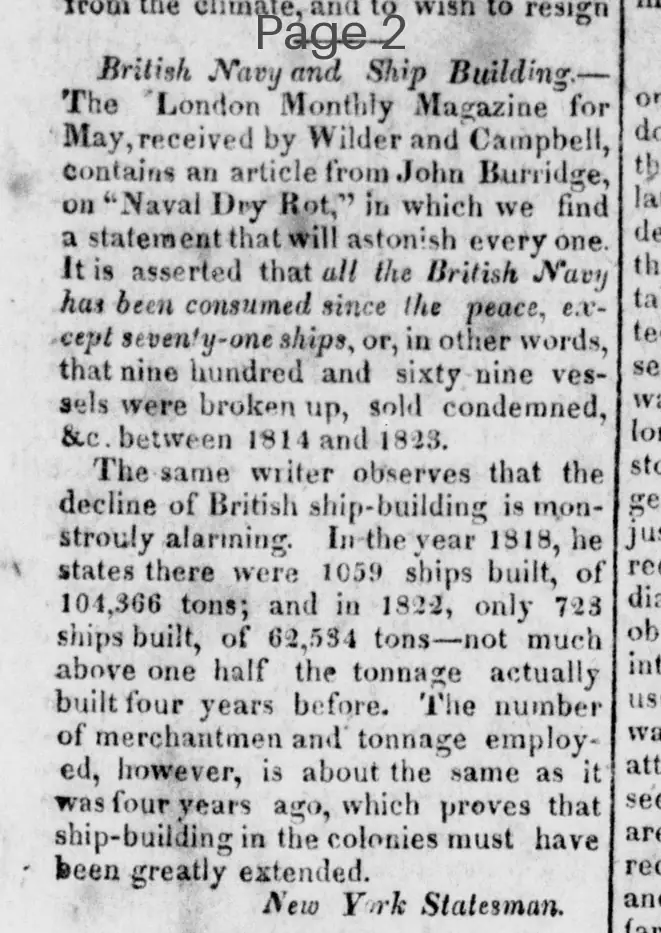
The London Monthly Magazine for May, received by Wilder and Campbell, contains an article from John Burridge, on "Naval Dry Rot," in which we find a statement that will astonish every one. It is asserted that all the British Navy has been consumed since the peace, except seventy-one ships, or, in other words, that nine hundred and sixty nine vessels were broken up, sold, condemned, &c. between 1814 and 1823.
The same writer observes that the decline of British ship-building is most alarmingly. In the year 1818, he states there were 1059 ships built, of 104,366 tons; and in 1822, only 723 ships built, of 62,534 tons—not much above one half the tonnage actually built four years before. The number of merchantmen and tonnage employed, however, is about the same as it was four years ago, which proves that ship-building in the colonies must have been greatly extended.
What sub-type of article is it?
What keywords are associated?
What entities or persons were involved?
Where did it happen?
Foreign News Details
Primary Location
Britain
Event Date
Between 1814 And 1823
Key Persons
Outcome
969 vessels broken up, sold, or condemned; ship-building declined from 1059 ships (104,366 tons) in 1818 to 723 ships (62,534 tons) in 1822; merchant tonnage stable, indicating extended colonial ship-building
Event Details
London Monthly Magazine article by John Burridge on Naval Dry Rot states British Navy reduced to 71 ships since peace, with 969 vessels disposed between 1814-1823. Ship-building declined alarmingly, halving tonnage from 1818 to 1822, while merchant employment remained steady, suggesting colonial growth.