Thank you for visiting SNEWPapers!
Sign up free
Literary
March 4, 1841
Rutland Herald
Rutland, Rutland County, Vermont
What is this article about?
On Christmas Eve, a mysterious stranger interrupts a festive ball, reminding revelers of Christ's birth and urging true gifts of charity. She guides a young maiden to aid the poor and pray, transforming her life. The maiden dies peacefully, ascending with the revealed angel.
Clipping
OCR Quality
95%
Excellent
Full Text
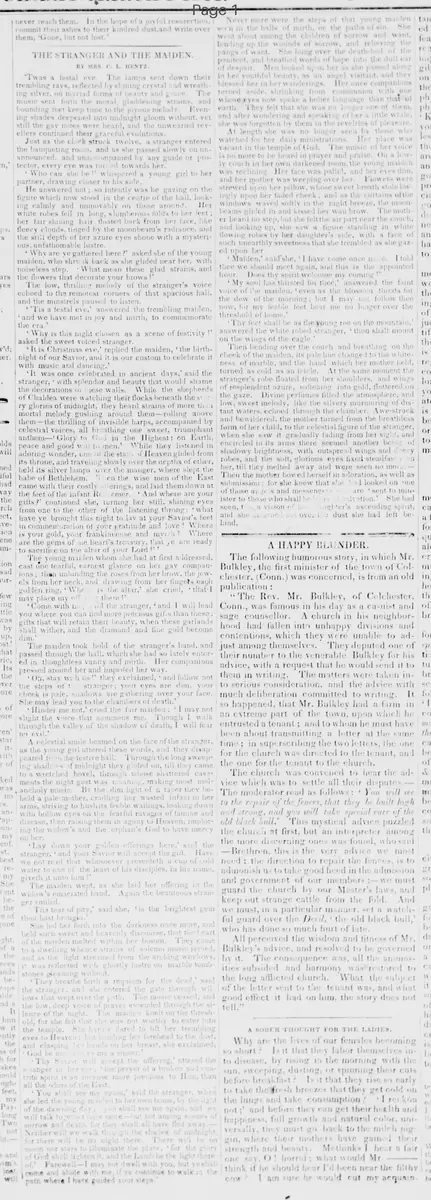
THE STRANGER AND THE MAIDEN
BY MISS C. L. HENIZ
'Twas a festal eve. The lamps sent down their trembling rays, reflected by shining crystal and wreathing silver, on myriad forms of beauty and grace. The music sent forth the most gladdening strains, and bounding feet keep time to the joyous melody. Evening shades deepened into midnight gloom without, yet still the gay notes were heard, and the unwearied revellers continued their graceful evolutions.
Just as the clock struck twelve, a stranger entered the banqueting room, and as she passed slowly on unannounced, and unaccompanied by any guide or protector, every eye was turned towards her.
"Who can she be?" whispered a young girl to her partner, drawing closer to his side.
He answered not, so intently was he gazing on the figure which now stood in the centre of the hall, looking calmly and immovably on those around. Her white robes fell in long, slumberous folds to her feet. Her fair shining hair floated back from her face, like fleecy clouds, tinged by the moonbeam's radiance, and the still depth of her azure eyes shone with a mysterious, unfathomable lustre.
"Why are ye gathered here?" asked she of the young maiden, who shrunk back as she glided near her, with noiseless step. "What mean these glad strains, and the flowers that decorate your brows?"
The low, thrilling melody of the stranger's voice echoed to the remotest corners of that spacious hall, and the minstrels paused to listen.
"'Tis a festal eve," answered the trembling maiden, "and we have met in joy and mirth, to commemorate the day."
"Why is this night chosen as a scene of festivity?" asked the sweet voiced stranger.
"It is Christmas eve," replied the maiden, "the birth-night of our Savior, and it is our custom to celebrate it with music and dancing."
"It was once celebrated in ancient days," said the stranger, "with splendor and beauty that would shame the decorations of these walls. While the shepherds of Chaldea were watching their flocks beneath the starry glories of midnight, they heard strains of more than mortal melody gushing around them—rolling above them—the thrilling of invisible harps, accompanied by celestial voices, all breathing one sweet, triumphant anthem—'Glory to God in the Highest: on Earth, peace and good will to men.' While they listened in adoring wonder, one of the stars of Heaven glided from its throne, and traveling slowly over the depths of ether, held its silver lamp over the manger, where slept the babe of Bethlehem. Then the wise men of the East came with their costly offerings, and laid them down at the feet of the infant Redeemer. And where are your gifts?" continued she, turning her still, shining eyes from one to the other of the listening throng; "what have ye brought this night to lay at your Savior's feet in commemoration of your gratitude and love? Where is your gold, your frankincense and myrrh? Where are the gems of the heart's treasury, that ye are ready to sacrifice on the altar of your Lord?"
The young maiden whom she had at first addressed, cast one tearful, earnest glance on her gay companions, then unbinding the roses from her brow, the jewels from her neck, and drawing from her fingers each golden ring, "Where is the altar," she cried, "that I may place my offering there?"
"Come with me," said the stranger, "and I will lead you where you can find more precious gifts than these, gifts that will retain their beauty, when these garlands shall wither, and the diamond and fine gold become dim."
The maiden took hold of the stranger's hand, and passed through the hall, which she had so lately entered in thoughtless vanity and mirth. Her companions pressed around her and impeded her way.
"Oh, stay with us," they exclaimed, "and follow not the steps of the stranger, your eyes are dim. Your cheek is pale. Shadows are gathering over your face. She may lead you to the chambers of death."
"Hinder me not," cried the fair maiden, "I may not slight the voice that summons me. Though I walk through the valley of the shadow of death, I will fear no evil."
A celestial smile beamed on the face of the stranger, as the young girl uttered these words, and they disappeared from the festive hall. Through the long sweeping shadows of midnight they glided on, till they came to a wretched hovel, through whose shattered casements the night gust was whistling, making most melancholy music. By the dim light of a taper they beheld a pale mother, cradling her wasted infant in her arms, striving to hush its feeble wailings, looking down with hollow eyes on the fearful ravages of famine and disease, then raising them in agony to Heaven, imploring the widow's and the orphan's God to have mercy on her.
"Lay down your golden offerings here," said the stranger, "and your Savior will accept the gift. Have we not read that whosoever presenteth a cup of cold water to one of the least of his disciples, in his name, giveth it unto him."
The maiden wept, as she laid her offering in the widow's emaciated hand. Again the beauteous stranger smiled.
"The tear of pity," said she, "is the brightest gem thou hast brought."
She led her forth into the darkness once more, and held such sweet and heavenly discourse, that the heart of the maiden melted within her bosom. They came to a dwelling whence strains of solemn music issued, and as the light streamed from the arching windows, it was reflected with ghostly lustre on marble tomb-stones gleaming without.
"They breathe forth a requiem for the dead," said the stranger and she entered the gate through willows that wept over the path. The music ceased, and the low, deep voice of prayer ascended through the silence of the night. The maiden knelt on the threshold, for she felt that she was not worthy to enter into the temple. She dared not lift her trembling eyes to Heaven but by closing her forehead to the dust, and clasping her hands on her breast, she exclaimed,
"God be merciful to me a sinner."
"Thy Savior will accept the offering," uttered the stranger in her softest tones; "the prayer of a broken and contrite spirit is an incense more precious to Him, than all the odor of the East."
"You shall see me again," said the stranger, when she led the young maiden to her own home, by the light of the dawning day. "You shall see me again, and we will talk together in a home—not among scenes of sorrow and death for they shall all have fled away.—Neither will we walk then in the shades of midnight for there will be no night there. There will be no moon nor stars to illuminate the place: for the glory of God shall lighten it, and the Lamb be the light thereof." "Farewell—I may not dwell with you, but you shall come and abide with me, if ye continue to walk in the path where I have guided you."
Never more were the steps of that young maiden seen in the halls of mirth, or the paths of sin. She went about among the children of sorrow and want, binding up the wounds of sorrow, and relieving the pangs of want. She hung over the death-bed of the penitent, and breathed words of hope into the dull ear of despair. Men looked upon her as she passed along in her youthful beauty, as an angel visitant, and they blessed her in her wanderings. Her once companions turned aside, shrinking from communion with one whose eyes now spoke a holier language than that of earth. They felt that she was no longer one of them, and after wondering and speaking of her a little while, she was forgotten by them in the revelry of pleasure.
At length she was no longer seen by those who watched for her daily ministrations. Her place was vacant in the temple of God. The music of her voice is no more to be heard in prayer and praise. On a low couch in her own darkened room, the young maiden was reclining. Her face was pallid, and her eyes dim, and her mother was weeping over her. Flowers were strewed upon her pillow, whose sweet breath stole lovingly upon her faded cheek, and as the curtains of the windows waved softly in the night breeze, the moonbeams glided in and kissed her wan brow. The mother heard no step, but she felt the air part near the couch, and looking up, she saw a figure standing in white flowing robes by her daughter's side, with a face of such unearthly sweetness that she trembled as she gazed upon her.
"Maiden," said she, "I have come once more. I told thee we should meet again, and this is the appointed hour. Does thy spirit welcome my coming?"
"My soul hath thirsted for thee," answered the faint voice of the maiden, "even as the blossom thirsts for the dew of the morning: but I may not follow thee now, for my feeble feet bear me no longer over the threshold of home."
"Thy feet shall be as the young roe on the mountain," answered the white robed stranger, "thou shalt mount on the wings of the eagle."
Then bending over the couch and breathing on the cheek of the maiden, its pale hue changed to the whiteness of marble, and the hand which her mother held turned as cold as an icicle. At the same moment the stranger's robe floated from her shoulders, and wings of resplendent azure, softening into gold, fluttered on the gaze. Divine perfumes filled the atmosphere, and low, sweet melody, like the silvery murmuring of distant waters, echoed through the chamber. Awe-struck and bewildered, the mother turned from the breathless form of her child, to the celestial figure of the stranger, when she saw it gradually fading from her sight, and encircled in its arms there seemed another being of shadowy brightness, with outspread wings and dewy robes, and the soft, glorious eyes fixed steadfast on her, till they melted away and were seen no more.—
Then the mother bowed herself in adoration, as well as submission: for she knew that she too had looked on one of those angels and messengers who are 'sent to minister to those who shall be heirs of salvation.' She had seen a vision of her daughter's ascending spirit, and she mourned not over the dust she had left behind.
BY MISS C. L. HENIZ
'Twas a festal eve. The lamps sent down their trembling rays, reflected by shining crystal and wreathing silver, on myriad forms of beauty and grace. The music sent forth the most gladdening strains, and bounding feet keep time to the joyous melody. Evening shades deepened into midnight gloom without, yet still the gay notes were heard, and the unwearied revellers continued their graceful evolutions.
Just as the clock struck twelve, a stranger entered the banqueting room, and as she passed slowly on unannounced, and unaccompanied by any guide or protector, every eye was turned towards her.
"Who can she be?" whispered a young girl to her partner, drawing closer to his side.
He answered not, so intently was he gazing on the figure which now stood in the centre of the hall, looking calmly and immovably on those around. Her white robes fell in long, slumberous folds to her feet. Her fair shining hair floated back from her face, like fleecy clouds, tinged by the moonbeam's radiance, and the still depth of her azure eyes shone with a mysterious, unfathomable lustre.
"Why are ye gathered here?" asked she of the young maiden, who shrunk back as she glided near her, with noiseless step. "What mean these glad strains, and the flowers that decorate your brows?"
The low, thrilling melody of the stranger's voice echoed to the remotest corners of that spacious hall, and the minstrels paused to listen.
"'Tis a festal eve," answered the trembling maiden, "and we have met in joy and mirth, to commemorate the day."
"Why is this night chosen as a scene of festivity?" asked the sweet voiced stranger.
"It is Christmas eve," replied the maiden, "the birth-night of our Savior, and it is our custom to celebrate it with music and dancing."
"It was once celebrated in ancient days," said the stranger, "with splendor and beauty that would shame the decorations of these walls. While the shepherds of Chaldea were watching their flocks beneath the starry glories of midnight, they heard strains of more than mortal melody gushing around them—rolling above them—the thrilling of invisible harps, accompanied by celestial voices, all breathing one sweet, triumphant anthem—'Glory to God in the Highest: on Earth, peace and good will to men.' While they listened in adoring wonder, one of the stars of Heaven glided from its throne, and traveling slowly over the depths of ether, held its silver lamp over the manger, where slept the babe of Bethlehem. Then the wise men of the East came with their costly offerings, and laid them down at the feet of the infant Redeemer. And where are your gifts?" continued she, turning her still, shining eyes from one to the other of the listening throng; "what have ye brought this night to lay at your Savior's feet in commemoration of your gratitude and love? Where is your gold, your frankincense and myrrh? Where are the gems of the heart's treasury, that ye are ready to sacrifice on the altar of your Lord?"
The young maiden whom she had at first addressed, cast one tearful, earnest glance on her gay companions, then unbinding the roses from her brow, the jewels from her neck, and drawing from her fingers each golden ring, "Where is the altar," she cried, "that I may place my offering there?"
"Come with me," said the stranger, "and I will lead you where you can find more precious gifts than these, gifts that will retain their beauty, when these garlands shall wither, and the diamond and fine gold become dim."
The maiden took hold of the stranger's hand, and passed through the hall, which she had so lately entered in thoughtless vanity and mirth. Her companions pressed around her and impeded her way.
"Oh, stay with us," they exclaimed, "and follow not the steps of the stranger, your eyes are dim. Your cheek is pale. Shadows are gathering over your face. She may lead you to the chambers of death."
"Hinder me not," cried the fair maiden, "I may not slight the voice that summons me. Though I walk through the valley of the shadow of death, I will fear no evil."
A celestial smile beamed on the face of the stranger, as the young girl uttered these words, and they disappeared from the festive hall. Through the long sweeping shadows of midnight they glided on, till they came to a wretched hovel, through whose shattered casements the night gust was whistling, making most melancholy music. By the dim light of a taper they beheld a pale mother, cradling her wasted infant in her arms, striving to hush its feeble wailings, looking down with hollow eyes on the fearful ravages of famine and disease, then raising them in agony to Heaven, imploring the widow's and the orphan's God to have mercy on her.
"Lay down your golden offerings here," said the stranger, "and your Savior will accept the gift. Have we not read that whosoever presenteth a cup of cold water to one of the least of his disciples, in his name, giveth it unto him."
The maiden wept, as she laid her offering in the widow's emaciated hand. Again the beauteous stranger smiled.
"The tear of pity," said she, "is the brightest gem thou hast brought."
She led her forth into the darkness once more, and held such sweet and heavenly discourse, that the heart of the maiden melted within her bosom. They came to a dwelling whence strains of solemn music issued, and as the light streamed from the arching windows, it was reflected with ghostly lustre on marble tomb-stones gleaming without.
"They breathe forth a requiem for the dead," said the stranger and she entered the gate through willows that wept over the path. The music ceased, and the low, deep voice of prayer ascended through the silence of the night. The maiden knelt on the threshold, for she felt that she was not worthy to enter into the temple. She dared not lift her trembling eyes to Heaven but by closing her forehead to the dust, and clasping her hands on her breast, she exclaimed,
"God be merciful to me a sinner."
"Thy Savior will accept the offering," uttered the stranger in her softest tones; "the prayer of a broken and contrite spirit is an incense more precious to Him, than all the odor of the East."
"You shall see me again," said the stranger, when she led the young maiden to her own home, by the light of the dawning day. "You shall see me again, and we will talk together in a home—not among scenes of sorrow and death for they shall all have fled away.—Neither will we walk then in the shades of midnight for there will be no night there. There will be no moon nor stars to illuminate the place: for the glory of God shall lighten it, and the Lamb be the light thereof." "Farewell—I may not dwell with you, but you shall come and abide with me, if ye continue to walk in the path where I have guided you."
Never more were the steps of that young maiden seen in the halls of mirth, or the paths of sin. She went about among the children of sorrow and want, binding up the wounds of sorrow, and relieving the pangs of want. She hung over the death-bed of the penitent, and breathed words of hope into the dull ear of despair. Men looked upon her as she passed along in her youthful beauty, as an angel visitant, and they blessed her in her wanderings. Her once companions turned aside, shrinking from communion with one whose eyes now spoke a holier language than that of earth. They felt that she was no longer one of them, and after wondering and speaking of her a little while, she was forgotten by them in the revelry of pleasure.
At length she was no longer seen by those who watched for her daily ministrations. Her place was vacant in the temple of God. The music of her voice is no more to be heard in prayer and praise. On a low couch in her own darkened room, the young maiden was reclining. Her face was pallid, and her eyes dim, and her mother was weeping over her. Flowers were strewed upon her pillow, whose sweet breath stole lovingly upon her faded cheek, and as the curtains of the windows waved softly in the night breeze, the moonbeams glided in and kissed her wan brow. The mother heard no step, but she felt the air part near the couch, and looking up, she saw a figure standing in white flowing robes by her daughter's side, with a face of such unearthly sweetness that she trembled as she gazed upon her.
"Maiden," said she, "I have come once more. I told thee we should meet again, and this is the appointed hour. Does thy spirit welcome my coming?"
"My soul hath thirsted for thee," answered the faint voice of the maiden, "even as the blossom thirsts for the dew of the morning: but I may not follow thee now, for my feeble feet bear me no longer over the threshold of home."
"Thy feet shall be as the young roe on the mountain," answered the white robed stranger, "thou shalt mount on the wings of the eagle."
Then bending over the couch and breathing on the cheek of the maiden, its pale hue changed to the whiteness of marble, and the hand which her mother held turned as cold as an icicle. At the same moment the stranger's robe floated from her shoulders, and wings of resplendent azure, softening into gold, fluttered on the gaze. Divine perfumes filled the atmosphere, and low, sweet melody, like the silvery murmuring of distant waters, echoed through the chamber. Awe-struck and bewildered, the mother turned from the breathless form of her child, to the celestial figure of the stranger, when she saw it gradually fading from her sight, and encircled in its arms there seemed another being of shadowy brightness, with outspread wings and dewy robes, and the soft, glorious eyes fixed steadfast on her, till they melted away and were seen no more.—
Then the mother bowed herself in adoration, as well as submission: for she knew that she too had looked on one of those angels and messengers who are 'sent to minister to those who shall be heirs of salvation.' She had seen a vision of her daughter's ascending spirit, and she mourned not over the dust she had left behind.
What sub-type of article is it?
Prose Fiction
Allegory
What themes does it cover?
Religious
Moral Virtue
Death Mortality
What keywords are associated?
Christmas Eve
Stranger
Maiden
Charity
Angel
Salvation
Moral Awakening
Deathbed Vision
What entities or persons were involved?
By Miss C. L. Heniz
Literary Details
Title
The Stranger And The Maiden
Author
By Miss C. L. Heniz
Subject
Christmas Eve Celebration And Moral Awakening
Key Lines
"Glory To God In The Highest: On Earth, Peace And Good Will To Men."
"Lay Down Your Golden Offerings Here," Said The Stranger, "And Your Savior Will Accept The Gift."
"God Be Merciful To Me A Sinner."
"Thy Savior Will Accept The Offering," Uttered The Stranger In Her Softest Tones; "The Prayer Of A Broken And Contrite Spirit Is An Incense More Precious To Him, Than All The Odor Of The East."
Then The Mother Bowed Herself In Adoration, As Well As Submission: For She Knew That She Too Had Looked On One Of Those Angels And Messengers Who Are 'Sent To Minister To Those Who Shall Be Heirs Of Salvation.'