Thank you for visiting SNEWPapers!
Sign up free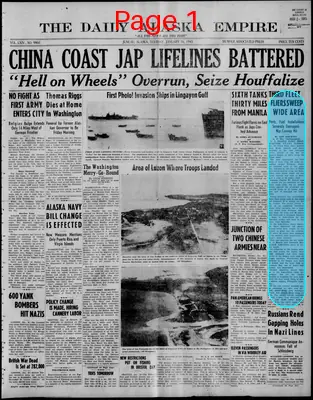
The Daily Alaska Empire
Juneau, Juneau County, Alaska
What is this article about?
US Third Fleet carrier planes bombed Japanese ports on China coast (Hong Kong, Swatow, Amoy) and Formosa on Jan. 14, after Indo-China strikes on Jan. 12 that sank 41 ships, damaged 28, destroyed 120 planes, and hit Saigon/Camranh Bay facilities; 16 US planes lost.
Clipping
OCR Quality
Full Text
Ports, Fuel Installations Severely Damaged-
Nip Convoy Hit
By LEIF ERICKSON
(A. P. War Correspondent)
U. S. PACIFIC FLEET HEADQUARTERS, PEARL HARBOR
Jan. 16-Third Fleet fliers bombed Hong Kong, Swatow and Amoy Saturday in the first full-scale carrier attacks of the war on Japan's lifeline of ports along the China coast.
The navy announced the bold sweep of more than 300 miles extending behind Formosa, which was pounded anew at the same time. followed by two days of Third Fleet carrier attacks along the Indo-China coast which wiped out two enemy convoys and sank or damaged a total of 69 enemy ships.
Admiral Chester W. Nimitz said no details are yet available on the China coast raids, but he moved sharply upward the previously announced totals of 25 enemy ships sunk and 13 damaged off Indo-China.
Nimitz disclosed that venturesome Third Fleet pilots sank 41 Jap ships and damaged 28 in wiping out the two convoys. The overall picture is that of an audacious American carrier force sweeping like a huge paint brush from Formosa, where more than 100 ships and 98 planes were destroyed or damaged January 8, down to Indo-China for the Thursday strikes and back to the China coast Saturday.
In the Indo-China sweep American fliers destroyed 120 planes. Seventy-seven were caught on the ground, so great was the surprise and about 50 others were damaged in the western most penetration of Japan's inner defenses.
They also pounded the key facilities at Saigon and Camranh Bay, excellent Indo-China ports in enemy hands.
Oil refineries in the Saigon area, vital fuel source for Japan, were badly damaged and fires were started in the Saigon navy yard oil storage facilities. Warehouses and buildings in the Saigon area were set ablaze, and the large dock at Camranh Bay, one of Asia's best harbors, was demolished.
Sixteen American planes were lost in the Indo-China raids, remarkably few for the results achieved in crippling the area from which the Japs would likely be able to bolster slipping Philippine holdings.
Of the two convoys knocked out, one contained an oiler, four medium cargo ships, two destroyer escorts, four coastal cargo ships all sunk. The second convoy included a light cruiser. four destroyer escorts, four oilers, seven medium cargo ships, two small cargo ships and one coastal vessel, all sunk or beached.
What sub-type of article is it?
What keywords are associated?
What entities or persons were involved?
Where did it happen?
Foreign News Details
Primary Location
China Coast
Event Date
Jan. 16
Key Persons
Outcome
sank 41 japanese ships and damaged 28 in two convoys off indo-china; destroyed or damaged over 100 ships and 98 planes at formosa on january 8; destroyed 120 planes in indo-china; damaged oil refineries, navy yard, warehouses in saigon; demolished dock at camranh bay; 16 american planes lost.
Event Details
Third Fleet carrier aircraft conducted attacks on Hong Kong, Swatow, Amoy, and Formosa, followed by strikes on Indo-China coast convoys and ports at Saigon and Camranh Bay, sinking or damaging numerous enemy ships and destroying aircraft and facilities.