Thank you for visiting SNEWPapers!
Sign up free
The Milwaukee Leader
Milwaukee, Milwaukee County, Wisconsin
What is this article about?
Helena Rubinstein discusses historical beauty practices across ancient civilizations, from Atlantean cosmetics and Chinese foot binding to Egyptian preserved creams and Jezebel's face painting, emphasizing enduring human interest in appearance.
Clipping
OCR Quality
Full Text
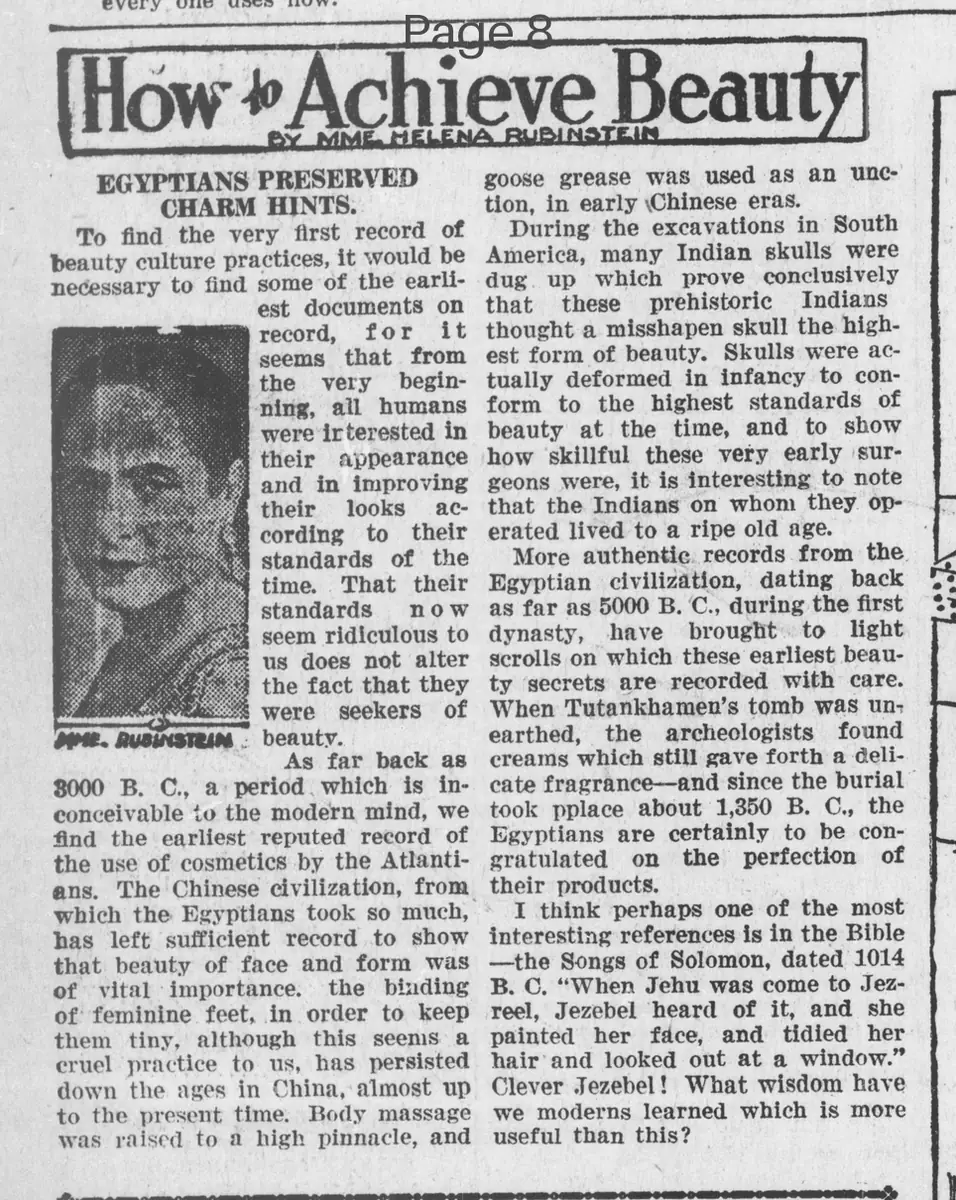
HELENA RUBINSTEIN
EGYPTIANS PRESERVED CHARM HINTS.
To find the very first record of beauty culture practices, it would be necessary to find some of the earliest documents on record, for it seems that from the very beginning, all humans were interested in their appearance and in improving their looks according to their standards of the time.
That their standards now seem ridiculous to us does not alter the fact that they were seekers of beauty.
As far back as 3000 B. C., a period which is inconceivable to the modern mind, we find the earliest reputed record of the use of cosmetics by the Atlantians. The Chinese civilization, from which the Egyptians took so much, has left sufficient record to show that beauty of face and form was of vital importance. The binding of feminine feet, in order to keep them tiny, although this seems a cruel practice to us, has persisted down the ages in China, almost up to the present time. Body massage was raised to a high pinnacle, and goose grease was used as an unction, in early Chinese eras.
During the excavations in South America, many Indian skulls were dug up which prove conclusively that these prehistoric Indians thought a misshapen skull the highest form of beauty. Skulls were actually deformed in infancy to conform to the highest standards of beauty at the time, and to show how skillful these very early surgeons were, it is interesting to note that the Indians on whom they operated lived to a ripe old age.
More authentic records from the Egyptian civilization, dating back as far as 5000 B. C., during the first dynasty, have brought to light scrolls on which these earliest beauty secrets are recorded with care.
When Tutankhamen's tomb was unearthed, the archeologists found creams which still gave forth a delicate fragrance-and since the burial took place about 1,350 B. C., the Egyptians are certainly to be congratulated on the perfection of their products.
I think perhaps one of the most interesting references is in the Bible -the Songs of Solomon. dated 1014 B. C. "When Jehu was come to Jezreel, Jezebel heard of it, and she painted her face, and tidied her hair and looked out at a window."
Clever Jezebel! What wisdom have we moderns learned which is more useful than this?
What sub-type of article is it?
What themes does it cover?
What keywords are associated?
What entities or persons were involved?
Where did it happen?
Story Details
Key Persons
Location
Egypt, China, South America, Atlantis
Event Date
From 5000 B.C. To 1014 B.C.
Story Details
Overview of ancient beauty practices including Atlantean cosmetics around 3000 B.C., Chinese foot binding and body massage, South American skull deformation in infancy, Egyptian beauty secrets from 5000 B.C. with preserved creams from Tutankhamen's tomb circa 1350 B.C., and biblical reference to Jezebel painting her face in 1014 B.C.