Thank you for visiting SNEWPapers!
Sign up free
Phenix Gazette
Alexandria, Virginia
What is this article about?
A detailed description of an innovative artificial human anatomical model, or 'Mannikin,' created by Parisian physician Auzoux and recently acquired by Yale College's Medical Institution. Exhibited by Dr. Knight, it allows detailed study of human anatomy without dissection, using durable, lifelike materials that surpass natural specimens in some aspects.
Clipping
OCR Quality
Full Text
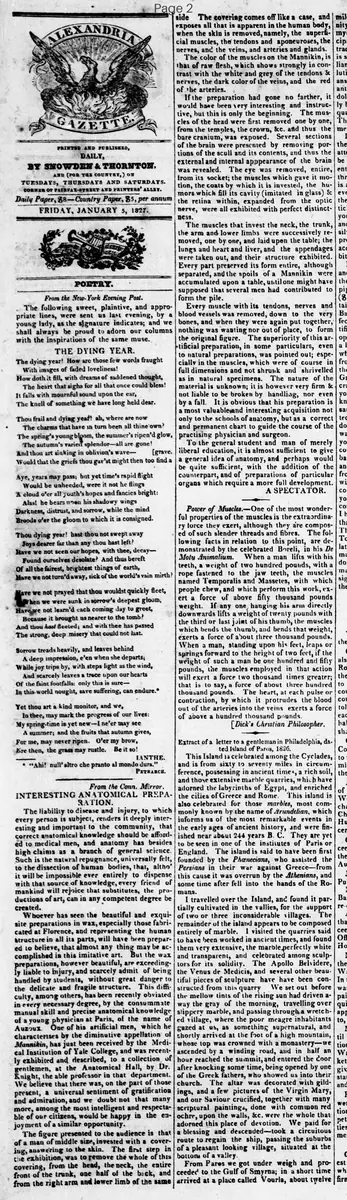
INTERESTING ANATOMICAL PREPARATION.
The liability to disease and injury, to which every person is subject, renders it deeply interesting and important to the community, that correct anatomical knowledge should be afforded to medical men, and anatomy has besides high claims as a branch of general science.
Such is the natural repugnance, universally felt, to the dissection of human bodies, that, altho' it will be impossible ever entirely to dispense with that source of knowledge, every friend of mankind will rejoice that substitutes, the productions of art, can in any competent degree be created.
Whoever has seen the beautiful and exquisite preparations in wax, especially those fabricated at Florence, and representing the human structure in all its parts, will have been prepared to believe, that almost any thing may be accomplished in this imitative art. But the wax preparations, however beautiful, are exceedingly liable to injury, and scarcely admit of being handled by students, without great danger to the delicate and fragile structure. This difficulty, among others, has been recently obviated in every necessary degree, by the consummate manual skill and precise anatomical knowledge of a young physician at Paris, of the name of Auzoux. One of his artificial men, which he characterises by the diminutive appellation of Mannikin, has just been received by the Medical Institution of Yale College, and was recently exhibited and described, to a collection of gentlemen, at the Anatomical Hall, by Dr. Knight, the able professor in that department. We believe that there was, on the part of those present, a universal sentiment of gratification and admiration, and we doubt not that many more, among the most intelligent and respectable of our citizens, would be happy in the enjoyment of a similar opportunity.
The figure presented to the audience is that of a man of middle size, invested with a covering, answering to the skin. The first step in the exhibition, was to remove the whole of this covering, from the head, the neck, the entire front of the trunk, one half of the back, and from the right arm and lower limb of the same side. The covering comes off like a case, and exposes all that is apparent in the human body, when the skin is removed, namely, the superficial muscles, the tendons and aponeuroses, the nerves, and the veins, and arteries and glands. The color of the muscles on the Mannikin, is that of raw flesh, which shows strongly in contrast with the white and grey of the tendons & nerves, the dark color of the veins, and the red of the arteries.
If the preparation had gone no farther, it would have been very interesting and instructive, but this is only the beginning.
The muscles of the head were first removed one by one, from the temples, the crown, &c. and thus the bare cranium, was exposed. Several sections of the brain were presented by removing portions of the skull and its contents, and thus the external and internal appearance of the brain was revealed. The eye was removed, entire, from its socket; the muscles which gave it motion, the coats by which it is invested, the humors which fill its cavity (imitated in glass) & the retina within, expanded from the optic nerve, were all exhibited with perfect distinctness.
The muscles that invest the neck, the trunk, the arm and lower limbs were successively removed, one by one, and laid upon the table; the lungs and heart and liver, and the appendages were taken out, and their structure exhibited. Every part preserved its form entire, although separated, and the spoils of a Mannikin were accumulated upon a table, until one might have supposed that several men had contributed to form the pile.
Every muscle with its tendons, nerves and blood vessels was removed, down to the very bones, and when they were again put together, nothing was wanting nor out of place, to form the original figure. The superiority of this artificial preparation, in some particulars, over natural preparations, was pointed out; especially in the muscles, which were of course in full dimensions and not shrunk and shrivelled as in natural specimens. The nature of the material is unknown; it is however very firm & not liable to be broken by handling, nor even by a fall. It is obvious that this preparation is a most valuable and interesting acquisition not only to the schools of anatomy, but as a correct and permanent chart to guide the course of the practising physician and surgeon.
To the general student and man of merely liberal education, it is almost sufficient to give a general idea of anatomy, and perhaps would be quite sufficient, with the addition of the counterpart, and of preparations of particular organs which require a more full development.
A SPECTATOR.
What sub-type of article is it?
What themes does it cover?
What keywords are associated?
What entities or persons were involved?
Where did it happen?
Story Details
Key Persons
Location
Paris; Yale College, Connecticut
Event Date
Recently
Story Details
Auzoux's durable artificial Mannikin model of the human body is received at Yale College and exhibited by Dr. Knight, demonstrating removable parts for anatomical study, surpassing wax models and natural dissections in utility and permanence.