Thank you for visiting SNEWPapers!
Sign up free
Wheeling Times And Advertiser
Wheeling, Ohio County, West Virginia
What is this article about?
Historical article cites Thomas Jefferson's 1803 letters expressing constitutional doubts about the Louisiana Purchase treaty, arguing these views oppose annexing Texas without amending the Constitution, warning of potential Union dissolution under President Tyler's recommendation.
Clipping
OCR Quality
Full Text
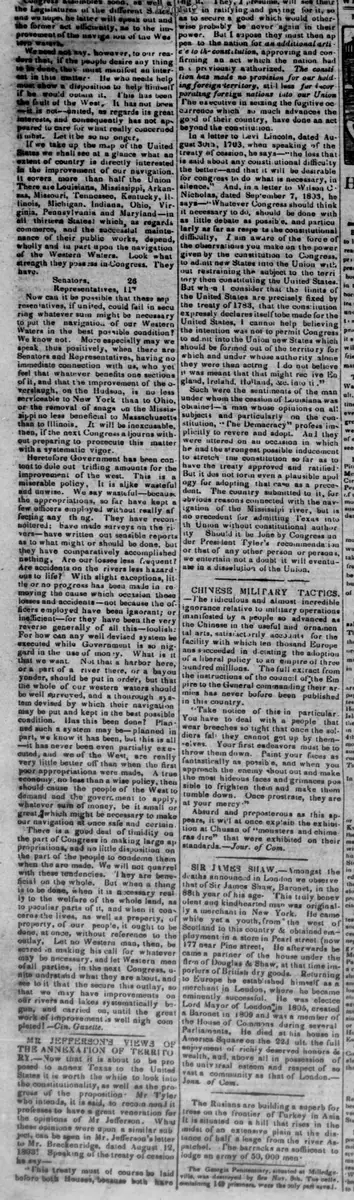
Now that it is about to be proposed to annex Texas to the United States it is worth the while to look into the constitutionality, as well as the propriety of the proposition. Mr. Tyler who intends, it is said, to recommend it possesses, to have a great veneration for the opinions of Mr. Jefferson. What these opinions were upon a similar subject, can be seen in Mr. Jefferson's letter to Mr. Breckenridge, dated August 12, 1803. Speaking of the treaty of cession he says--
This treaty must of course be laid before both Houses, because both have important rights to exercise over it. They may disapprove of its different articles, and may disapprove of the whole together. If they disapprove, they have a right, as in the case of a treaty with an Indian nation, to disapprove and to declare it void. But if they approve, they cannot change a single article in it. We might, then, as well as the Executive, secure a guide which would otherwise probably be overbearing to their power. But I suppose they must then appeal to the nation for an additional article to the constitution, approving and confirming an act which the nation had previously authorized. The constitution has made the Executive the treaty-making power, and the Senate the approver. They have not extended this to the acquiring foreign territory, and still less to incorporating foreign nations into our Union. The Executive in seizing the fugitive occurrences which so much advances the good of their country, have done an act beyond the constitution.
In a letter to Levi Lincoln, dated August 30th, 1803, when speaking of the treaty of cession, he says--"the less that is said about any constitutional difficulty the better--and that it will be desirable for congress to do what is necessary, in silence." And, in a letter to Wilson C. Nicholas, dated September 7, 1803, he says--"Whatever Congress should think it necessary to do, should be done with as little debate as possible, and particularly as far as respects the constitutional difficulty. I am aware of the force of the observations you make on the power given by the constitution to Congress, to admit new States into the Union without restraining the subject to the territory then constituting the United States. But when I consider that the limits of the United States are precisely fixed by the treaty of 1783, that the constitution expressly declares itself to be made for the United States, I cannot help believing the intention was not to permit Congress to admit into the Union new States which should be formed out of the territory for which and under whose authority alone they were then acting I do not believe it was meant that they might receive England, Ireland, Holland, &c. into it."
Such were the sentiments of the man under whom the cession of Louisiana was obtained--a man whose opinions on all subjects and particularly on the constitution, "the Democracy" profess implicitly to revere and adopt. And they were uttered on an occasion in which he had the strongest possible inducement to stretch the constitution so far as to have the treaty approved and ratified. But it does not form even a plausible apology for adopting that case as a precedent. The country submitted to it, for obvious reasons connected with the navigation of the Mississippi river, but it is no precedent for admitting Texas into the Union without constitutional authority Should it be done by Congress under President Tyler's recommendation or that of any other person or persons, we entertain not a doubt it will eventuate in a dissolution of the Union.
What sub-type of article is it?
What themes does it cover?
What keywords are associated?
What entities or persons were involved?
Story Details
Key Persons
Event Date
August 12, 1803; August 30, 1803; September 7, 1803
Story Details
Article quotes Jefferson's letters from 1803 expressing constitutional concerns over the Louisiana Purchase, suggesting it exceeded presidential powers and required constitutional amendment; applies this to argue against Texas annexation without similar process, predicting Union dissolution if pursued.