Thank you for visiting SNEWPapers!
Sign up free
Editorial
December 26, 1811
The Enquirer
Richmond, Henrico County, Virginia
What is this article about?
Editorial criticizing the practical effects of the Apportionment Bill, arguing it unfairly favors the four largest states (Virginia, Pennsylvania, New York, Massachusetts) at a 35,000 ratio, sacrificing smaller and southern states through unequal representation and congressional voting.
Merged-components note: Tables are fragmented calculations integral to the editorial on the apportionment bill; merged into single editorial component.
Clipping
OCR Quality
25%
Poor
Full Text
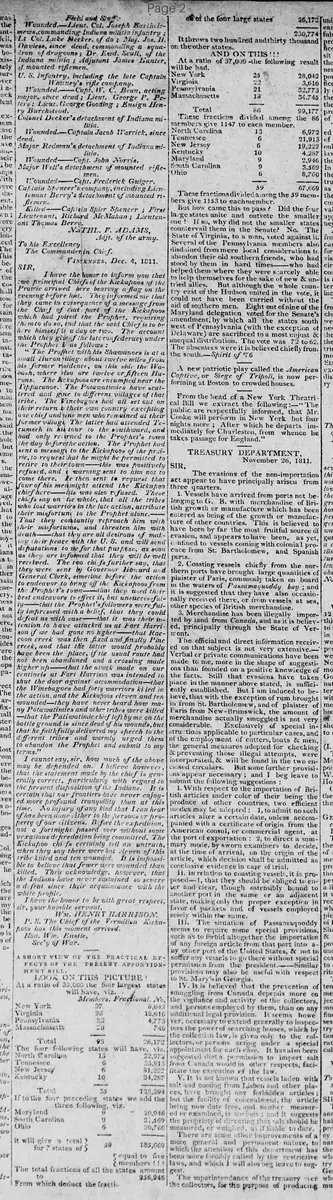
A SHORT VIEW OF THE PRACTICAL EFFECTS OF THE PRESENT APPORTIONMENT BILL.
LOOK ON THIS PICTURE!
At a ratio of 35,000 the four largest states will have, viz.
Virginia 230,774
Pennsylvania 230,774
New York 230,774
Massachusetts 230,774
It throws two hundred and thirty thousand on the other states.
AND ON THIS!!!
At a ratio of 37,000 - the following result will be had.
Total 99,177
These fractions divided among the 86
59 67,669
These fractions divided among the 59 members give 1153 to each member.
But how came this to pass? Did the four largest states unite and outvote the smaller ones? If so, why did not the smaller states countervail them in the Senate? No. The State of Virginia, to a man, voted against it. Several of the Pennsylvania members also disdained from mere local considerations to abandon their old southern friends, who had stood by them in hard times -- who had helped them where they were scarcely able to help themselves for the sake of new & untried allies. But although the whole country east of the Hudson united in the vote, it could not have been carried without the aid of southern men. Eight out of nine of the Maryland delegation voted for the Senate's amendment, by which all the states south west of Pennsylvania (with the exception of Delaware) are sacrificed to a most unjust & unequal distribution. The vote was 72 to 62. The absentees were it is believed chiefly from the south. -- Spirit of 76
LOOK ON THIS PICTURE!
At a ratio of 35,000 the four largest states will have, viz.
Virginia 230,774
Pennsylvania 230,774
New York 230,774
Massachusetts 230,774
It throws two hundred and thirty thousand on the other states.
AND ON THIS!!!
At a ratio of 37,000 - the following result will be had.
Total 99,177
These fractions divided among the 86
59 67,669
These fractions divided among the 59 members give 1153 to each member.
But how came this to pass? Did the four largest states unite and outvote the smaller ones? If so, why did not the smaller states countervail them in the Senate? No. The State of Virginia, to a man, voted against it. Several of the Pennsylvania members also disdained from mere local considerations to abandon their old southern friends, who had stood by them in hard times -- who had helped them where they were scarcely able to help themselves for the sake of new & untried allies. But although the whole country east of the Hudson united in the vote, it could not have been carried without the aid of southern men. Eight out of nine of the Maryland delegation voted for the Senate's amendment, by which all the states south west of Pennsylvania (with the exception of Delaware) are sacrificed to a most unjust & unequal distribution. The vote was 72 to 62. The absentees were it is believed chiefly from the south. -- Spirit of 76
| New York | 27 | 8,043 |
| Virginia | 23 | 12,616 |
| Pennsylvania | 23 | 4,773 |
| Massachusetts | 20 | 740 |
| The four following states will have, viz. North Carolina | 13 | 32,972 |
| Tennessee | 6 | 33,913 |
| New Jersey | 6 | 31,222 |
| Kentucky | 10 | 24,287 |
| Total | 35 | 122,394 |
| If to the four preceding states we add the |
| Maryland | 9 | - | 20,946 |
| South Carolina | 9 | - | 21,569 |
| Ohio | 6 | - | 20,760 |
| it will give a total $ \sum $ for 7 states of $ \sum $ | 59 | 185,669 |
| The total fractions of all the states amount to 256,946 |
| From which deduct the fracti- |
| New York | 25 | 28,042 |
| Virginia | 22 | 3,616 |
| Pennsylvania | 21 | 32,773 |
| Massachusetts | 13 | 34,745 |
| members give 1147 to each member. | ||
| North Carolina | 13 | 6,972 |
| Tennessee | 6 | 21,913 |
| New Jersey | 6 | 19,322 |
| Kentucky | 10 | 4,287 |
| Maryland | 9 | 2,946 |
| South Carolina | 9 | 3,569 |
| Ohio | 6 | 8,760 |
What sub-type of article is it?
Constitutional
Partisan Politics
What keywords are associated?
Apportionment Bill
State Representation
Population Ratio
Congressional Vote
Southern States
What entities or persons were involved?
Virginia
Pennsylvania
New York
Massachusetts
Maryland
Senate
Editorial Details
Primary Topic
Inequities In The Apportionment Bill's State Representation
Stance / Tone
Strongly Critical Of Unjust Distribution Favoring Larger States
Key Figures
Virginia
Pennsylvania
New York
Massachusetts
Maryland
Senate
Key Arguments
At 35,000 Ratio, Four Largest States Each Get 230,774, Burdening Others
Bill Passed With Aid From Southern Men Despite Virginia's Opposition
Smaller And Southwestern States Sacrificed To Unequal Distribution
Vote 72 To 62, Absentees Mostly Southern