Thank you for visiting SNEWPapers!
Sign up free
Literary
July 19, 1820
Daily National Intelligencer
Washington, District Of Columbia
What is this article about?
Colonel Watson's narrative describes the abundant and perilous wildlife along the Orinoco and Apure rivers, including venomous insects like the 'devil sticker,' lizards, alligators, porpoises, various fish, birds, and mammals, encountered during a journey to San Fernando.
Clipping
OCR Quality
98%
Excellent
Full Text
SELECTED.
Scenes of the river Apure, and at the Town of San Fernando,
FROM COL. WATSON'S NARRATIVE.
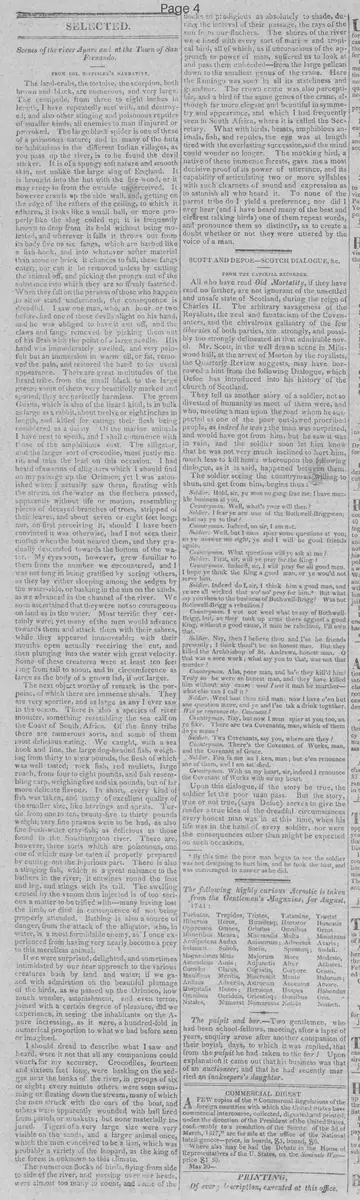
The land-crabs, the tortoise, the scorpion, both brown and black, are numerous, and very large. The centipede, from three to eight inches in length, I have repeatedly met with, and destroyed; and also other stinging and poisonous reptiles of smaller kinds, all enemies to man if injured or provoked. The large black spider is one of these of a poisonous nature; and in many of the huts or habitations in the different Indian villages, as you pass up the river, is to be found the devil sticker. It is of a spongy soft nature and smooth skin, not unlike the large slug of England. It is brought into the hut with the fire wood, or it may creep in from the outside unperceived. It however crawls up the side wall, and, getting on the edge of the rafters of the ceiling, to which it adheres, it looks like a small ball, or more properly like the slug coiled up; it is frequently known to drop from its hold without being molested, and wherever it falls it throws out from its body five or six fangs, which are barbed like a fish-hook, and into whatever softer material than stone or brick it chances to fall, these fangs enter; nor can it be removed unless by cutting the animal off, and picking the prongs out of the substance into which they are so firmly fastened. When they fall on the persons of those who happen to sit or stand underneath, the consequence is dreadful. I saw one man, who, an hour or two before, had one of those devils alight on his hand, and he was obliged to have it cut off, and the claws and fangs removed by picking them out of his flesh with the point of a large needle. His hand was immoderately swelled, and very painful: but an immersion in warm oil, or fat, removed the pain, and restored the hand to its usual appearance.
There are great multitudes of the lizard tribe, from the small black to the large green; some of them very beautifully marked and spotted; they are perfectly harmless. The green Iguana, which is also of the lizard kind, is in bulk as large as a rabbit, about twelve or eight inches in length, and killed for eating: their flesh being considered as a dainty.
Of the marine animals I have next to speak, and I shall commence with those of the amphibious cast. The alligator, and the larger sort of crocodile, most justly merit, and take the lead on this occasion. I had heard of swarms of alligators which I should find on my passage up the Orinoco; yet I was astonished when I actually saw them, floating with the stream on the water as the flechera passed, apparently without life or motion, resembling pieces of decayed branches of trees, stripped of their leaves, and about seven or eight feet long; nor, on first perceiving it, should I have been convinced it was otherwise, had I not seen their motion when the boat neared them, and they gradually descended towards the bottom of the water. My eyes soon, however, grew familiar to them from the number we encountered, and I was not long in being gratified by seeing others, as they lay either sleeping among the sedges by the water-side, or basking in the sun on the sands, as we advanced in the channel of the river. We soon ascertained that they were not so courageous on land as in the water. Most terrific they certainly were; yet many of the men would advance towards them and attack them with their sabres, while they appeared immoveable; with their mouths open actually receiving the cut, and then plunging into the water with great velocity. Some of these creatures were at least ten feet long from tail to snout, and in circumference as large as the body of a grown lad, if not larger.
The next object worthy of remark is the porpoise, of which there are immense shoals. They are very sportive, and as large as any I ever saw in the ocean. There is also a species of river monster, something resembling the sea calf on the Coast of South Africa.
Of the finny tribe there are numerous sorts, and some of them most delicious eating. We caught, with a sea hook and line, the large dog-headed fish, weighing from thirty to sixty pounds, the flesh of which was well tasted; rock fish, red mullets, large roach, from four to eight pounds, and fish resembling carp, weighing five and six pounds, but of far more delicate flavour. In short, every kind of fish was taken, and many of excellent quality of the smaller size, like herrings and sprats. Turtle from one to ten, twenty-five to thirty pounds weight; very fine prawns were to be had, as also fine fresh-water craw-fish, as delicious as those found in the Southampton river. There are, however, three sorts which are poisonous, one of which may be eaten if properly prepared by cutting out the injurious part. There is also a stinging fish, which is a great nuisance to the bathers in the river; it entwines round the foot and leg, and stings with its tail. The swelling caused by the venom thus injected is of too serious a matter to be trifled with—many having lost the limb, or died in consequence of not being properly attended. Bathing is also a source of danger, from the attack of the alligator, who, in water, is a most formidable enemy, as I once experienced from having very nearly become a prey to this merciless animal.
If we were surprised, delighted, and sometimes intimidated by our near approach to the various creatures both by land and water; if we gazed with admiration on the beautiful plumage of the birds, as we passed up the Orinoco, how much wonder, astonishment, and even terror, joined with a certain degree of pleasure, did we experience, in seeing the inhabitants on the Apure increasing, as it were, a hundred-fold in numerical proportion to what we had before seen or imagined. I should dread to describe what I saw and heard, were it not that all my companions could vouch for my accuracy. Crocodiles, fourteen and sixteen feet long, were basking on the sedges near the banks of the river, in groups of six or eight; every minute others were seen swimming or floating down the stream, many of which the men struck with the oars of the boat, and others were apparently wounded with ball fired from pistols or muskets; but none materially injured. Tigers of a very large size were very visible on the sands, and a larger animal once, which the men conceived to be a lion, which was probably a variety of the leopard, as the king of the forest is unknown to this climate. The numerous flocks of birds, flying from side to side of the river, and passing over our heads, were almost too many to count, and some of the flocks so prodigious as absolutely to shade, during the interval of their passage, the rays of the sun from our flechera. The shores of the river were lined with every sort of marine and tropical bird, all of which, as if unconscious of the approach or power of man, suffered us to look at and pass them unheeded—from the large pelican down to the smallest genus of the crane. Here the flamingo was seen in all its stateliness and grandeur. The crown crane was also perceptible, and a bird of the same genus of the crane, although far more elegant and beautiful in symmetry and appearance, and which I had frequently seen in South Africa, where it is called the Secretary. What with birds, beasts, amphibious animals, fish, and reptiles, the eye was at length tired with the everlasting succession, and the mind could wonder no longer. The mocking bird, a native of these immense forests, gave me a most decisive proof of its power of utterance, and its capability of articulating two or more syllables with such clearness of sound and expression as to astonish all who heard it. To none of the parrot tribe do I yield a preference; nor did I ever hear (and I have heard many of the best and clearest talking birds) one of them repeat words, and pronounce them so distinctly, as to create a doubt whether or not they were uttered by the voice of a man.
Scenes of the river Apure, and at the Town of San Fernando,
FROM COL. WATSON'S NARRATIVE.
The land-crabs, the tortoise, the scorpion, both brown and black, are numerous, and very large. The centipede, from three to eight inches in length, I have repeatedly met with, and destroyed; and also other stinging and poisonous reptiles of smaller kinds, all enemies to man if injured or provoked. The large black spider is one of these of a poisonous nature; and in many of the huts or habitations in the different Indian villages, as you pass up the river, is to be found the devil sticker. It is of a spongy soft nature and smooth skin, not unlike the large slug of England. It is brought into the hut with the fire wood, or it may creep in from the outside unperceived. It however crawls up the side wall, and, getting on the edge of the rafters of the ceiling, to which it adheres, it looks like a small ball, or more properly like the slug coiled up; it is frequently known to drop from its hold without being molested, and wherever it falls it throws out from its body five or six fangs, which are barbed like a fish-hook, and into whatever softer material than stone or brick it chances to fall, these fangs enter; nor can it be removed unless by cutting the animal off, and picking the prongs out of the substance into which they are so firmly fastened. When they fall on the persons of those who happen to sit or stand underneath, the consequence is dreadful. I saw one man, who, an hour or two before, had one of those devils alight on his hand, and he was obliged to have it cut off, and the claws and fangs removed by picking them out of his flesh with the point of a large needle. His hand was immoderately swelled, and very painful: but an immersion in warm oil, or fat, removed the pain, and restored the hand to its usual appearance.
There are great multitudes of the lizard tribe, from the small black to the large green; some of them very beautifully marked and spotted; they are perfectly harmless. The green Iguana, which is also of the lizard kind, is in bulk as large as a rabbit, about twelve or eight inches in length, and killed for eating: their flesh being considered as a dainty.
Of the marine animals I have next to speak, and I shall commence with those of the amphibious cast. The alligator, and the larger sort of crocodile, most justly merit, and take the lead on this occasion. I had heard of swarms of alligators which I should find on my passage up the Orinoco; yet I was astonished when I actually saw them, floating with the stream on the water as the flechera passed, apparently without life or motion, resembling pieces of decayed branches of trees, stripped of their leaves, and about seven or eight feet long; nor, on first perceiving it, should I have been convinced it was otherwise, had I not seen their motion when the boat neared them, and they gradually descended towards the bottom of the water. My eyes soon, however, grew familiar to them from the number we encountered, and I was not long in being gratified by seeing others, as they lay either sleeping among the sedges by the water-side, or basking in the sun on the sands, as we advanced in the channel of the river. We soon ascertained that they were not so courageous on land as in the water. Most terrific they certainly were; yet many of the men would advance towards them and attack them with their sabres, while they appeared immoveable; with their mouths open actually receiving the cut, and then plunging into the water with great velocity. Some of these creatures were at least ten feet long from tail to snout, and in circumference as large as the body of a grown lad, if not larger.
The next object worthy of remark is the porpoise, of which there are immense shoals. They are very sportive, and as large as any I ever saw in the ocean. There is also a species of river monster, something resembling the sea calf on the Coast of South Africa.
Of the finny tribe there are numerous sorts, and some of them most delicious eating. We caught, with a sea hook and line, the large dog-headed fish, weighing from thirty to sixty pounds, the flesh of which was well tasted; rock fish, red mullets, large roach, from four to eight pounds, and fish resembling carp, weighing five and six pounds, but of far more delicate flavour. In short, every kind of fish was taken, and many of excellent quality of the smaller size, like herrings and sprats. Turtle from one to ten, twenty-five to thirty pounds weight; very fine prawns were to be had, as also fine fresh-water craw-fish, as delicious as those found in the Southampton river. There are, however, three sorts which are poisonous, one of which may be eaten if properly prepared by cutting out the injurious part. There is also a stinging fish, which is a great nuisance to the bathers in the river; it entwines round the foot and leg, and stings with its tail. The swelling caused by the venom thus injected is of too serious a matter to be trifled with—many having lost the limb, or died in consequence of not being properly attended. Bathing is also a source of danger, from the attack of the alligator, who, in water, is a most formidable enemy, as I once experienced from having very nearly become a prey to this merciless animal.
If we were surprised, delighted, and sometimes intimidated by our near approach to the various creatures both by land and water; if we gazed with admiration on the beautiful plumage of the birds, as we passed up the Orinoco, how much wonder, astonishment, and even terror, joined with a certain degree of pleasure, did we experience, in seeing the inhabitants on the Apure increasing, as it were, a hundred-fold in numerical proportion to what we had before seen or imagined. I should dread to describe what I saw and heard, were it not that all my companions could vouch for my accuracy. Crocodiles, fourteen and sixteen feet long, were basking on the sedges near the banks of the river, in groups of six or eight; every minute others were seen swimming or floating down the stream, many of which the men struck with the oars of the boat, and others were apparently wounded with ball fired from pistols or muskets; but none materially injured. Tigers of a very large size were very visible on the sands, and a larger animal once, which the men conceived to be a lion, which was probably a variety of the leopard, as the king of the forest is unknown to this climate. The numerous flocks of birds, flying from side to side of the river, and passing over our heads, were almost too many to count, and some of the flocks so prodigious as absolutely to shade, during the interval of their passage, the rays of the sun from our flechera. The shores of the river were lined with every sort of marine and tropical bird, all of which, as if unconscious of the approach or power of man, suffered us to look at and pass them unheeded—from the large pelican down to the smallest genus of the crane. Here the flamingo was seen in all its stateliness and grandeur. The crown crane was also perceptible, and a bird of the same genus of the crane, although far more elegant and beautiful in symmetry and appearance, and which I had frequently seen in South Africa, where it is called the Secretary. What with birds, beasts, amphibious animals, fish, and reptiles, the eye was at length tired with the everlasting succession, and the mind could wonder no longer. The mocking bird, a native of these immense forests, gave me a most decisive proof of its power of utterance, and its capability of articulating two or more syllables with such clearness of sound and expression as to astonish all who heard it. To none of the parrot tribe do I yield a preference; nor did I ever hear (and I have heard many of the best and clearest talking birds) one of them repeat words, and pronounce them so distinctly, as to create a doubt whether or not they were uttered by the voice of a man.
What sub-type of article is it?
Journey Narrative
Essay
What themes does it cover?
Nature
What keywords are associated?
Travel Narrative
Orinoco River
Apure River
Wildlife
Alligators
Birds
Venomous Creatures
South America Exploration
What entities or persons were involved?
Col. Watson
Literary Details
Title
Scenes Of The River Apure, And At The Town Of San Fernando, From Col. Watson's Narrative.
Author
Col. Watson
Subject
Journey Up The Orinoco And Apure Rivers
Form / Style
Descriptive Prose Narrative
Key Lines
The Large Black Spider Is One Of These Of A Poisonous Nature; And In Many Of The Huts Or Habitations In The Different Indian Villages, As You Pass Up The River, Is To Be Found The Devil Sticker.
I Had Heard Of Swarms Of Alligators Which I Should Find On My Passage Up The Orinoco; Yet I Was Astonished When I Actually Saw Them, Floating With The Stream On The Water As The Flechera Passed, Apparently Without Life Or Motion, Resembling Pieces Of Decayed Branches Of Trees.
What With Birds, Beasts, Amphibious Animals, Fish, And Reptiles, The Eye Was At Length Tired With The Everlasting Succession, And The Mind Could Wonder No Longer.
The Mocking Bird, A Native Of These Immense Forests, Gave Me A Most Decisive Proof Of Its Power Of Utterance, And Its Capability Of Articulating Two Or More Syllables With Such Clearness Of Sound And Expression As To Astonish All Who Heard It.