Thank you for visiting SNEWPapers!
Sign up free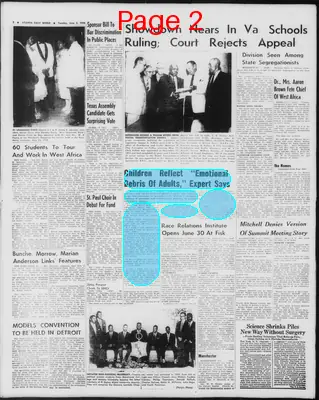
Atlanta Daily World
Atlanta, Fulton County, Georgia
What is this article about?
In a U.S. News & World Report interview, Dr. William C. Kvaraceus explains how school integration exacerbates educational challenges, reflects adult racial tensions in children's behavior, and links higher Negro delinquency rates to subcultural pressures. (198 characters)
Clipping
OCR Quality
Full Text
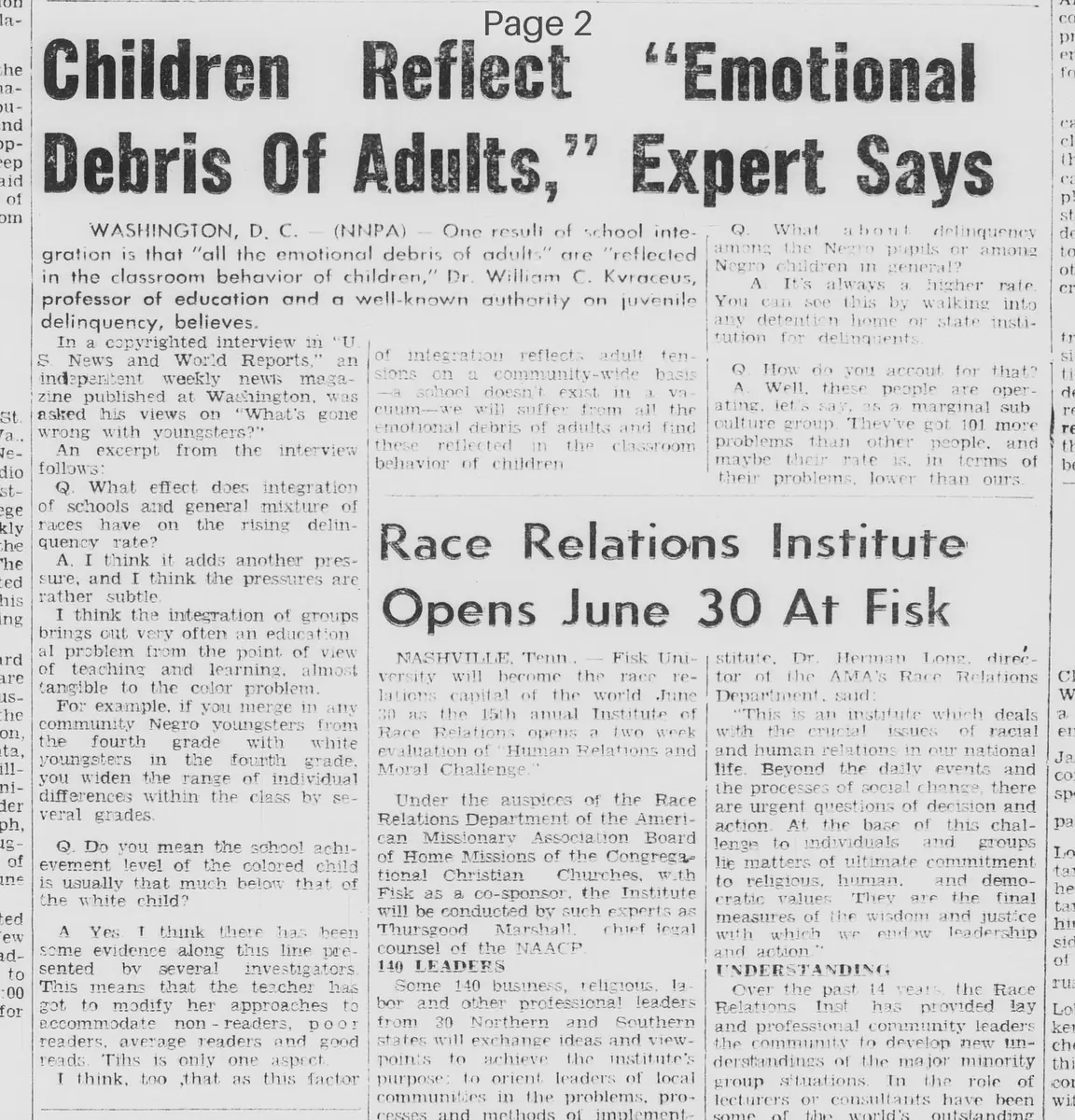
Reflect
"Emotional
Debris Of Adults,
' Expert Says
WASHINGTON, D. C. - (NNPA) - One result of school integration is that "all the emotional debris of adults," are "reflected in the classroom behavior of children," Dr. William C. Kvaraceus, professor of education and a well-known authority on juvenile delinquency, believes.
In a copyrighted interview in 'U.S. News and World Report,' an independent weekly news magazine published at Washington, was asked his views on 'What's gone wrong with youngsters?'
An excerpt from the interview follows
Q. What effect does integration of schools and general mixture of races have on the rising delinquency rate?
A. I think it adds another pressure, and I think the pressures are rather subtle.
I think the integration of groups brings out very often an educational problem from the point of view of teaching and learning, almost tangible to the color problem.
For example, if you merge in any community Negro youngsters from the fourth grade with white youngsters in the fourth grade, you widen the range of individual differences within the class by several grades.
Q. Do you mean the school achievement level of the colored child is usually that much below that of the white child?
A. Yes, I think there has been some evidence along this line presented by several investigators.
This means that the teacher has got to modify her approaches to accommodate non-readers, poor readers, average readers and good readers. This is only one aspect.
I think, too, that as this factor of integration reflects adult tensions on a community-wide basis, it doesn't exist in vacuum—we will suffer from all the emotional debris of adults and find these reflected in the classroom behavior of children.
Q. What about delinquency among the Negro pupils or among Negro children in general?
A. It's always a higher rate. You can see this by walking into any detention home or state institution for delinquents.
Q. How do you account for that?
A. Well, these people are operating, let's say, as a marginal subculture group. They've got a lot more problems than other people, and maybe their rate is, in terms of their problems, lower than ours.
What sub-type of article is it?
What themes does it cover?
What keywords are associated?
What entities or persons were involved?
Where did it happen?
Story Details
Key Persons
Location
Washington, D. C.
Story Details
Dr. William C. Kvaraceus, professor of education and authority on juvenile delinquency, discusses in an interview how school integration adds pressures, widens achievement gaps between Negro and white children, reflects adult emotional tensions in classroom behavior, and contributes to higher delinquency rates among Negro children due to their marginal subculture status.