Thank you for visiting SNEWPapers!
Sign up free
National Gazette
Philadelphia, Philadelphia County, Pennsylvania
What is this article about?
U.S. House of Representatives proceedings from April 18-20: reports on petitions for invalid officers and sailors; memorials on iron duties; bills for claims and frontier funding; Senate messages on Vice-President's absence and department alterations; debates on stamp duties for cards and bill duration, with votes and amendments.
Merged-components note: These two components form a continuous report on House of Representatives proceedings, with text directly connecting across the split. Relabeled from 'story' to 'domestic_news' as it is national legislative news rather than a narrative article.
Clipping
OCR Quality
Full Text
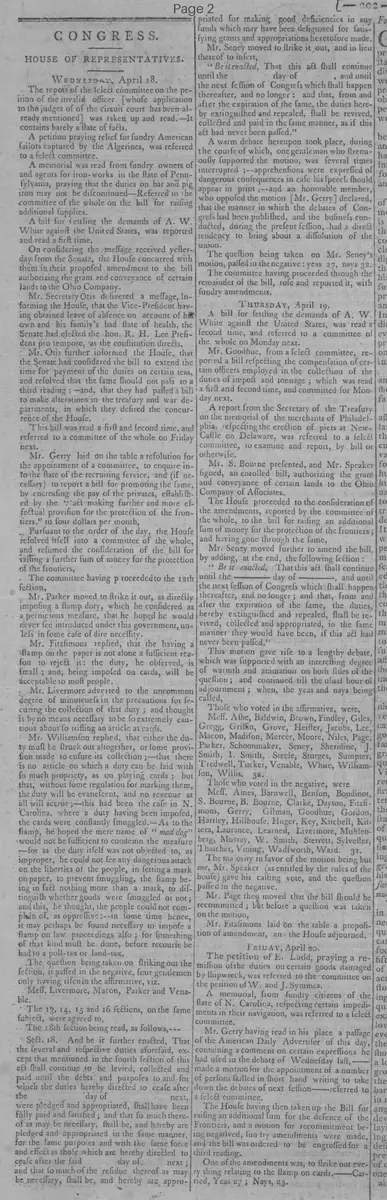
HOUSE OF REPRESENTATIVES.
Wednesday April 18.
The report of the select committee on the petition of the invalid officers whose application to the judges of the circuit court has been already mentioned, was taken up and read. It contains barely a state of facts.
A petition praying relief for sundry American sailors captured by the Algerines, was referred to a select committee.
A memorial was read from sundry owners of and agents for iron-works in the state of Pennsylvania, praying that the duties on bar and pig iron may not be discontinued. Referred to the committee of the whole on the bill for raising additional supplies.
A bill for settling the demands of A. W. White against the United States, was reported and read a first time.
On considering the message received yesterday from the Senate, the House concurred with them in their proposed amendment to the bill authorizing the grant and conveyance of certain lands to the Ohio Company.
Mr. Secretary Otis delivered a message, informing the House, that the Vice-President having obtained leave of absence on account of his own and his family's bad state of health, the Senate had elected the hon. R. H. Lee President pro tempore, as the constitution directs.
Mr. Otis further informed the House, that the Senate had considered the bill to extend the time for payment of the duties on certain teas, and resolved that the same should not pass to a third reading: —and, that they had passed a bill to make alterations in the treasury and war departments, in which they desired the concurrence of the House.
This bill was read a first and second time, and referred to a committee of the whole on Friday next.
Mr. Gerry laid on the table a resolution for the appointment of a committee, to enquire into the state of the recruiting service, and (if necessary) to report a bill for promoting the same, by increasing the pay of the privates, established by the act making further and more effectual provision for the protection of the frontiers, to four dollars per month.
Pursuant to the order of the day, the House resolved itself into a committee of the whole, and resumed the consideration of the bill for raising a further sum of money for the protection of the frontiers.
The committee having proceeded to the 12th section,
Mr. Parker moved to strike it out, as directly imposing a stamp duty, which he considered as a pernicious measure, that he hoped he would never see introduced under this government, unless in some case of dire necessity.
Mr. Fitzsimons replied, that the having a stamp on the paper is not alone a sufficient reason to reject it: the duty, he observed, is small; and, being imposed on cards, will be acceptable to most people.
Mr. Livermore adverted to the uncommon degree of minuteness in the precautions for securing the collection of that duty; and thought it by no means necessary to be so extremely cautious about so trifling an article as cards.
Mr. Williamson replied, that either the duty must be struck out altogether, or some provision made to ensure its collection;—that there is no article on which a duty can be laid with so much propriety, as on playing cards; but that, without some regulation for marking them, the duty will be evanescent, and no revenue at all will accrue; this had been the case in N. Carolina, where a duty having been imposed, the cards were constantly smuggled.—As to the stamp, he hoped the mere name of "mad dog" would not be sufficient to condemn the measure —for as the duty itself was not objected to, as improper, he could not see any dangerous attack on the liberties of the people, in setting a mark on paper, to prevent smuggling, the stamp being in fact nothing more than a mark, to distinguish whether goods were smuggled or not; and this, he thought, the people could not complain of, as oppressive:—in some time hence, it may perhaps be found necessary to impose a stamp on law proceedings also; for something of that kind must be done, before recourse be had to a poll-tax or land-tax.
The question being taken on striking out the section, it passed in the negative, four gentlemen only having risen in the affirmative, viz.
Mess. Livermore, Macon, Parker and Venable.
The 13, 14, 15 and 16 sections, on the same subject, were agreed to.
The 18th section being read, as follows,— —
Sect. 18. And be it further enacted, That the several and respective duties aforesaid, except that mentioned in the fourth section of this act shall continue to be levied, collected and paid until the debts and purposes to and for which the duties hereby directed to cease after the
day of
next,
were pledged and appropriated, shall have been fully paid and satisfied; and that so much thereof as may be necessary, shall be, and hereby are pledged and appropriated in the same manner, for the same purposes and with the same force and effect as those which are hereby directed to cease after the said
day of.
next;
and that so much of the residue thereof as may be necessary, shall be, and hereby are appro-
priated for making good deficiencies in any funds which may have been designated for satisfying grants and appropriations heretofore made.
Mr. Seney moved to strike it out, and in lieu thereof to insert,
" Be it enacted, That this act shall continue until the
day of
, and until
the next session of Congress which shall happen thereafter, and no longer: and that, from and after the expiration of the same, the duties hereby extinguished and repealed, shall be revived, collected and paid in the same manner, as if this act had never been passed."
A warm debate hereupon took place, during the course of which, one gentleman who strenuously supported the motion, was several times interrupted ;—apprehensions were expressed of dangerous consequences in case his speech should appear in print ,—and an honorable member, who opposed the motion [Mr. Gerry] declared, that the manner in which the debates of Congress had been published, and the business conducted, during the present session,—had a direct tendency to bring about a dissolution of the union.
The question being taken on Mr. Seney's motion, passed in the negative: yeas 27, nays 32.
The committee having proceeded through the remainder of the bill, rose and reported it, with sundry amendments.
THURSDAY, April 19.
A bill for settling the demands of A. W. White against the United States, was read a second time, and referred to a committee of the whole on Monday next.
Mr. Goodhue, from a select committee, reported a bill respecting the compensation of certain officers employed in the collection of the duties of impost and tonnage; which was read a first and second time, and committed for Monday next.
A report from the Secretary of the Treasury on the memorial of the merchants of Philadelphia, respecting the erection of piers at New-Castle on Delaware, was referred to a select committee, to examine and report, by bill or otherwise.
Mr. S. Bourne presented, and Mr. Speaker signed, an enrolled bill, authorizing the grant and conveyance of certain lands to the Ohio Company of Associates.
The House proceeded to the consideration of the amendments, reported by the committee of the whole, to the bill for raising an additional sum of money for the protection of the frontiers; and having gone through the same,
Mr. Seney moved further to amend the bill, by adding, at the end, the following section:
Be it enacted, That this act shall continue until the
day of
, and until
the next session of Congress which shall happen thereafter, and no longer; and that, from and after the expiration of the same, the duties,
hereby extinguished and repealed, shall be revived, collected and appropriated, in the same manner they would have been, if this act had never been passed,
This motion gave rise to a lengthy debate, which was supported with an interesting degree
of warmth and animation on both sides of the question; and continued till the usual hour of adjournment; when, the yeas and nays being called,
Those who voted in the affirmative, were,
Mess. Ashe, Baldwin, Brown, Findley, Giles, Gregg, Griffin, Grove, Hiester, Jacobs, Lee, Macon, Madison, Mercer, Moore, Niles, Page, Parker, Schoonmaker, Seney, Sheridan, J. Smith, I. Smith, Steele, Sturges, Sumter, Tredwell, Tucker, Venable, White, Williamson, Willis. 32.
Those who voted in the negative, were
Mess. Ames, Barnwell, Benson, Boudinot, S. Bourne, B. Bourne, Clarke, Dayton, Fitzsimons, Gerry, Gilman, Goodhue, Gordon, Hartley, Hillhouse, Huger, Key, Kitchell, Kittera, Laurance, Learned, Livermore, Muhlenberg, Murray, W. Smith, Sterrett, Sylvester, Thatcher, Vining, Wadsworth, Ward. 31.
The majority in favor of the motion being but one, Mr. Speaker (as entitled by the rules of the house) gave his casting vote, and the question passed in the negative.
Mr. Page then moved that the bill should be recommitted; but before a question was taken on the motion,
Mr. Fitzsimons laid on the table a proposition of amendment, and the House adjourned.
FRIDAY, April 20.
The petition of E. Ladd, praying a remission of the duties on certain goods damaged by shipwreck, was referred to the committee on the petition of W. and I. Symmes,
A memorial, from sundry citizens of the state of N. Carolina, respecting certain impediments in their navigation, was referred to a select committee.
Mr. Gerry having read in his place a passage of the American Daily Advertiser of this day, containing a comment on certain expressions he had used in the debate of Wednesday last, —
made a motion for the appointment of a number of persons skilled in short hand writing to take down the debates of next session—referred to a select committee.
The House having then taken up the Bill for raising an additional sum for the defence of the Frontiers, and a motion for recommitment being negatived, sundry amendments were made, and the bill was ordered to be engrossed for a third reading.
One of the amendments was, to strike out every thing relating to the stamp on cards.—Carried, Yeas 27; Nays, 25.
What sub-type of article is it?
What keywords are associated?
What entities or persons were involved?
Domestic News Details
Event Date
April 18 20
Key Persons
Outcome
various motions and amendments debated and voted on; stamp duty on cards struck out (yeas 27, nays 25); bill for frontier protection advanced to third reading; senate elects r. h. lee president pro tempore.
Event Details
House considers reports, petitions, and bills including relief for sailors and iron works owners; concurs with Senate on Ohio Company lands; receives Senate messages on Vice-President's absence and department bills; debates recruiting service and frontier funding bill, including stamp duties on cards and bill duration, with votes rejecting motions to strike sections and limit duration.