Thank you for visiting SNEWPapers!
Sign up free
Literary
June 3, 1880
The Northern Pacific Farmer
Wadena, Wadena County, Minnesota
What is this article about?
A poor boy, Geoffrey Baird, is wrongly accused of stealing a watch from his employer, Abraham Hoyt. His employer's daughter, Daisy, gives him a gold piece as a talisman of her belief in his innocence. Years later, inheriting a fortune and changing his name to Willard Wharton, he reunites with Daisy, revealing the gold piece as a symbol of their enduring bond, leading to marriage.
Clipping
OCR Quality
95%
Excellent
Full Text
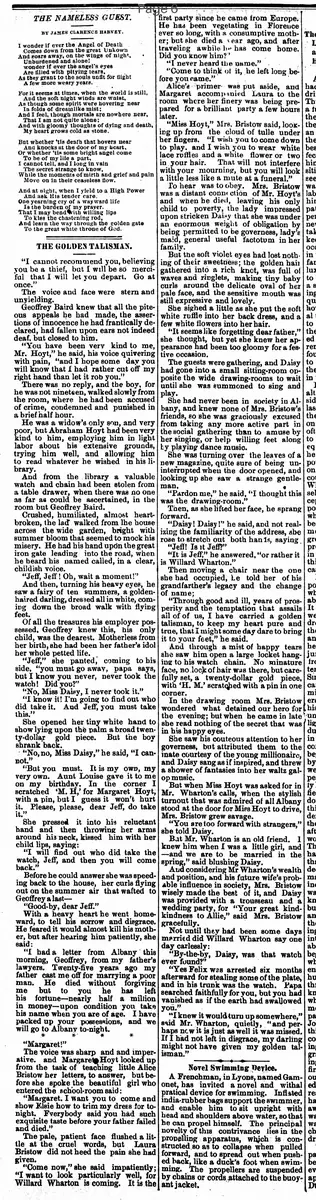
THE GOLDEN TALISMAN.
"I cannot recommend you, believing you be a thief, but I will be so merciful that I will let you depart. Go at once."
The voice and face were stern and unyielding.
Geoffrey Baird knew that all the piteous appeals he had made, the assertions of innocence he had frantically declared, had fallen upon ears not indeed deaf, but closed to him.
"You have been very kind to me. Mr. Hoyt," he said, his voice quivering with pain, "and I hope some day you will know that I had rather cut off my right hand than let it rob you."
There was no reply, and the boy, for he was not nineteen, walked slowly from the room, where he had been accused of crime, condemned and punished in a brief half hour.
He was a widow's only son, and very poor, but Abraham Hoyt had been very kind to him, employing him in light labor about his extensive grounds, trying him well, and allowing him to read whatever he wished in his library.
And from the library a valuable watch and chain had been stolen from a table drawer, when there was no one as far as could be ascertained, in the room but Geoffrey Baird.
Crushed, humiliated, almost heart broken, the lad walked from the house across the wide garden, bright with summer bloom that seemed to mock his misery. He had his hand upon the great iron gate leading into the road, when he heard his name called, in a clear, childish voice.
"Jeff! Jeff! Oh, wait a moment!"
And then, turning his heavy eyes, he saw a fairy of ten summers, a golden-haired darling, dressed all in white, coming down the broad walk with flying feet.
Of all the treasures his employer possessed, Geoffrey knew this, his only child, was the dearest. Motherless from her birth, she had been her father's idol her whole petted life.
"Jeff," she panted, coming to his side, "you must go away, papa says, but I know you never, never took the watch! Did you?"
"No, Miss Daisy, I never took it."
"I know it! I'm going to find out who did take it. And Jeff, you must take this."
She opened her tiny white hand to show lying upon the palm a broad twenty-dollar gold piece.
But the boy shrank back.
"No, no, Miss Daisy," he said, "I cannot."
"But you must. It is my own, my very own. Aunt Louise gave it to me on my birthday. In the corner I scratched 'M. H.' for Margaret Hoyt, with a pin, but I guess it won't hurt it. Please, please, dear Jeff, do take it."
She pressed it into his reluctant hand and then throwing her arms around his neck, kissed him with her child lips, saying:
"I will find out who did take the watch, Jeff, and then you will come back."
Before he could answer she was speeding back to the house, her curls flying out on the summer air that wafted to Geoffrey a last-
"Good-by, dear Jeff."
With a heavy heart he went homeward, to tell his sorrow and disgrace. He feared it would almost kill his mother, but after hearing him patiently, she said:
"I had a letter from Albany this morning, Geoffrey, from my father's lawyers. Twenty-five years ago my father cast me off for marrying a poor man. He died without forgiving me but to you he has left his fortune—nearly half a million in money—upon condition you take his name when you are of age. I have packed up your possessions, and we will go to Albany to-night."
"Margaret!"
The voice was sharp and imperative, and Margaret Hoyt looked up from the task of teaching little Alice Bristow her letters, to answer, but before she spoke the beautiful girl who entered the school-room said:
"Margaret, I want you to come and show Elsie how to trim my dress for to-night. Everybody said you had such exquisite taste before your father failed and died."
The pale, patient face flushed a little at the cruel words, but Laura Bristow did not heed the pain she had given.
"Come now," she said impatiently; "I want to look particularly well, for Willard Wharton is coming. It is the first party since he came from Europe. He has been vegetating in Florence ever so long, with a consumptive mother; but she died a year ago, and after traveling awhile he has come home. Did you know him?"
"I never heard the name."
"Come to think of it, he left long before you came."
Alice's primer was put aside, and Margaret accompanied Laura to the room where her finery was being prepared for a brilliant party a few hours later.
"Miss Hoyt," Mrs. Bristow said, looking up from the cloud of tulle under her fingers. "I wish you to come down to play, and I wish you to wear white lace ruffles and a white flower or two in your hair. That will not interfere with your mourning, but you will look a little less like a mute at a funeral."
To hear was to obey. Mrs. Bristow was a distant connection of Mr. Hoyt's and when he died, leaving his only child to poverty, the lady impressed upon stricken Daisy that she was under an enormous weight of obligation by being permitted to be governess, lady's maid, general useful factotum in her family.
But the soft violet eyes had lost nothing of their sweetness; the golden hair gathered into a rich knot, was full of waves and ringlets, making tiny baby curls around the delicate oval of her pale face, and the sensitive mouth was still expressive and lovely.
She sighed a little as she put the soft white ruffle into her back dress, and a few white flowers into her hair.
"It seems like forgetting dear father," she thought, but yet she knew her appearance had been too gloomy for a festive occasion.
The guests were gathering, and Daisy had gone into a small sitting-room opposite the wide drawing-rooms to wait until she was summoned to sing and play.
She had never been in society in Albany, and knew none of Mrs. Bristow's friends, so she was graciously excused from taking any more active part in the social gathering than to amuse by her singing, or help willing feet along by playing dance music.
She was turning over the leaves of a new magazine, quite sure of being uninterrupted when the door opened, and looking up she saw a strange gentleman,
"Pardon me," he said, "I thought this was the drawing-room."
Then, as she lifted her face, he sprang forward.
"Daisy! Daisy!" he said, and not realizing the familiarity of the address, she rose to stretch out both hands, saying.
"Jeff! Is it Jeff?"
"It is Jeff," he answered, "or rather it is Willard Wharton.
Then moving a chair near the one she had occupied, he told her of his grandfather's legacy and the change of name;
"Through good and ill, years of prosperity and the temptation that assails all of us, I have carried a golden talisman, to keep my heart pure and true, that I might some day dare to bring it to your feet," he said.
And through a mist of happy tears she saw him open a large locket hanging to his watch chain. No miniature face, no lock of hair was there, but carefully set, a twenty-dollar gold piece, with 'M. H.' scratched with a pin in one corner.
In the drawing room Mrs. Bristow wondered what detained our hero for the evening; but when he came in late she read nothing of the secret that was in his happy eyes.
She saw his courteous attention to her governess, but attributed them to the innate courtesy of the young millionaire, and Daisy sang as if inspired, and threw a shower of fantasies into her waltz gallop music.
But when Miss Hoyt was asked for in Mr. Wharton's calls, when the stylish turnout that was admired of all Albany stood at the door for Miss Hoyt to drive, Mrs. Bristow grew savage.
"You are too forward with strangers," she told Daisy.
But Mr. Wharton is an old friend. I knew him when I was a little girl, and —and we are to be married in the spring," said blushing Daisy.
And considering Mr. Wharton's wealth and position, and his future wife's probable influence in society, Mrs. Bristow wisely made the best of it, and Daisy was provided with a trousseau and a wedding party, for "Your great kindness to Allie," said Mrs. Bristow gracefully.
Not until they had been some days married did Willard Wharton say one day carelessly:
"By-the-by, Daisy, was that watch ever found?"
"Yes; Felix was arrested six months afterward for stealing some of the plate and in his trunk was the watch. Papa searched faithfully for you, but you had vanished as if the earth had swallowed you."
"I knew it would turn up somewhere," said Mr. Wharton, quietly, "and perhaps now it is just as well it was missed. If I had not left in disgrace, my darling might not have given me my golden talisman."
"I cannot recommend you, believing you be a thief, but I will be so merciful that I will let you depart. Go at once."
The voice and face were stern and unyielding.
Geoffrey Baird knew that all the piteous appeals he had made, the assertions of innocence he had frantically declared, had fallen upon ears not indeed deaf, but closed to him.
"You have been very kind to me. Mr. Hoyt," he said, his voice quivering with pain, "and I hope some day you will know that I had rather cut off my right hand than let it rob you."
There was no reply, and the boy, for he was not nineteen, walked slowly from the room, where he had been accused of crime, condemned and punished in a brief half hour.
He was a widow's only son, and very poor, but Abraham Hoyt had been very kind to him, employing him in light labor about his extensive grounds, trying him well, and allowing him to read whatever he wished in his library.
And from the library a valuable watch and chain had been stolen from a table drawer, when there was no one as far as could be ascertained, in the room but Geoffrey Baird.
Crushed, humiliated, almost heart broken, the lad walked from the house across the wide garden, bright with summer bloom that seemed to mock his misery. He had his hand upon the great iron gate leading into the road, when he heard his name called, in a clear, childish voice.
"Jeff! Jeff! Oh, wait a moment!"
And then, turning his heavy eyes, he saw a fairy of ten summers, a golden-haired darling, dressed all in white, coming down the broad walk with flying feet.
Of all the treasures his employer possessed, Geoffrey knew this, his only child, was the dearest. Motherless from her birth, she had been her father's idol her whole petted life.
"Jeff," she panted, coming to his side, "you must go away, papa says, but I know you never, never took the watch! Did you?"
"No, Miss Daisy, I never took it."
"I know it! I'm going to find out who did take it. And Jeff, you must take this."
She opened her tiny white hand to show lying upon the palm a broad twenty-dollar gold piece.
But the boy shrank back.
"No, no, Miss Daisy," he said, "I cannot."
"But you must. It is my own, my very own. Aunt Louise gave it to me on my birthday. In the corner I scratched 'M. H.' for Margaret Hoyt, with a pin, but I guess it won't hurt it. Please, please, dear Jeff, do take it."
She pressed it into his reluctant hand and then throwing her arms around his neck, kissed him with her child lips, saying:
"I will find out who did take the watch, Jeff, and then you will come back."
Before he could answer she was speeding back to the house, her curls flying out on the summer air that wafted to Geoffrey a last-
"Good-by, dear Jeff."
With a heavy heart he went homeward, to tell his sorrow and disgrace. He feared it would almost kill his mother, but after hearing him patiently, she said:
"I had a letter from Albany this morning, Geoffrey, from my father's lawyers. Twenty-five years ago my father cast me off for marrying a poor man. He died without forgiving me but to you he has left his fortune—nearly half a million in money—upon condition you take his name when you are of age. I have packed up your possessions, and we will go to Albany to-night."
"Margaret!"
The voice was sharp and imperative, and Margaret Hoyt looked up from the task of teaching little Alice Bristow her letters, to answer, but before she spoke the beautiful girl who entered the school-room said:
"Margaret, I want you to come and show Elsie how to trim my dress for to-night. Everybody said you had such exquisite taste before your father failed and died."
The pale, patient face flushed a little at the cruel words, but Laura Bristow did not heed the pain she had given.
"Come now," she said impatiently; "I want to look particularly well, for Willard Wharton is coming. It is the first party since he came from Europe. He has been vegetating in Florence ever so long, with a consumptive mother; but she died a year ago, and after traveling awhile he has come home. Did you know him?"
"I never heard the name."
"Come to think of it, he left long before you came."
Alice's primer was put aside, and Margaret accompanied Laura to the room where her finery was being prepared for a brilliant party a few hours later.
"Miss Hoyt," Mrs. Bristow said, looking up from the cloud of tulle under her fingers. "I wish you to come down to play, and I wish you to wear white lace ruffles and a white flower or two in your hair. That will not interfere with your mourning, but you will look a little less like a mute at a funeral."
To hear was to obey. Mrs. Bristow was a distant connection of Mr. Hoyt's and when he died, leaving his only child to poverty, the lady impressed upon stricken Daisy that she was under an enormous weight of obligation by being permitted to be governess, lady's maid, general useful factotum in her family.
But the soft violet eyes had lost nothing of their sweetness; the golden hair gathered into a rich knot, was full of waves and ringlets, making tiny baby curls around the delicate oval of her pale face, and the sensitive mouth was still expressive and lovely.
She sighed a little as she put the soft white ruffle into her back dress, and a few white flowers into her hair.
"It seems like forgetting dear father," she thought, but yet she knew her appearance had been too gloomy for a festive occasion.
The guests were gathering, and Daisy had gone into a small sitting-room opposite the wide drawing-rooms to wait until she was summoned to sing and play.
She had never been in society in Albany, and knew none of Mrs. Bristow's friends, so she was graciously excused from taking any more active part in the social gathering than to amuse by her singing, or help willing feet along by playing dance music.
She was turning over the leaves of a new magazine, quite sure of being uninterrupted when the door opened, and looking up she saw a strange gentleman,
"Pardon me," he said, "I thought this was the drawing-room."
Then, as she lifted her face, he sprang forward.
"Daisy! Daisy!" he said, and not realizing the familiarity of the address, she rose to stretch out both hands, saying.
"Jeff! Is it Jeff?"
"It is Jeff," he answered, "or rather it is Willard Wharton.
Then moving a chair near the one she had occupied, he told her of his grandfather's legacy and the change of name;
"Through good and ill, years of prosperity and the temptation that assails all of us, I have carried a golden talisman, to keep my heart pure and true, that I might some day dare to bring it to your feet," he said.
And through a mist of happy tears she saw him open a large locket hanging to his watch chain. No miniature face, no lock of hair was there, but carefully set, a twenty-dollar gold piece, with 'M. H.' scratched with a pin in one corner.
In the drawing room Mrs. Bristow wondered what detained our hero for the evening; but when he came in late she read nothing of the secret that was in his happy eyes.
She saw his courteous attention to her governess, but attributed them to the innate courtesy of the young millionaire, and Daisy sang as if inspired, and threw a shower of fantasies into her waltz gallop music.
But when Miss Hoyt was asked for in Mr. Wharton's calls, when the stylish turnout that was admired of all Albany stood at the door for Miss Hoyt to drive, Mrs. Bristow grew savage.
"You are too forward with strangers," she told Daisy.
But Mr. Wharton is an old friend. I knew him when I was a little girl, and —and we are to be married in the spring," said blushing Daisy.
And considering Mr. Wharton's wealth and position, and his future wife's probable influence in society, Mrs. Bristow wisely made the best of it, and Daisy was provided with a trousseau and a wedding party, for "Your great kindness to Allie," said Mrs. Bristow gracefully.
Not until they had been some days married did Willard Wharton say one day carelessly:
"By-the-by, Daisy, was that watch ever found?"
"Yes; Felix was arrested six months afterward for stealing some of the plate and in his trunk was the watch. Papa searched faithfully for you, but you had vanished as if the earth had swallowed you."
"I knew it would turn up somewhere," said Mr. Wharton, quietly, "and perhaps now it is just as well it was missed. If I had not left in disgrace, my darling might not have given me my golden talisman."
What sub-type of article is it?
Prose Fiction
What themes does it cover?
Love Romance
Moral Virtue
What keywords are associated?
Golden Talisman
Stolen Watch
Innocent Boy
Child's Gift
Romantic Reunion
Literary Details
Title
The Golden Talisman.
Key Lines
She Opened Her Tiny White Hand To Show Lying Upon The Palm A Broad Twenty Dollar Gold Piece.
And Through A Mist Of Happy Tears She Saw Him Open A Large Locket Hanging To His Watch Chain. No Miniature Face, No Lock Of Hair Was There, But Carefully Set, A Twenty Dollar Gold Piece, With 'M. H.' Scratched With A Pin In One Corner.