Thank you for visiting SNEWPapers!
Sign up free
Virginia Argus
Richmond, Virginia
What is this article about?
In the U.S. House of Representatives on Wednesday, May 6, 1812, a heated debate occurred over a memorial from 800 Albany, NY residents protesting the embargo policy and seeking relief. The motion to postpone consideration until July 4 passed 58-30, amid discussions on war, economic distress, and political divisions involving speakers like Randolph, Calhoun, and Grundy.
Clipping
OCR Quality
Full Text
Extract to the Editors, dated Washington, May 7.
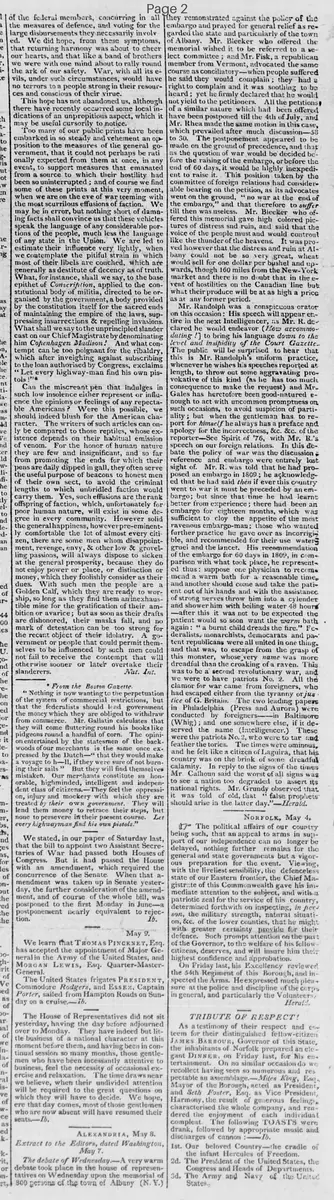
The debate of Wednesday.—A very warm debate took place in the house of representatives on Wednesday upon the memorial of 800 persons of the town of Albany (N. Y.) they remonstrated against the policy of the embargo and prayed for general relief as regarded the state and particularly of the town of Albany. Mr. Bleeker who offered the memorial wished it to be referred to a select committee; and Mr. Fisk, a republican member from Vermont, advocated the same course as conciliatory—when people suffered he said they would complain; they had a right to complain and it was soothing to be heard; yet he firmly declared that he would not yield to the petitioners. All the petitions of a similar nature which had been offered have been postponed till the 4th of July, and Mr. Rhea made the same motion in this case, which prevailed after much discussion—58 to 30. The postponement appeared to be made on the ground of precedence, and that as the question of war would be decided before the raising of the embargo, or before the end of 60 days, it would be highly inexpedient to raise it. This position taken by the committee of foreign relations had considerable bearing on the petition, as its advocates went on the ground, 'no war at the end of the embargo,' and that therefore to suffer till then was useless. Mr. Bleeker who offered this memorial gave high colored pictures of distress and ruin, and said that the voice of the people must and would controul like the thunder of the heavens. It was proved however that the distress and ruin at Albany could not be so very great, wheat would sell for one dollar per bushel and upwards, though 160 miles from the New-York market and there is no doubt that in the event of hostilities on the Canadian line but what their produce will be at as high a price as at any former period.
Mr. Randolph was a conspicuous orator on this occasion: His speech will appear entire in the next Intelligencer, as Mr. R. declared he would endeavor (How accommodating!) to bring his language down to the level and insipidity of the Court Gazette. The public will be surprised to hear that this is Mr. Randolph's uniform practice. whenever he wishes his speeches reported at length, to throw out some aggravating provocative of this kind (as he has too much consequence to make the request) and Mr. Gales has heretofore been good-natured enough to act with uncommon promptness on such occasions, to avoid suspicion of partiality; but when the gentleman has. to report for himself he always has a preface and apology for the incorrectness, &c. &c. of the reporter—See Spirit of '76, with Mr. R.'s speech on our foreign relations. In this debate the policy of war was the discussion reference and embargo were entirely lost sight of. Mr. R. was told that he had proposed an embargo in 1809; he acknowledged that he had said then if ever this country went to war it must be preceded by an embargo; but since that time he had learnt better from experience; there had been an embargo for eighteen months, which was sufficient to cloy the appetite of the most ravenous embargo-man; those who wanted further practice he gave over as incorrigible, and recommended for their use water gruel and the lancet. His recommendation of the embargo for 60 days in 1809, in comparison with what took place, he represented thus: suppose one physician to recommend a warm bath for a reasonable time and another should come and take the patient out of his hands and with the assistance of strong nerves throw him into a cylinder and shower him with boiling water 48 hours—after this it was not to be expected the patient would so soon want the warm bath again: 'a burnt child dreads the fire.' Federalists, monarchists, democrats and patent republicans were all united in one thing. and that was, to escape from the grasp of this monster, whose very name was more dreadful than the croaking of a raven. This was to be a second revolutionary war, and we were to have patriots No. 2. All the clamor for war came from foreigners, who had escaped either from the tyranny or justice of G. Britain. The two leading papers in Philadelphia (Press and Aurora) were conducted by foreigners—in Baltimore (Whig); and one somewhere else, if it deserved the name (Intelligencer.) These were the patriots No. 2, who were to tar and feather the tories. The times were ominous. and he felt like a citizen of Laguira, that his country was on the brink of some dreadful calamity. In reply to the signs of the times Mr Calhoun said the worst of all signs was to see a nation too degraded to assert its national rights. Mr. Grundy observed that it was told of old, that 'false prophets should arise in the latter day.'
Herald.
What sub-type of article is it?
What keywords are associated?
What entities or persons were involved?
Where did it happen?
Domestic News Details
Primary Location
Washington
Event Date
Wednesday, May 1812
Key Persons
Outcome
motion to postpone the memorial until july 4 passed 58 to 30.
Event Details
A debate in the House of Representatives on a memorial from 800 Albany residents against the embargo policy, advocating postponement due to impending war decisions; speakers highlighted economic distress claims but noted wheat prices remained viable; discussion shifted to war policy and embargo criticisms.