Thank you for visiting SNEWPapers!
Sign up free
Nashville Union And American
Nashville, Davidson County, Tennessee
What is this article about?
Hon. Percy Walker, a Know Nothing congressman from Alabama, explains in a House speech his decision to support Democratic nominee James Buchanan over American Party's Millard Fillmore in the 1856 presidential election, citing Fillmore's acceptance of a platform that weakens Southern rights on slavery and the Missouri Compromise repeal.
Clipping
OCR Quality
Full Text
[Mr. Walker is the Know Nothing Member of Congress from the Mobile, (Ala.) District, and a Delegate to the Convention that nominated Mr. Fillmore for the Presidency.]
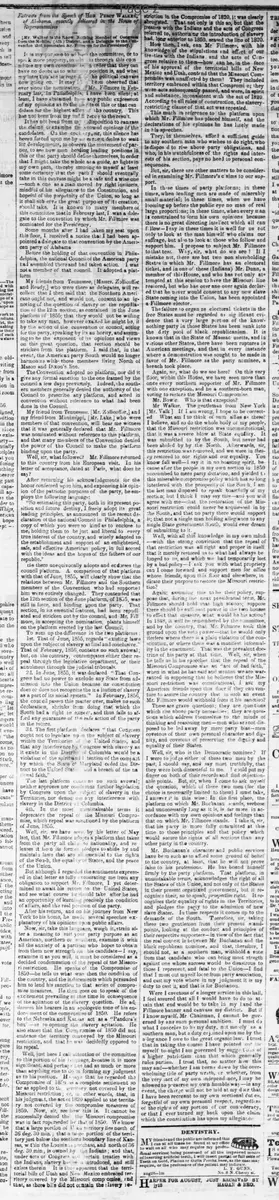
It is my purpose to address the committee, or to speak more properly, to write myself through this committee my own constitution in order that they can have no doubt as to where my position is, and what my intentions are in regard to the political canvass now going on. It may have been observed that ever since the nomination of Mr. Fillmore in February last, in Philadelphia, I have been silent; at least, I have abstained from any public expression of my opinions as to the merits of this or that candidate for the highest office in the country. This has not been from my indifference to the result. It has not been from my indisposition to canvass the claims or examine the avowed opinions of the candidates. On the contrary, sir, this silence has been forced upon me by an earnest desire to wait for developments, to observe the movement of parties, to see how men holding leading positions in this or that party should define themselves, in order that I might take the whole as a guide, as lights in my own path, thereby insuring to myself at least some certainty that the path I should eventually take in this Canvass might be a safe and a wise one—such a one as a man moved by right instincts, mindful of his allegiance to the Constitution, and hopeful of the perpetuity of the Union, so long as it shall subserve the great purposes of its creation, should take. It is known to many members of this committee that in February last, I was a delegate to the convention by which Mr. Fillmore was nominated for the Presidency.
Some months after I had taken my seat upon this floor, I received a notice that I had been appointed a delegate to that convention by the American party of Alabama. Before the holding of that convention in Philadelphia, the national Council of the American party had assembled there and had taken action. I was not a member of that council. It adopted a platform. My friends from Tennessee, [Messrs. Zollicoffer and Ready,] who were there as delegates, will recollect that I then said that the Southern Americans ought not, and would not, consent to an ignoring of the question of slavery or the repudiation of the 12th section, as contained in the June platform of 1855; that they would not be willing to take any man, however exalted he might be, if by the action of the convention or council, acting for the party, speaking by its authority, and assuming to be the exponent of its opinions and views on this great question, that section should be stricken from the platform. I said that, in that event, the American party South would no longer harmonize with those members living North of Mason and Dixon's line.
The Convention adopted no platform, nor did it give any formal sanction to the one framed by the council a few days previously. Indeed, the southern members generally denied the authority of the Council to prescribe any platform, and acted in convention without reference to what had been done in the Council. My friend from Tennessee, [Mr. Zollicoffer,] and my friend from Mississippi, [Mr. Lake,] who were members of that convention, will bear me witness that it was generally declared that Mr. Fillmore was nominated without reference to this platform, and that many members of the Convention denied the power of the Council to make the platform binding upon the party.
Well, sir, what followed? Mr. Fillmore returned to this country from his European visit. In his letter of acceptance, dated at Paris, what does he say?
After returning his acknowledgments for the honor conferred upon him, and expressing his opinion of the patriotic purposes of the party, he employs the following language:
"So estimating this party, both in its present position and future destiny, I freely adopt its great leading principles, as announced in the recent declaration of the national Council in Philadelphia, a copy of which you were so kind as to enclose to me, holding them to be just and liberal to every true interest of the country, and wisely adapted to the establishment and support of an enlightened, safe, and effective American policy, in full accord with the ideas and the hopes of the fathers of our republic."
He there unequivocally adopts and endorses the council platform. A comparison of that platform with that of June, 1855, will clearly show that the relations between Mr. Fillmore and the Southern members of the Convention who had supported him were entirely changed. They contended that the 12th section of the June platform, of 1855, was still in force, and binding upon the party. That section, in its essential features, had been repudiated and stricken out by the council, and Mr. Fillmore, in accepting the nomination, plants himself on the platform erected by the last Council.
To sum up the difference in the two platforms:
1st. That of June, 1855, regards "existing laws upon the subject of slavery as final and conclusive."
That of February, 1856, contains no such avowal; but, on the contrary, contemplates either their repeal through the legislative department, or their annulment through the judicial tribunals.
2d. In June, 1855, it was declared "That Congress had no power to exclude any State from admission into the Union because its constitution does or does not recognize the institution of slavery as a part of its social system." In February, 1856, the council passes this matter over, makes no such declaration, shrinks from doing that which the South had a right to expect, and thus fails to afford any guarantee of the safe action of the party in the future.
3d. The first platform declares "that Congress ought not to legislate upon the subject of slavery within the Territories of the United States, and that any interference by Congress with slavery as it exists in the District of Columbia would be a violation of the spirit and intention of the compact by which the State of Maryland ceded the District to the United States and a breach of the national faith."
The last platform utters no such avowal; neither approves nor condemns further legislation by Congress upon the subject of slavery in the Territories, nor denounces any interference with slavery in the District of Columbia.
4th. In the most unmistakable terms it deprecates the repeal of the Missouri Compromise, which repeal was sanctioned by the platform of June, 1855.
Well, sir, we have seen by his letter of May last, that Mr. Fillmore adopts a platform that takes from the party all claim to nationality, and releases it from its former pledges to abide by and maintain laws that are all essential to the rights of the South, the equality of States, and the peace of the Union.
But although I regarded the sentiments expressed in that letter as fully exonerating me from any obligation to support Mr. Fillmore, I yet determined to await his return to the United States and see what course he should take after he had an opportunity of learning precisely the condition of affairs, and the real position of the party.
After his return, and on his journey from New York to his home, he made several speeches explanatory of his opinions upon public affairs.
Now, sir, take this language, weigh it, strain after a meaning to suit your party purpose as an American, northern or southern, examine it with all the anxiety of a partisan who hopes to obtain from them new strength for his candidate—I say, examine it as you will, it must be considered as a decided condemnation of the repeal of the Missouri restriction. He speaks of the Compromise of 1850—he tells us what was then the condition of the country, and the inducements which persuaded him to lend his sanction to that series of compromise measures. He then goes on to speak of the excitement prevailing at this time in consequence of the agitation of the slavery question. He addresses his hearers in an apologetic tone of his endorsement of the compromise of 1850. He refers to the Nebraska and Kansas act as a "Pandora's box"—as re-opening the slavery agitation. He also states that the Compromise of 1850 did not embrace the territory conveyed by the Missouri restriction, and that he was decidedly opposed to its repeal.
Well, just here I call attention of the committee to this portion of his language, because it is more significant, and perhaps has had as much or more than anything else to do in forming my judgment as to his position. He says that he regarded the Compromise of 1850 as a complete settlement so far as applied to the territory not covered by the Missouri restriction; or, in other words, that, in his judgment, the act of 1820 applied to the territory not covered by the compromise measures of 1850. Now, sir, see how this is. It cannot be successfully denied that the Missouri compromise was in fact superseded by that of 1850. We know that a large portion of our territory lies north of 36 deg. 30 min.; that a large portion of the territory just below the southern boundary line of Kansas, within the Louisiana Purchase, and north of 36 deg. 30 min., is owned by the Indians: and that, under acts of Congress and certain treaties with the Indians, slavery has been introduced, and still exists therein. It is thus apparent that the territorial bills of Utah and New Mexico embraced territory covered by the Missouri compromise, and that, as those bills did not contain the slavery restriction in the Compromise of 1820, it was clearly abrogated. That not only is this so, but that the treaties with the Indians and the acts of Congress referred to, authorizing the introduction of slavery had, long anterior to 1850, erased the line of 1820.
How then, I ask, can Mr. Fillmore, with his knowledge of the stipulations and effect of our treaties with the Indians, and the acts of Congress relative to them—how can he, in the face of his approval of the territorial bills of New Mexico and Utah, contend that the Missouri Compromise was unaffected by them! They included territory embraced within that Compromise; they were acts subsequently passed, and were, in spirit and substance, inconsistent with the act of 1820. According to all rules of construction, the slavery-restricting clause of that act was repealed.
This much in reference to the platform upon which Mr. Fillmore has placed himself, and the declarations of his opinions he has lately made in his speeches.
They, in themselves, afford a sufficient guide to any southern man who wishes to do right, who is disposed to rise above party obligations, and who, in his watchfulness of the rights and interests of his section, pays no heed to personal consequences.
But, sir, there are other matters to be considered in examining Mr. Fillmore's claims to our support.
In these times of party platforms; in these times, when leading men are made of miserably small material; in these times, when we have looming up before the public eye no man of real large proportions: in these times, when every man is constrained to form his own opinions because there is no great directing intellect which all can follow—I say in these times it is well for us not only to look at the man himself who claims our suffrage, but also to look at those who follow and support him. I propose to subject Mr. Fillmore to that test. Why, sir, what do we see? If I mistake not, there are but two non slaveholding States in which Mr. Fillmore has an electoral ticket, and in one of these (Indiana) Mr. Dunn, a member of this House, and who has not only attempted at this session to have the Missouri line restored, but who has over and over again declared that he never would consent to any new slave State coming into the Union, has been appointed a Fillmore elector.
The failure to organize electoral tickets in the free States must be regarded as significant evidence that a very large portion of the know nothing party in those States has been sunk into the dirty pool of black republicanism. It is known that in the State of Massachusetts, and in various other States, there have been ruptures in American meetings, and that in every instance where a demonstration was sought to be made in favor of Mr. Fillmore as the party nominee, a breach took place.
Again, sir, what do we see here? On this very floor, within this House, we have seen more than once every northern supporter of Mr. Fillmore with one exception, and he a southern-born man, voting to restore the Missouri Compromise. Mr. Bowie. Who is that exception?
Mr. Walker. The gentleman from New York [Mr. Valk] If I am wrong, I hope to be corrected.
What am I to think of such allies as these? I believe, and so do the whole body of my people, that the Missouri restriction was unconstitutional; that it was a severe blow at State equality. It was submitted to by the South, but never had been abided by by the North. Afterwards, sir, this restriction was removed, and we were in theory restored to our rights and our equality. You know full well—I say it in no boasting spirit, because after the people in my own section in 1850 succumbed to mere party dictation, and yielded to this miserable compromise policy which has so long interfered with the prosperity of the South. I am the last man disposed to speak boastfully of my section; but I think I may say this—and you will agree with me—that the restoration of the Missouri restriction could never be acquiesced in by the South, and that no party there would support it; that not a single man holding allegiance to any single State government South, would ever dream of submitting to it.
Well, with all this knowledge in my own mind—with the strong conviction that the repeal of that restriction was all right and proper in itself, that it merely restored us to what had always belonged to us, and which we had temporarily lost by a bad policy—I ask you with what propriety can I come forward and support men for office whose friends, upon this floor and elsewhere, indicate their purpose to restore the Missouri restriction?
Again: assuming this to be their policy, suppose that, during the next presidential term, Mr. Fillmore should hold that high station; suppose there should be sufficient power in the two houses to effect that measure, what would be his action? In 1848, it will be remembered by the committee, and by the country, that Mr. Fillmore took this ground upon the veto power—that he would only interfere where there is a plain violation of the constitution, or where there was a manifest informality in the enactment. That was the prevalent doctrine of his party at that time. Well, sir, when he tells us in his speeches that the repeal of the Missouri Compromise was an "act of bad faith," when in what he has said and written we are warranted in supposing that he believes that the Missouri restriction was constitutional, I ask my American friends upon this floor if they can venture to assure the country that in such an event Mr. Fillmore would withhold from it his sanction?
These are grave questions: they are questions which rise above party predilections; they are questions which address themselves to the minds of thinking and reasoning men—men who are not disposed to be led away by mere party bias—men covetous of their own personal character and dignity, and covetous of preserving the dignity and equality of their States.
Well, sir, who is the Democratic nominee? If I were to judge either of these two men by the past, I should say, and say most truthfully, that they were both distasteful to me. I could put my finger on both of their records and find objectionable points. But, sir, when I come to ask myself the question, which of these two men (for the choice is necessarily limited to them) I must take, I answer it in this wise: In the first place, the platform on which Mr. Buchanan stands, verbose and unnecessarily long as it is, is far more in accordance with my own opinions and feelings than that on which Mr. Fillmore stands. I take it, sir, that his party is more fully committed at this time to those principles and that policy which would secure the rights of all sections than any other party in the country.
Mr. Buchanan's character and public services have been such as to afford some ground of belief to the country, at least, that he will not prove false to his professions. He has bound himself firmly by the party platform. That platform, in unmistakable terms, acknowledges the right of all the States of this Union, and not only of the States in their present organized government, but it recognizes their, so to speak, prospective right. It recognizes their equality of rights in the Territories, and pledges the party to the admission of new slave States. In these respects it comes up to the demands of the South. Therefore, sir, taking these two gentlemen from their present stand-points, looking at the conduct and principles of their respective supporters—in view of the fact that the real contest is between Mr. Buchanan and the black republican nominee, and that, therefore, I should not, as a southern man, withhold a vote from that candidate who can bring most strength against one whose success would be disastrous to those I represent, and fatal to the Union—I find that I must cut myself loose from party association, and cast my vote where in my judgment it is my duty to cast it, and that is for Buchanan.
Were I covetous of a longer service in this hall I feel assured that all I would have to do to attain that end would be to take in my hand the Fillmore banner and canvass my district. But if I know myself, Mr. Chairman, I cannot be governed by any such personal ambition. I must do what I conceive to be my duty, not merely as a southern man, but a duty enjoined upon me by the allegiance I owe to the great organic law. I trust that in taking the course I have pointed out for myself to-night I am governed by suggestions of a higher patriotism than that which generally rules parties. I trust that, no matter how this may end—whether I am borne down by the overwhelming tide of party wrath, or whether, from the very fact of my own independence, I may be allowed to preserve my own humble way—in any event, the charge will not be laid at my door that I have been recreant to my own sectional duties, forgetful of my own personal respect, regardless of the rights of any portion of our confederacy, or that I ever turned my back upon the claim which the constitution has upon my allegiance.
What sub-type of article is it?
What themes does it cover?
What keywords are associated?
What entities or persons were involved?
Where did it happen?
Story Details
Key Persons
Location
House Of Representatives
Event Date
1856
Story Details
Percy Walker, a Southern delegate to the American Party convention, initially supported Fillmore but withdraws due to Fillmore's endorsement of a platform repudiating pro-Southern slavery protections from the 1855 platform, including the Missouri Compromise repeal. Walker criticizes Fillmore's speeches and allies' anti-Southern votes, deciding to support Buchanan whose Democratic platform upholds Southern rights and equality.