Thank you for visiting SNEWPapers!
Sign up free
The Rhode Island Republican
Newport, Newport County, Rhode Island
What is this article about?
In 'Whig No. 5,' the author attributes US political woes to British plots to divide the northern states from the Union via federalist allies and spies, praises the administration's peace efforts, and condemns federalist resistance and secession threats, drawing parallels to British legal abuses.
Clipping
OCR Quality
Full Text
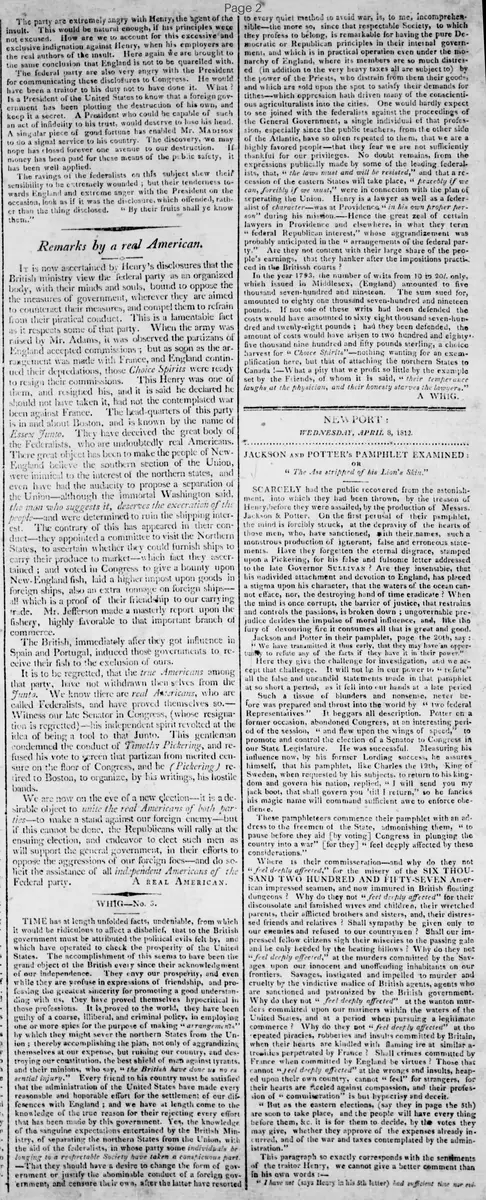
Time has at length unfolded facts, undeniable, from which it would be ridiculous to affect a disbelief, that to the British government must be attributed the political evils felt by, and which have operated to check the prosperity of the United States. The accomplishment of this seems to have been the grand object of the British every since their acknowledgment of our independence. They envy our prosperity, and even while they are profuse in expressions of friendship, and professing the greatest sincerity for promoting a good understanding with us, they have proved themselves hypocritical in those professions. It is proved to the world, they have been guilty of a coarse, illiberal, and criminal policy, in employing one or more spies for the purpose of making "arrangements" by which they might sever the northern States from the Union; thereby accomplishing the plan, not only of aggrandizing themselves at our expense, but ruining our country, and destroying our constitution, the best shield of man against tyrants, and their minions, who say, "the British have done us no essential injury." Every friend to his country must be satisfied that the administration of the United States have made every reasonable and honorable effort for the settlement of our differences with England; and we have at length come to the knowledge of the true reason for their rejecting every effort that has been made by this government. Yes, the knowledge of the sanguine expectations entertained by the British Ministry, of separating the northern States from the Union, with the aid of the federalists, in whose party some individuals belonging to a respectable Society have taken a conspicuous part.—That they should have a desire to change the form of government or justify the abominable conduct of a foreign government, and censure their own, after the latter have resorted to every quiet method to avoid war, is, to me, incomprehensible—the more so, since that respectable Society, to which they profess to belong, is remarkable for having the pure Democratic or Republican principles in their internal government, and which is in practical operation even under the monarchy of England, where its members are so much distressed (in addition to the very heavy taxes all are subject to) by the power of the Priests, who distrain from them their goods, and which are sold upon the spot to satisfy their demands for tithes—which oppression hath driven many of the conscientious agriculturalists into the cities. One would hardly expect to see joined with the federalists against the proceedings of the General Government, a single individual of that profession, especially since the public teachers, from the other side of the Atlantic, have so often repeated to them, that we are a highly favored people—that they fear we are not sufficiently thankful for our privileges. No doubt remains, from the expressions publicly made by some of the leading federalists, that, "the laws must and will be resisted," and that a secession of the eastern States will take place, "peaceably if we can, forcibly if we must," were in connection with the plan of separating the Union. Henry is a lawyer as well as a federalist of character—was at Providence "in his own proper person" during his mission.—Hence the great zeal of certain lawyers in Providence and elsewhere, in what they term "federal Republican interest," whose aggrandizement was probably anticipated in the "arrangements of the federal party." Are they not content with their large share of the people's earnings, that they hanker after the impositions practiced in the British courts?
In the year 1793, the number of writs from 10 to 20l. only, which issued in Middlesex, (England) amounted to five thousand seven-hundred and nineteen. The sum sued for, amounted to eighty one thousand seven-hundred and nineteen pounds. If not one of these writs had been defended the costs would have amounted to sixty eight thousand seven-hundred and twenty-eight pounds; had they been defended, the amount of costs would have arisen to two hundred and eighty-five thousand nine hundred and fifty pounds sterling, a choice harvest for "Choice Spirits"—nothing wanting for an exemplification here, but that of attaching the northern States to Canada!—What a pity that we profit so little by the example set by the Friends, of whom it is said, "their temperance laughs at the physician, and their honesty starves the lawyers."
A WHIG.
What sub-type of article is it?
What themes does it cover?
What keywords are associated?
What entities or persons were involved?
Letter to Editor Details
Author
A Whig.
Main Argument
the british government is responsible for political evils in the united states by employing spies to separate the northern states from the union with federalist aid, while the us administration has made honorable efforts for peace that britain rejects; federalists and some in a respectable society unjustly oppose the government.
Notable Details