Thank you for visiting SNEWPapers!
Sign up free
Literary
September 26, 1930
Maryland Independent
La Plata, Port Tobacco, Waldorf, Charles County, Maryland
What is this article about?
Lester B. Colby's narrative recounts the 1856 hurricane tragedy on L'Île Dernière (Last Island), Louisiana, where a grand hotel resort was destroyed, killing over 400 fashionable Creole guests during a dance, leaving the island desolate.
Clipping
OCR Quality
98%
Excellent
Full Text
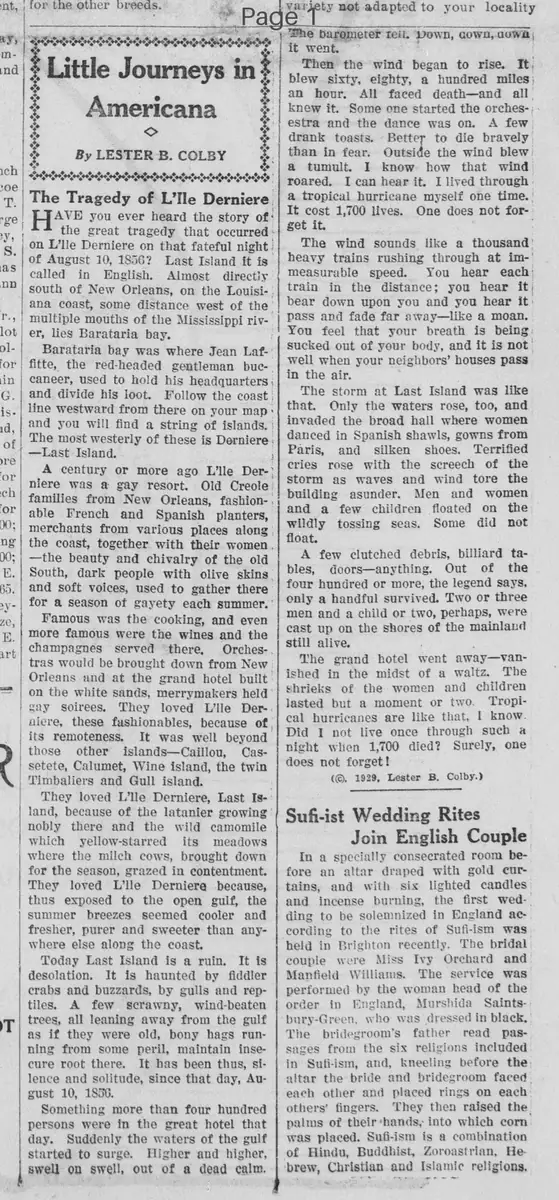
Little Journeys in
Americana
By
LESTER B. COLBY
The Tragedy of L'Île Dernière
Have you ever heard the story of the great tragedy that occurred on L'Île Dernière on that fateful night of August 10, 1856? Last Island it is called in English. Almost directly south of New Orleans, on the Louisiana coast, some distance west of the multiple mouths of the Mississippi river, lies Barataria bay.
Barataria bay was where Jean Lafitte, the red-headed gentleman buccaneer, used to hold his headquarters and divide his loot. Follow the coast line westward from there on your map and you will find a string of islands. The most westerly of these is Dernière—Last Island.
A century or more ago L'Île Dernière was a gay resort. Old Creole families from New Orleans, fashionable French and Spanish planters, merchants from various places along the coast, together with their women—the beauty and chivalry of the old South, dark people with olive skins and soft voices, used to gather there for a season of gayety each summer.
Famous was the cooking, and even more famous were the wines and the champagnes served there. Orchestras would be brought down from New Orleans and at the grand hotel built on the white sands, merrymakers held gay soirees. They loved L'Île Dernière, these fashionables, because of its remoteness. It was well beyond those other islands—Caillou, Cassetete, Calumet, Wine island, the twin Timbaliers and Gull island.
They loved L'Île Dernière, Last Island, because of the latanier growing nobly there and the wild camomile which yellow-starred its meadows where the milch cows, brought down for the season, grazed in contentment.
They loved L'Île Dernière because, thus exposed to the open gulf, the summer breezes seemed cooler and fresher, purer and sweeter than anywhere else along the coast.
Today Last Island is a ruin. It is desolation. It is haunted by fiddler crabs and buzzards, by gulls and reptiles. A few scrawny, wind-beaten trees, all leaning away from the gulf as if they were old, bony hags running from some peril, maintain insecure root there. It has been thus, silence and solitude, since that day, August 10, 1856.
Something more than four hundred persons were in the great hotel that day. Suddenly the waters of the gulf started to surge. Higher and higher, swell on swell, out of a dead calm.
The barometer fell. Down, down, down it went.
Then the wind began to rise. It blew sixty, eighty, a hundred miles an hour. All faced death—and all knew it. Some one started the orchestra and the dance was on. A few drank toasts. Better to die bravely than in fear. Outside the wind blew a tumult. I know how that wind roared. I can hear it. I lived through a tropical hurricane myself one time. It cost 1,700 lives. One does not forget it.
The wind sounds like a thousand heavy trains rushing through at immeasurable speed. You hear each train in the distance: you hear it bear down upon you and you hear it pass and fade far away—like a moan.
You feel that your breath is being sucked out of your body, and it is not well when your neighbors' houses pass in the air.
The storm at Last Island was like that. Only the waters rose, too, and invaded the broad hall where women danced in Spanish shawls, gowns from Paris, and silken shoes. Terrified cries rose with the screech of the storm as waves and wind tore the building asunder. Men and women and a few children floated on the wildly tossing seas. Some did not float.
A few clutched debris, billiard tables, doors—anything. Out of the four hundred or more, the legend says, only a handful survived. Two or three men and a child or two, perhaps, were cast up on the shores of the mainland still alive.
The grand hotel went away—vanished in the midst of a waltz. The shrieks of the women and children lasted but a moment or two. Tropical hurricanes are like that, I know. Did I not live once through such a night when 1,700 died? Surely, one does not forget!
(©, 1929, Lester B. Colby.)
Americana
By
LESTER B. COLBY
The Tragedy of L'Île Dernière
Have you ever heard the story of the great tragedy that occurred on L'Île Dernière on that fateful night of August 10, 1856? Last Island it is called in English. Almost directly south of New Orleans, on the Louisiana coast, some distance west of the multiple mouths of the Mississippi river, lies Barataria bay.
Barataria bay was where Jean Lafitte, the red-headed gentleman buccaneer, used to hold his headquarters and divide his loot. Follow the coast line westward from there on your map and you will find a string of islands. The most westerly of these is Dernière—Last Island.
A century or more ago L'Île Dernière was a gay resort. Old Creole families from New Orleans, fashionable French and Spanish planters, merchants from various places along the coast, together with their women—the beauty and chivalry of the old South, dark people with olive skins and soft voices, used to gather there for a season of gayety each summer.
Famous was the cooking, and even more famous were the wines and the champagnes served there. Orchestras would be brought down from New Orleans and at the grand hotel built on the white sands, merrymakers held gay soirees. They loved L'Île Dernière, these fashionables, because of its remoteness. It was well beyond those other islands—Caillou, Cassetete, Calumet, Wine island, the twin Timbaliers and Gull island.
They loved L'Île Dernière, Last Island, because of the latanier growing nobly there and the wild camomile which yellow-starred its meadows where the milch cows, brought down for the season, grazed in contentment.
They loved L'Île Dernière because, thus exposed to the open gulf, the summer breezes seemed cooler and fresher, purer and sweeter than anywhere else along the coast.
Today Last Island is a ruin. It is desolation. It is haunted by fiddler crabs and buzzards, by gulls and reptiles. A few scrawny, wind-beaten trees, all leaning away from the gulf as if they were old, bony hags running from some peril, maintain insecure root there. It has been thus, silence and solitude, since that day, August 10, 1856.
Something more than four hundred persons were in the great hotel that day. Suddenly the waters of the gulf started to surge. Higher and higher, swell on swell, out of a dead calm.
The barometer fell. Down, down, down it went.
Then the wind began to rise. It blew sixty, eighty, a hundred miles an hour. All faced death—and all knew it. Some one started the orchestra and the dance was on. A few drank toasts. Better to die bravely than in fear. Outside the wind blew a tumult. I know how that wind roared. I can hear it. I lived through a tropical hurricane myself one time. It cost 1,700 lives. One does not forget it.
The wind sounds like a thousand heavy trains rushing through at immeasurable speed. You hear each train in the distance: you hear it bear down upon you and you hear it pass and fade far away—like a moan.
You feel that your breath is being sucked out of your body, and it is not well when your neighbors' houses pass in the air.
The storm at Last Island was like that. Only the waters rose, too, and invaded the broad hall where women danced in Spanish shawls, gowns from Paris, and silken shoes. Terrified cries rose with the screech of the storm as waves and wind tore the building asunder. Men and women and a few children floated on the wildly tossing seas. Some did not float.
A few clutched debris, billiard tables, doors—anything. Out of the four hundred or more, the legend says, only a handful survived. Two or three men and a child or two, perhaps, were cast up on the shores of the mainland still alive.
The grand hotel went away—vanished in the midst of a waltz. The shrieks of the women and children lasted but a moment or two. Tropical hurricanes are like that, I know. Did I not live once through such a night when 1,700 died? Surely, one does not forget!
(©, 1929, Lester B. Colby.)
What sub-type of article is it?
Prose Fiction
Essay
What themes does it cover?
Death Mortality
Nature
What keywords are associated?
Hurricane Tragedy
Last Island
L'ile Derniere
Louisiana Coast
1856 Disaster
Creole Resort
Tropical Storm
What entities or persons were involved?
Lester B. Colby
Literary Details
Title
The Tragedy Of L'île Dernière
Author
Lester B. Colby
Subject
The Great Tragedy That Occurred On L'île Dernière On That Fateful Night Of August 10, 1856
Form / Style
Narrative Prose Recounting A Historical Hurricane Disaster
Key Lines
The Grand Hotel Went Away—Vanished In The Midst Of A Waltz.
The Shrieks Of The Women And Children Lasted But A Moment Or Two.
The Wind Sounds Like A Thousand Heavy Trains Rushing Through At Immeasurable Speed.