Thank you for visiting SNEWPapers!
Sign up free
Literary
July 25, 1807
Alexandria Daily Advertiser
Alexandria, Virginia
What is this article about?
Extracts from Azuni's 'Universal System of Principles of Maritime Law,' translated for the Federal Gazette. Discusses U.S. role in proposing freedom of commerce, historical denials due to naval power, and defines territorial sea extent as three miles, the reach of cannon shot, aligning with practices of Russia, Tuscany, Genoa, and Venice.
Clipping
OCR Quality
95%
Excellent
Full Text
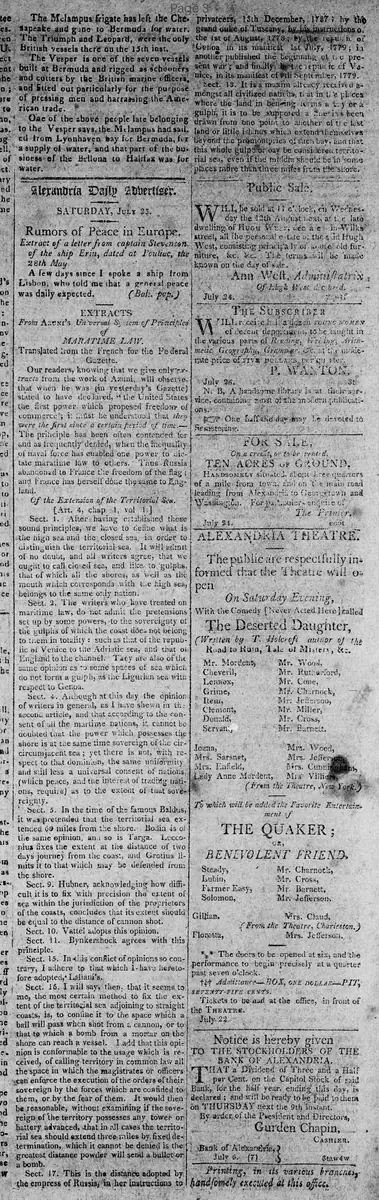
EXTRACTS
From Azuni's Universal System of Principles of
MARITIME LAW.
Translated from the French for the Federal Gazette.
Our readers, knowing that we give only extracts from the work of Azuni, will observe, that when he was (in yesterday's Gazette) stated to have declared, "the United States the first power which proposed freedom of commerce;" it must be understood that they were the first since a certain period of time.
The principle has been often contended for and as frequently denied, when the inequality of naval force has enabled one power to dictate maritime law to others. Thus Russia abandoned to France the freedom of the flag; and France has herself done the same to England.
Of the Extension of the Territorial Sea.
[Art. 4, chap.1, vol 1.]
Sect. 1. After having established these sound principles, we have to define what is the high sea and the closed sea, in order to distinguish the territorial sea. It will admit of no doubt, and all writers agree, that we ought to call closed sea, and like to gulphs, that of which all the shores, as well as the mouth which corresponds with the high sea, belongs to the same only nation.
Sect. 2. The writers who have treated on maritime law, do not admit the pretensions set up by some powers, to the sovereignty of the gulphs of which the coast does not belong to them in totality: such as that of the republic of Venice to the Adriatic sea, and that of England to the channel. They are also of the same opinion as to some spaces of sea which do not form a gulph, as the Ligurian sea with respect to Genoa.
Sect. 4. Although at this day the opinion of writers in general, as I have shewn in the second article, and that according to the consent of all the maritime nations, it cannot be doubted that the power which possesses the shore is at the same time sovereign of the circumjacent sea; yet there is not, with respect to that dominion, the same uniformity and still less a universal consent of nations (which peace, and the interest of trading nations, require) as to the extent of that sovereignty.
Sect. 5. In the time of the famous Baldus, it was pretended that the territorial sea extended 60 miles from the shore. Bodin is of the same opinion, and so is Targa. Locconius fixes the extent at the distance of two days journey from the coast, and Grotius limits it to that which may be defended from the shore.
Sect. 9. Hubner, acknowledging how difficult it is to fix with precision the extent of sea within the jurisdiction of the proprietors of the coasts, concludes that its extent should be equal to the distance of cannon shot.
Sect. 10. Vattel adopts this opinion.
Sect. 11. Bynkershock agrees with this principle.
Sect. 15. In this conflict of opinions so contrary, I adhere to that which I have heretofore adopted, Valiani's.
Sect. 16. I will say, then, that it seems to me, the most certain method to fix the extent of the territorial sea adjoining to straight coasts, is, to confine it to the space which a ball will pass when shot from a cannon, or to that to which a bomb from a mortar on the shore can reach a vessel. I add that this opinion is conformable to the usage which is received, of calling territory in common law all the space in which the magistrates or officers can enforce the execution of the orders of their sovereign by the forces which are confided to them, or by the fear of them. It would then be reasonable, without examining if the sovereign of the territory possesses any tower or battery advanced, that in all cases the territorial sea should extend three miles by fixed determination, which it cannot be denied is the greatest distance powder will send a bullet or a bomb.
Sect. 17. This is the distance adopted by the empress of Russia, in her instructions to privateers, 13th December, 1780; by the grand duke of Tuscany by his instructions of the 1st of August 1780; by the republic of Genoa in its manifesto 1st July, 1779; in another published the beginning of the present war; and finally, by the republic of Venice, in its manifesto of 9th September, 1779.
Sect. 18. It is a maxim already received amongst all civilized nations, that in the places where the land being forms a bay or a gulph it is to be supposed: a line has been drawn from one point to another of the last land or little islands which extend themselves beyond the promontories of such bay, and that this whole gulph or bay be considered territorial sea, even if the middle should be in some places more than three miles from the shore.
From Azuni's Universal System of Principles of
MARITIME LAW.
Translated from the French for the Federal Gazette.
Our readers, knowing that we give only extracts from the work of Azuni, will observe, that when he was (in yesterday's Gazette) stated to have declared, "the United States the first power which proposed freedom of commerce;" it must be understood that they were the first since a certain period of time.
The principle has been often contended for and as frequently denied, when the inequality of naval force has enabled one power to dictate maritime law to others. Thus Russia abandoned to France the freedom of the flag; and France has herself done the same to England.
Of the Extension of the Territorial Sea.
[Art. 4, chap.1, vol 1.]
Sect. 1. After having established these sound principles, we have to define what is the high sea and the closed sea, in order to distinguish the territorial sea. It will admit of no doubt, and all writers agree, that we ought to call closed sea, and like to gulphs, that of which all the shores, as well as the mouth which corresponds with the high sea, belongs to the same only nation.
Sect. 2. The writers who have treated on maritime law, do not admit the pretensions set up by some powers, to the sovereignty of the gulphs of which the coast does not belong to them in totality: such as that of the republic of Venice to the Adriatic sea, and that of England to the channel. They are also of the same opinion as to some spaces of sea which do not form a gulph, as the Ligurian sea with respect to Genoa.
Sect. 4. Although at this day the opinion of writers in general, as I have shewn in the second article, and that according to the consent of all the maritime nations, it cannot be doubted that the power which possesses the shore is at the same time sovereign of the circumjacent sea; yet there is not, with respect to that dominion, the same uniformity and still less a universal consent of nations (which peace, and the interest of trading nations, require) as to the extent of that sovereignty.
Sect. 5. In the time of the famous Baldus, it was pretended that the territorial sea extended 60 miles from the shore. Bodin is of the same opinion, and so is Targa. Locconius fixes the extent at the distance of two days journey from the coast, and Grotius limits it to that which may be defended from the shore.
Sect. 9. Hubner, acknowledging how difficult it is to fix with precision the extent of sea within the jurisdiction of the proprietors of the coasts, concludes that its extent should be equal to the distance of cannon shot.
Sect. 10. Vattel adopts this opinion.
Sect. 11. Bynkershock agrees with this principle.
Sect. 15. In this conflict of opinions so contrary, I adhere to that which I have heretofore adopted, Valiani's.
Sect. 16. I will say, then, that it seems to me, the most certain method to fix the extent of the territorial sea adjoining to straight coasts, is, to confine it to the space which a ball will pass when shot from a cannon, or to that to which a bomb from a mortar on the shore can reach a vessel. I add that this opinion is conformable to the usage which is received, of calling territory in common law all the space in which the magistrates or officers can enforce the execution of the orders of their sovereign by the forces which are confided to them, or by the fear of them. It would then be reasonable, without examining if the sovereign of the territory possesses any tower or battery advanced, that in all cases the territorial sea should extend three miles by fixed determination, which it cannot be denied is the greatest distance powder will send a bullet or a bomb.
Sect. 17. This is the distance adopted by the empress of Russia, in her instructions to privateers, 13th December, 1780; by the grand duke of Tuscany by his instructions of the 1st of August 1780; by the republic of Genoa in its manifesto 1st July, 1779; in another published the beginning of the present war; and finally, by the republic of Venice, in its manifesto of 9th September, 1779.
Sect. 18. It is a maxim already received amongst all civilized nations, that in the places where the land being forms a bay or a gulph it is to be supposed: a line has been drawn from one point to another of the last land or little islands which extend themselves beyond the promontories of such bay, and that this whole gulph or bay be considered territorial sea, even if the middle should be in some places more than three miles from the shore.
What sub-type of article is it?
Essay
What themes does it cover?
Political
Commerce Trade
Liberty Freedom
What keywords are associated?
Maritime Law
Territorial Sea
Cannon Shot
Three Miles
Freedom Of Commerce
Gulphs
High Sea
What entities or persons were involved?
Azuni (Translated From The French For The Federal Gazette)
Literary Details
Title
Extracts From Azuni's Universal System Of Principles Of Maritime Law.
Author
Azuni (Translated From The French For The Federal Gazette)
Subject
Of The Extension Of The Territorial Sea
Key Lines
The Territorial Sea Should Extend Three Miles By Fixed Determination, Which It Cannot Be Denied Is The Greatest Distance Powder Will Send A Bullet Or A Bomb.
This Is The Distance Adopted By The Empress Of Russia, In Her Instructions To Privateers, 13th December, 1780; By The Grand Duke Of Tuscany By His Instructions Of The 1st Of August 1780; By The Republic Of Genoa In Its Manifesto 1st July, 1779; In Another Published The Beginning Of The Present War; And Finally, By The Republic Of Venice, In Its Manifesto Of 9th September, 1779.