Thank you for visiting SNEWPapers!
Sign up free
The Virginian
Lynchburg, Virginia
What is this article about?
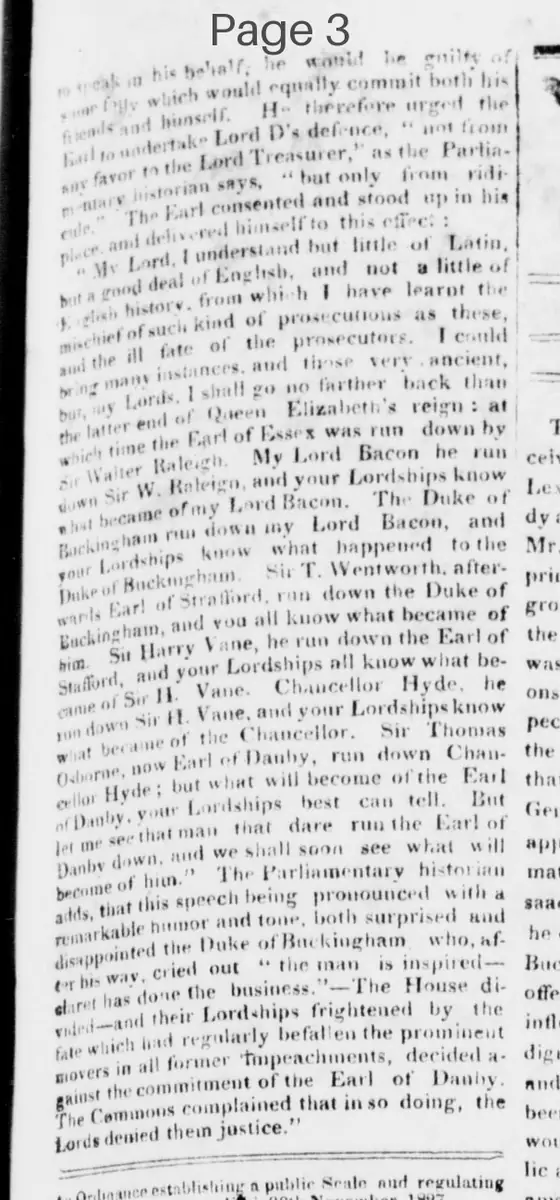
In the House of Lords, a speaker defends the Earl of Danby against impeachment by recounting historical precedents where prosecutors like Sir W. Raleigh, Lord Bacon, Duke of Buckingham, Earl of Strafford, Sir H. Vane, and others who 'ran down' prominent figures met ill fates, warning of similar consequences. The Lords, influenced, deny commitment, prompting Commons' complaints of denied justice.
Clipping
OCR Quality
Full Text
Therefore urged by a good deal of English, and not a little of French and Dutch resentment himself to this cause, current historian says,
"My Lord, I understand but little of Latin, but only from reading which I have learnt the mischief of such kind of prosecutions as these and the ill fate of the prosecutors. I could by my own many instances, and those very ancient, by your Lordships. I shall go no farther back than the latter end of Queen Elizabeth's reign: at which time the Earl of Essex was run down by Sir W. Raleigh, and your Lordships know Sir Walter Raleigh.
My Lord Bacon run down the Duke of Buckingham run down my Lord Bacon, and your Lordships know what became of my Lord Bacon. The Duke of Buckingham run down the warlike Earl of Strafford, run down the Duke of Buckingham, and you all know what became of the Duke of Buckingham. Sir T. Wentworth, afterwards Earl of Strafford, and your Lordships all know what became of him. Run down Sir H. Vane, Chancellor Hyde. He was one of the Chancellor. Sir Thomas Osborne, now Earl of Danby, run down Chancellor you down Sir H. Vane, and your Lordships know Chancellor Hyde; but what will become of the Earl of Danby, your Lordships best can tell. But let me see that man that dare run the Earl of Danby down, and we shall soon see what will become of him."
The Parliamentary historian pronounced with remarkable humor and tone. Both surprised and for his way, cried out "the man is inspired— Buckingham chree has done the business."—The House di- Lordships frightened at the fate which had regularly befallen the prominent movers in all former impeachments, decided against the commitment of the Earl of Danby.
The Commons complained that in so doing, the Lords denied their justice.
What sub-type of article is it?
What themes does it cover?
What keywords are associated?
What entities or persons were involved?
Where did it happen?
Story Details
Key Persons
Location
House Of Lords
Event Date
Latter End Of Queen Elizabeth's Reign And Later
Story Details
A speaker urges the House of Lords against committing the Earl of Danby by citing ancient instances of ill fates befalling prosecutors in impeachments, starting from Essex run down by Raleigh, Bacon, Buckingham, Strafford, Vane, and Hyde, predicting the same for Danby's accusers.