Thank you for visiting SNEWPapers!
Sign up free
Editorial
March 30, 1848
The Daily Union
Washington, District Of Columbia
What is this article about?
This editorial defends U.S. territorial expansion into New Mexico and California, criticizing Whig opposition as echoing Federalist resistance to the Louisiana Purchase. It quotes Webster's pessimistic speech and counters with a positive description from Lt. Wm. Singer, highlighting the region's fertility, minerals, and potential.
Clipping
OCR Quality
95%
Excellent
Full Text
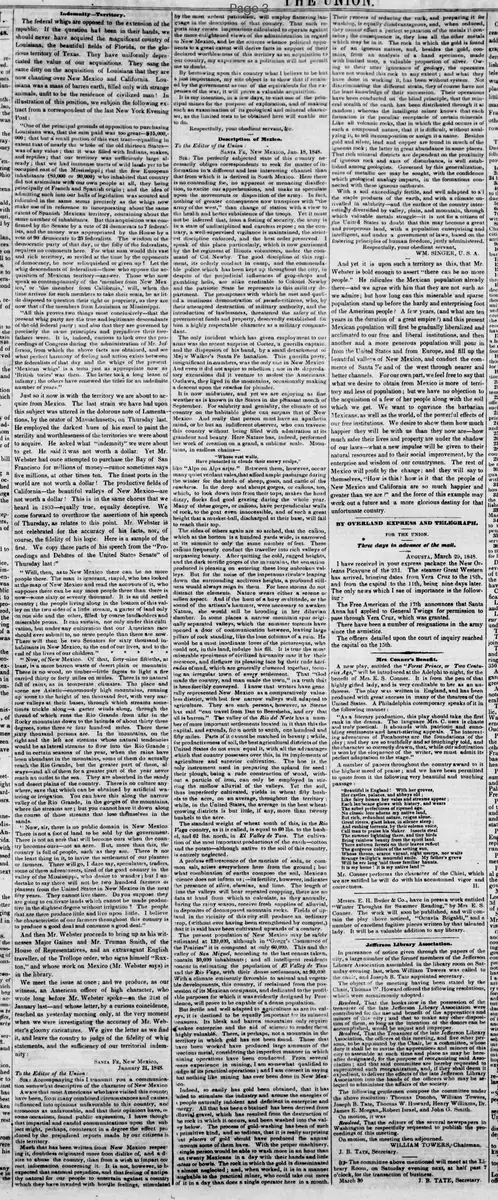
The federal whigs are opposed to the extension of the republic. If the question had been in their hands, we should never have acquired the magnificent country of Louisiana, the beautiful fields of Florida, or the glorious territory of Texas. They have uniformly depreciated the value of our acquisitions. They sang the same ditty on the acquisition of Louisiana that they are now chanting over New Mexico and California. Louisiana was a mass of barren earth, filled only with strange animals, unfit to be the residence of civilized man! In illustration of this position, we subjoin the following extract from a correspondent of the last New York Evening Post:
"One of the principal grounds of opposition to purchasing Louisiana was, that the sum paid was too great—$15,000,000; that but a small portion of this vast tract—equalling in extent that of nearly the whole of the old thirteen States—was of any value; that it was filled with Indians, snakes, and reptiles; that our territory was sufficiently large already; that we had immense tracts of wild lands yet to be occupied east of the Mississippi; that the few European inhabitants (80,000 or 90,000) who inhabited that country did not assimilate with our own people at all, they being principally of French and Spanish origin; and the idea of admitting such into our halls of legislation was scouted and ridiculed in the same terms precisely as the whigs now make use of in reference to incorporating about the same extent of Spanish Mexican territory, containing about the same number of inhabitants. But this acquisition was confirmed by the Senate by a vote of 24 democrats to 7 federalists, and the money was appropriated by the House by a vote of 90 democrats to 25 federalists. The wisdom of the democratic party of that day, or the folly of the federalists, requires no comments here. For what sum would this vast and rich territory, so reviled at the time by the opponents of democracy, be now relinquished or given up? Let the whig descendants of federalism—those who oppose the acquisition of Mexican territory—answer. Those who now speak so contemptuously of the 'member from New Mexico,' or 'the member from California,' will, when the time arrives for such members to take their seats, be as little disposed to question their right or propriety, as they are now that of the members from Louisiana or Mississippi.
"All this proves two things most conclusively—that the present whig party are the true and legitimate descendants of the old federal party; and also that they are governed by precisely the same principles and prejudices their forefathers were. It is, indeed, curious to look over the proceedings of Congress during the administration of Mr. Jefferson, from which the above facts are obtained, and see what perfect harmony of feeling and action exists between the federalists of that day and the whigs of the present. 'Mexican whigs' is a term just as appropriate now as 'British tories' was then. The latter took a long lease of infamy; the others have renewed the titles for an indefinite number of years."
Just so it now is with the territory we are about to acquire from Mexico. The last strain we have had upon this subject was uttered in the dolorous note of Lamentations, by the orator of Massachusetts; on Thursday last. He employed the darkest hues of his easel to paint the sterility and worthlessness of the territories we were about to acquire. He asked what "indemnity" we were about to get. He said it was not worth a dollar. Yet Mr. Webster had once attempted to purchase the Bay of San Francisco for millions of money—rumor sometimes says five millions, at other times ten. The finest ports in the world are not worth a dollar! The productive fields of California—the beautiful valleys of New Mexico—are not worth a dollar! This is in the same chorus that we heard in 1803—equally true, equally deceptive. We come forward to overthrow the assertions of his speech of Thursday, as relates to this point. Mr. Webster is not celebrated for the accuracy of his facts, nor, of course, the fidelity of his logic. Here is a sample of the first. We copy these parts of his speech from the "Proceedings and Debates of the United States Senate" of Thursday last:
"Well, then, as to New Mexico there can be no more people there. The man is ignorant, stupid, who has looked at the map of New Mexico and read the accounts of it, who supposes there can be any more people there than there is now—some sixty or seventy thousand. It is an old settled country; the people living along in the bottom of this valley on the two sides of a little stream, a garter of land only on one side and the other, filled by coarse landholders and miserable peons. It can sustain, not only under this cultivation, but under any cultivation that our American race should ever submit to, no more people than there are now. There will then be two Senators for sixty thousand inhabitants in New Mexico, to the end of our lives, and to the end of the lives of our children."
"Now, of New Mexico. Of that, forty-nine fiftieths, at least, is a mere barren waste of desert plain or mountain. There is no wood, no timber—little fagots to light a fire carried thirty or forty miles on mules. There is no natural fall of rains, as in temperate climates. The place and scene are Asiatic—enormously high mountains, running up some to the height of ten thousand feet, with very narrow valleys at their bases, through which streams sometimes trickle along—a garter winds along, through the thread of which runs the Rio Grande from afar in the Rocky Mountains down to the latitude of about thirty-three degrees, some three or four hundred miles. There these sixty thousand persons are. In the mountains, on the right and the left are streams whose natural tendencies would be as lateral streams to flow into the Rio Grande; and in certain seasons of the year, when the rains have been abundant in the mountains, some of them do actually reach the Rio Grande, but the greater part of them, always—and all of them for a greater part of the year never reach an outlet to the sea. They are absorbed in the sandy and desert plains of the country. There is no culture anywhere, save that which can be obtained by artificial watering or irrigation. You can have this along the narrow valley of the Rio Grande, in the gorges of the mountains, where the streams are; but you cannot have it down along the course of those streams that lose themselves in the sands.
Now, sir, there is no public domain in New Mexico. There is not a foot of land to be sold by the government. There is not an acre that will become ours when the country becomes ours—not an acre. But, more than this, the country is full of people, such as they are. There is not the least thing in it, to invite the settlement of our planters or farmers. There will go, I dare say, speculators, traders, some of them adventurers, tired of the good country in the valley of the Mississippi, who desire to wander; but I undertake to say there will not be two hundred farmers or planters from the United States in New Mexico in the next fifty years. They cannot live there. Do you suppose they are going to cultivate lands which cannot be made productive in the slightest degree without irrigation? The people that are there produce little and live upon little. I believe the characteristic of our farmers throughout this country is to produce a good deal and consume a good deal."
And then Mr. Webster proceeds to bring up as his witnesses Major Gaines and Mr. Truman Smith, of the House of Representatives, and an extravagant English traveller, of the Trollope order, who signs himself "Ruxton," and whose work on Mexico (Mr. Webster says) is in the library.
We meet the issue at once; and we produce, as our witness, an American officer of high character, who wrote long before Mr. Webster spoke—on the 21st of January last—and whose letter, by a curious coincidence, reached us yesterday morning only, at the very moment when we were investigating the accuracy of Mr. Webster's gloomy caricatures. We give the letter as we find it, and leave the country to judge of the fidelity of whig statements, and the sufficiency of our territorial indemnity:
SANTA FE, New Mexico,
January 21, 1848.
To the Editor of the Union:
Sir: Accompanying this I transmit you a communication somewhat descriptive of the character of New Mexico. Aware that most Americans who have visited this country have been, from many combined circumstances and causes, influenced into opinions unfavorable to this country, and erroneous as unfavorable, and that their opinions have, on some occasions, found public expression, I have thought that impartial and candid communications upon the subject might, perhaps, counteract in a degree the effect produced by the prejudiced reports made by our citizens in this territory.
Much that has been written from New Mexico respecting it, doubtless originated more from dislike of, and a desire to abuse the country, than from a wish to impart correct information concerning it. It is not, however, to be expected that national prejudice, and that feeling of antipathy natural for our people to entertain against a country which they have invaded with hostile feelings, stimulated by the most ardent patriotism, will employ flattering language in the description of that country. That such reports may create impressions calculated to operate against the more enlightened views of the administration in regard to New Mexico, and be the sources whence political opponents to a great extent will derive facts in support of their declared worthlessness of this territory as an acquisition to our country, my experience as a politician will not permit me to doubt.
By bestowing upon this country what I believe to be but a just importance, my sole object is to show that if retained by the government as one of the equivalents for the expenses of the war, it will prove a valuable acquisition. It is my intention, in a few days, to visit one of the principal mines for the purpose of exploration, and of making such an examination of its geological and mineral character, as the limited tests to be obtained here will enable me to do.
Respectfully, your obedient servant, &c.
Description of Mexico.
To the Editor of the Union:
Santa Fe, New Mexico, Jan. 18, 1848.
SIR: The perfectly subjected state of this country necessarily obliges correspondents to seek for matter of information in a different and less interesting channel than that from which it is derived in South Mexico. Here there is no contending foe, no apparent or menacing disaffection, to excite our apprehensions, and make us speculate upon the movements or disposition of the army. In fact, nothing of greater consequence now transpires with "the army of the west," than change of station with a view to the health and better subsistence of the troops. Yet it must not be inferred that, from a feeling of security, the army is in a state of undisciplined and careless repose; on the contrary, a well-supervised vigilance is maintained, the strictest discipline enforced, and the best order preserved. I speak of this place particularly, which is now garrisoned by the 1st regiment of Illinois volunteers, under the command of Col. Newby. The good discipline of this regiment, its orderly conduct in camp, and the commendable police which has been kept up throughout the city, in despite of the prejudicial influences of grog-shops and gambling hells, are alike creditable to Colonel Newby and the patriotic State he represents in this military department. The promptness with which he met and quelled a mutinous demonstration of pseudo-citizens, who, by their attempted destruction of military authority, and the introduction of lawlessness, threatened the safety of the government funds and property, deservedly established for him a highly respectable character as a military commandant.
The only incident which has given employment to our arms was the recent surprise of Cortez, a guerilla captain, and the dispersion of his band, by a small detachment of Major Walker's Santa Fe battalion. This guerilla party, insignificant in numbers, was the only one in New Mexico. And even it did not aspire to rebellion: nor in its depredatory excursions did it venture to molest the Americans. Outlaws, they lived in the mountains, occasionally making a descent upon the ranchos for plunder.
It is now midwinter, and yet we are enjoying as fine weather as is known in the States in the pleasant month of September. For salubrity and geniality, the climate of no country on the habitable globe can surpass that of New Mexico. And really that person must have an apathetic mind, or be but an indifferent observer, who can traverse this country without being filled with admiration at its grandeur and beauty. Here Nature has, indeed, performed her work of creation on a grand, a sublime scale. Mountains, in endless chains—
"Whose vast walls,
Have pinnacled in clouds their snowy scalps,
like "Alps on Alps arise." Between them, however, occur many quiet verdant vales, that afford ample pasturage during the winter for the herds of sheep, goats, and cattle of the rancheros. In the deep and abrupt gorges, or cañons, too, which, to look down into from their tops, makes the head dizzy, flocks find good grazing during the whole year. Many of these gorges, or cañons, have perpendicular walls of rock, to the goat even inaccessible, and of such a great height that a musket-ball, discharged at their base, will fail to reach their top.
The sides of others again are so arched, that the cañon, which at the bottom is a hundred yards wide, is narrowed at its summit to only the same number of feet. These canons frequently conduct the traveller into rich valleys of surpassing beauty. After quitting the cold, rugged heights, and the dark terrific gorges of the mountains, the sensation produced is pleasing on entering these long unbroken valleys. But for the noise of the impetuous rivulet's leaping down the surrounding acclivous heights, a profound stillness would always reign in them. For here storms do not distract the elements. Nature wears either a serene or sullen aspect. And if the hum of a busy multitude, or the sound of the artisan's hammer, were necessary to awaken Nature, she would still be brooding in her diluvian slumber. In some places a narrow mountain spur originally separated valleys, which the summer torrents have opened a door of communication between, leaving large pillars of rock standing like the lone Columns of a ruin. He would be a most inordinate lover of the picturesque, who could not, in this land, indulge his fill. It is true the most miserable specimens of civilized humanity mar it by their presence, and disfigure its pleasing face by their rude haciendas of mud, which are generally clustered together, forming an irregular town of every settlement. That "God made the country, and man made the town," is a truth that is here forcibly conveyed. I know that writers have generally represented New Mexico as a comparatively valueless district, with but few narrow valleys well adapted to agriculture. They are such persons, however, as Sterne has said "can travel from Dan to Beersheba, and cry that all is barren." The valley of the Rio del Norte has a number of more important settlements located in it than this the capital, and extends, from north to south, one hundred and fifty miles. Parts of it cannot be matched in beauty; while, for productiveness of soil, the best agricultural districts of the United States do not even equal it, with all the advantages which that country possesses over this, in its implements of agriculture and superior cultivation. The hoe is the only instrument used in preparing the upland for seed: their plough, being a rude construction of wood, without a particle of iron, can only be employed in stirring the mellow alluvial of the valleys. Yet the soil, thus imperfectly cultivated, yields in wheat fifty bushels to the acre, on an average, throughout the territory; while, in the United States, the average in the best wheat-growing districts is but little, if any, more than twenty bushels to the acre.
The standard weight of wheat south of this, in the Rio Vaga country, as it is called, is equal to 60 lbs. to the bushel, and 62 lbs. north, in El Valley de Taos. The cultivation of the most important productions of the earth—cotton and the potato—although native to the soil of this country, is entirely neglected.
A profuse efflorescence of the muriate of soda, or common salt, arises everywhere here from the ground; but what combination of earths compose the soil, Mexican science does not inform us;—its fertility, however, indicates the presence of silica, alumina, and lime. The length of time the valleys will bear repeated cropping, there are no data at hand from which to calculate, as they annually, during the rainy season, receive fresh supplies of alluvial, in deposits of decomposed mountain rocks. Fields of upland in the vicinity of this city still produce an ordinary crop, (without ever having been strengthened by compost,) that it is said have been cultivated upwards of a century.
The present population of New Mexico may be safely estimated at 120,000, although in "Gregg's Commerce of the Prairies" it is computed at only 60,000. This and the valley of San Miguel, according to the last census taken, contain 30,000 inhabitants; and all intelligent residents concur in estimating the population of El Valley de Taos and the Rio Vaga, with their dense settlements, at 90,000.
With a climate eminently favorable to animal and vegetable developments, this country, if reclaimed from the possession of its Mexican occupants, and dedicated to the profitable purposes for which it was evidently designed by Providence, will prove to be capable of a dense population.
But fertile and well adapted to agriculture as are its valleys, it is destined to be equally important for its mineral treasures. Its bleak and barren mountains only require Yankee enterprise and the aid of science to render them highly valuable. There is perhaps not a mountain in the territory in which gold has not been found. Those that have been worked have produced large amounts of the precious metal, considering the imperfect manner in which mining operations have been conducted. From several years experience in mining, I am somewhat qualified to judge of its practical operations; and I am correct in saying that nothing like mining has ever been done in New Mexico.
Indeed, so easily has gold been obtained, that it has failed to stimulate the industry and arouse the energies of a people naturally indolent and deficient in enterprise and energy. All that has been obtained has been derived from alluvial gravel, which has resulted from the destruction of the rock in which it occurs, and been washed into the valley below. The process of gold-washing has been of such primitive kind, and so tedious, that it is really surprising that placers of gold should have produced the annual amounts some of them have. With the proper machinery, a single person would be able to wash more in an hour than twenty Mexicans in a day with their hands and little ateas or bowls. The rock in which the gold is disseminated is almost neglected; and, when worked, it is in a manner laughable to the practical miner, who could take out more of it in a day than does a single operator here, in a month.
Their process of reducing the rock, and preparing it for washing, is equally disadvantageous, and, when reduced, they cannot effect a perfect separation of the metals it contains; the consequence is, they lose all the other metals which may be in it. The rock in which the gold is found is of an igneous nature, and, besides the gold, contains, from an analysis of a hand specimen, made with limited tests, a valuable proportion of silver. Owing to their utter ignorance of geology, the operators have not worked this rock to any extent; and what they have done in working it, has been without system. Not discriminating the different strata, they of course have not the least knowledge of their succession. Their operations have been conducted on the blind principle, that the mineral wealth of the earth has been distributed through it at random; whereas the intelligent miner knows that each formation is the peculiar receptacle of certain minerals.
Like all volcanic rocks, that in which the gold occurs is of such a compound nature, that it is difficult, without analyzing it, to tell its composition or assign it a name. Besides gold and silver, lead and copper are found in much of the igneous rock; the latter in great abundance in some places. That rich mineral districts are dependent on the proximity of igneous rock and axes of disturbance, is well established among geologists. Governed by this generalization, veins of metallic ore may be sought, with the confidence which geological analogy imparts, in the formations connected with these igneous outbursts.
With a soil exceedingly fertile, and well adapted to all the staple products of the earth, and with a climate unrivalled in salubrity—and the surface of the country interestingly diversified by valley, plain, and mountain, through which valuable metals struggle—it is not for a citizen of the United States to doubt that this may become a great and prosperous land, with a population enterprising and intelligent, and under a government of laws, based on the fostering principles of human freedom, justly administered.
Respectfully, your obedient servant,
WM. SINGER, U. S. A.
And yet it is upon such a territory as this, that Mr. Webster is bold enough to assert "there can be no more people." He ridicules the Mexican population already there—and we agree with him that they are not such as we admire; but how long can this miserable and sparse population stand up before the hardy and enterprising foot of the American people? A few years, (and what are ten years in the duration of a great empire?) and this present Mexican population will first be gradually liberalized and acclimated to our free and liberal institutions, and then another and a more generous population will pour in from the United States and from Europe, and fill up the beautiful valleys of New Mexico, and conduct the commerce of Santa Fe and of the west through nearer and better channels. For our own part, we feel free to say that what we desire to obtain from Mexico is more of territory and less of population; but we have no objection to the acquisition of a few of her people along with the soil which we get. We want to convince the barbarian Mexicans, as well as the world, of the powerful effects of our free institutions. We desire to show them how much happier they will be with us than they now are—how much safer their lives and property are under the shadow of our laws—what a new impulse will be given to their natural resources and to their social improvement, by the enterprise and wisdom of our countrymen. The rest of Mexico will profit by the change; and they will say to themselves, "How is this? how is it that the people of New Mexico and California are so much happier and greater than we are?" and the force of this example may work out a future and a more glorious destiny for that unfortunate country.
"One of the principal grounds of opposition to purchasing Louisiana was, that the sum paid was too great—$15,000,000; that but a small portion of this vast tract—equalling in extent that of nearly the whole of the old thirteen States—was of any value; that it was filled with Indians, snakes, and reptiles; that our territory was sufficiently large already; that we had immense tracts of wild lands yet to be occupied east of the Mississippi; that the few European inhabitants (80,000 or 90,000) who inhabited that country did not assimilate with our own people at all, they being principally of French and Spanish origin; and the idea of admitting such into our halls of legislation was scouted and ridiculed in the same terms precisely as the whigs now make use of in reference to incorporating about the same extent of Spanish Mexican territory, containing about the same number of inhabitants. But this acquisition was confirmed by the Senate by a vote of 24 democrats to 7 federalists, and the money was appropriated by the House by a vote of 90 democrats to 25 federalists. The wisdom of the democratic party of that day, or the folly of the federalists, requires no comments here. For what sum would this vast and rich territory, so reviled at the time by the opponents of democracy, be now relinquished or given up? Let the whig descendants of federalism—those who oppose the acquisition of Mexican territory—answer. Those who now speak so contemptuously of the 'member from New Mexico,' or 'the member from California,' will, when the time arrives for such members to take their seats, be as little disposed to question their right or propriety, as they are now that of the members from Louisiana or Mississippi.
"All this proves two things most conclusively—that the present whig party are the true and legitimate descendants of the old federal party; and also that they are governed by precisely the same principles and prejudices their forefathers were. It is, indeed, curious to look over the proceedings of Congress during the administration of Mr. Jefferson, from which the above facts are obtained, and see what perfect harmony of feeling and action exists between the federalists of that day and the whigs of the present. 'Mexican whigs' is a term just as appropriate now as 'British tories' was then. The latter took a long lease of infamy; the others have renewed the titles for an indefinite number of years."
Just so it now is with the territory we are about to acquire from Mexico. The last strain we have had upon this subject was uttered in the dolorous note of Lamentations, by the orator of Massachusetts; on Thursday last. He employed the darkest hues of his easel to paint the sterility and worthlessness of the territories we were about to acquire. He asked what "indemnity" we were about to get. He said it was not worth a dollar. Yet Mr. Webster had once attempted to purchase the Bay of San Francisco for millions of money—rumor sometimes says five millions, at other times ten. The finest ports in the world are not worth a dollar! The productive fields of California—the beautiful valleys of New Mexico—are not worth a dollar! This is in the same chorus that we heard in 1803—equally true, equally deceptive. We come forward to overthrow the assertions of his speech of Thursday, as relates to this point. Mr. Webster is not celebrated for the accuracy of his facts, nor, of course, the fidelity of his logic. Here is a sample of the first. We copy these parts of his speech from the "Proceedings and Debates of the United States Senate" of Thursday last:
"Well, then, as to New Mexico there can be no more people there. The man is ignorant, stupid, who has looked at the map of New Mexico and read the accounts of it, who supposes there can be any more people there than there is now—some sixty or seventy thousand. It is an old settled country; the people living along in the bottom of this valley on the two sides of a little stream, a garter of land only on one side and the other, filled by coarse landholders and miserable peons. It can sustain, not only under this cultivation, but under any cultivation that our American race should ever submit to, no more people than there are now. There will then be two Senators for sixty thousand inhabitants in New Mexico, to the end of our lives, and to the end of the lives of our children."
"Now, of New Mexico. Of that, forty-nine fiftieths, at least, is a mere barren waste of desert plain or mountain. There is no wood, no timber—little fagots to light a fire carried thirty or forty miles on mules. There is no natural fall of rains, as in temperate climates. The place and scene are Asiatic—enormously high mountains, running up some to the height of ten thousand feet, with very narrow valleys at their bases, through which streams sometimes trickle along—a garter winds along, through the thread of which runs the Rio Grande from afar in the Rocky Mountains down to the latitude of about thirty-three degrees, some three or four hundred miles. There these sixty thousand persons are. In the mountains, on the right and the left are streams whose natural tendencies would be as lateral streams to flow into the Rio Grande; and in certain seasons of the year, when the rains have been abundant in the mountains, some of them do actually reach the Rio Grande, but the greater part of them, always—and all of them for a greater part of the year never reach an outlet to the sea. They are absorbed in the sandy and desert plains of the country. There is no culture anywhere, save that which can be obtained by artificial watering or irrigation. You can have this along the narrow valley of the Rio Grande, in the gorges of the mountains, where the streams are; but you cannot have it down along the course of those streams that lose themselves in the sands.
Now, sir, there is no public domain in New Mexico. There is not a foot of land to be sold by the government. There is not an acre that will become ours when the country becomes ours—not an acre. But, more than this, the country is full of people, such as they are. There is not the least thing in it, to invite the settlement of our planters or farmers. There will go, I dare say, speculators, traders, some of them adventurers, tired of the good country in the valley of the Mississippi, who desire to wander; but I undertake to say there will not be two hundred farmers or planters from the United States in New Mexico in the next fifty years. They cannot live there. Do you suppose they are going to cultivate lands which cannot be made productive in the slightest degree without irrigation? The people that are there produce little and live upon little. I believe the characteristic of our farmers throughout this country is to produce a good deal and consume a good deal."
And then Mr. Webster proceeds to bring up as his witnesses Major Gaines and Mr. Truman Smith, of the House of Representatives, and an extravagant English traveller, of the Trollope order, who signs himself "Ruxton," and whose work on Mexico (Mr. Webster says) is in the library.
We meet the issue at once; and we produce, as our witness, an American officer of high character, who wrote long before Mr. Webster spoke—on the 21st of January last—and whose letter, by a curious coincidence, reached us yesterday morning only, at the very moment when we were investigating the accuracy of Mr. Webster's gloomy caricatures. We give the letter as we find it, and leave the country to judge of the fidelity of whig statements, and the sufficiency of our territorial indemnity:
SANTA FE, New Mexico,
January 21, 1848.
To the Editor of the Union:
Sir: Accompanying this I transmit you a communication somewhat descriptive of the character of New Mexico. Aware that most Americans who have visited this country have been, from many combined circumstances and causes, influenced into opinions unfavorable to this country, and erroneous as unfavorable, and that their opinions have, on some occasions, found public expression, I have thought that impartial and candid communications upon the subject might, perhaps, counteract in a degree the effect produced by the prejudiced reports made by our citizens in this territory.
Much that has been written from New Mexico respecting it, doubtless originated more from dislike of, and a desire to abuse the country, than from a wish to impart correct information concerning it. It is not, however, to be expected that national prejudice, and that feeling of antipathy natural for our people to entertain against a country which they have invaded with hostile feelings, stimulated by the most ardent patriotism, will employ flattering language in the description of that country. That such reports may create impressions calculated to operate against the more enlightened views of the administration in regard to New Mexico, and be the sources whence political opponents to a great extent will derive facts in support of their declared worthlessness of this territory as an acquisition to our country, my experience as a politician will not permit me to doubt.
By bestowing upon this country what I believe to be but a just importance, my sole object is to show that if retained by the government as one of the equivalents for the expenses of the war, it will prove a valuable acquisition. It is my intention, in a few days, to visit one of the principal mines for the purpose of exploration, and of making such an examination of its geological and mineral character, as the limited tests to be obtained here will enable me to do.
Respectfully, your obedient servant, &c.
Description of Mexico.
To the Editor of the Union:
Santa Fe, New Mexico, Jan. 18, 1848.
SIR: The perfectly subjected state of this country necessarily obliges correspondents to seek for matter of information in a different and less interesting channel than that from which it is derived in South Mexico. Here there is no contending foe, no apparent or menacing disaffection, to excite our apprehensions, and make us speculate upon the movements or disposition of the army. In fact, nothing of greater consequence now transpires with "the army of the west," than change of station with a view to the health and better subsistence of the troops. Yet it must not be inferred that, from a feeling of security, the army is in a state of undisciplined and careless repose; on the contrary, a well-supervised vigilance is maintained, the strictest discipline enforced, and the best order preserved. I speak of this place particularly, which is now garrisoned by the 1st regiment of Illinois volunteers, under the command of Col. Newby. The good discipline of this regiment, its orderly conduct in camp, and the commendable police which has been kept up throughout the city, in despite of the prejudicial influences of grog-shops and gambling hells, are alike creditable to Colonel Newby and the patriotic State he represents in this military department. The promptness with which he met and quelled a mutinous demonstration of pseudo-citizens, who, by their attempted destruction of military authority, and the introduction of lawlessness, threatened the safety of the government funds and property, deservedly established for him a highly respectable character as a military commandant.
The only incident which has given employment to our arms was the recent surprise of Cortez, a guerilla captain, and the dispersion of his band, by a small detachment of Major Walker's Santa Fe battalion. This guerilla party, insignificant in numbers, was the only one in New Mexico. And even it did not aspire to rebellion: nor in its depredatory excursions did it venture to molest the Americans. Outlaws, they lived in the mountains, occasionally making a descent upon the ranchos for plunder.
It is now midwinter, and yet we are enjoying as fine weather as is known in the States in the pleasant month of September. For salubrity and geniality, the climate of no country on the habitable globe can surpass that of New Mexico. And really that person must have an apathetic mind, or be but an indifferent observer, who can traverse this country without being filled with admiration at its grandeur and beauty. Here Nature has, indeed, performed her work of creation on a grand, a sublime scale. Mountains, in endless chains—
"Whose vast walls,
Have pinnacled in clouds their snowy scalps,
like "Alps on Alps arise." Between them, however, occur many quiet verdant vales, that afford ample pasturage during the winter for the herds of sheep, goats, and cattle of the rancheros. In the deep and abrupt gorges, or cañons, too, which, to look down into from their tops, makes the head dizzy, flocks find good grazing during the whole year. Many of these gorges, or cañons, have perpendicular walls of rock, to the goat even inaccessible, and of such a great height that a musket-ball, discharged at their base, will fail to reach their top.
The sides of others again are so arched, that the cañon, which at the bottom is a hundred yards wide, is narrowed at its summit to only the same number of feet. These canons frequently conduct the traveller into rich valleys of surpassing beauty. After quitting the cold, rugged heights, and the dark terrific gorges of the mountains, the sensation produced is pleasing on entering these long unbroken valleys. But for the noise of the impetuous rivulet's leaping down the surrounding acclivous heights, a profound stillness would always reign in them. For here storms do not distract the elements. Nature wears either a serene or sullen aspect. And if the hum of a busy multitude, or the sound of the artisan's hammer, were necessary to awaken Nature, she would still be brooding in her diluvian slumber. In some places a narrow mountain spur originally separated valleys, which the summer torrents have opened a door of communication between, leaving large pillars of rock standing like the lone Columns of a ruin. He would be a most inordinate lover of the picturesque, who could not, in this land, indulge his fill. It is true the most miserable specimens of civilized humanity mar it by their presence, and disfigure its pleasing face by their rude haciendas of mud, which are generally clustered together, forming an irregular town of every settlement. That "God made the country, and man made the town," is a truth that is here forcibly conveyed. I know that writers have generally represented New Mexico as a comparatively valueless district, with but few narrow valleys well adapted to agriculture. They are such persons, however, as Sterne has said "can travel from Dan to Beersheba, and cry that all is barren." The valley of the Rio del Norte has a number of more important settlements located in it than this the capital, and extends, from north to south, one hundred and fifty miles. Parts of it cannot be matched in beauty; while, for productiveness of soil, the best agricultural districts of the United States do not even equal it, with all the advantages which that country possesses over this, in its implements of agriculture and superior cultivation. The hoe is the only instrument used in preparing the upland for seed: their plough, being a rude construction of wood, without a particle of iron, can only be employed in stirring the mellow alluvial of the valleys. Yet the soil, thus imperfectly cultivated, yields in wheat fifty bushels to the acre, on an average, throughout the territory; while, in the United States, the average in the best wheat-growing districts is but little, if any, more than twenty bushels to the acre.
The standard weight of wheat south of this, in the Rio Vaga country, as it is called, is equal to 60 lbs. to the bushel, and 62 lbs. north, in El Valley de Taos. The cultivation of the most important productions of the earth—cotton and the potato—although native to the soil of this country, is entirely neglected.
A profuse efflorescence of the muriate of soda, or common salt, arises everywhere here from the ground; but what combination of earths compose the soil, Mexican science does not inform us;—its fertility, however, indicates the presence of silica, alumina, and lime. The length of time the valleys will bear repeated cropping, there are no data at hand from which to calculate, as they annually, during the rainy season, receive fresh supplies of alluvial, in deposits of decomposed mountain rocks. Fields of upland in the vicinity of this city still produce an ordinary crop, (without ever having been strengthened by compost,) that it is said have been cultivated upwards of a century.
The present population of New Mexico may be safely estimated at 120,000, although in "Gregg's Commerce of the Prairies" it is computed at only 60,000. This and the valley of San Miguel, according to the last census taken, contain 30,000 inhabitants; and all intelligent residents concur in estimating the population of El Valley de Taos and the Rio Vaga, with their dense settlements, at 90,000.
With a climate eminently favorable to animal and vegetable developments, this country, if reclaimed from the possession of its Mexican occupants, and dedicated to the profitable purposes for which it was evidently designed by Providence, will prove to be capable of a dense population.
But fertile and well adapted to agriculture as are its valleys, it is destined to be equally important for its mineral treasures. Its bleak and barren mountains only require Yankee enterprise and the aid of science to render them highly valuable. There is perhaps not a mountain in the territory in which gold has not been found. Those that have been worked have produced large amounts of the precious metal, considering the imperfect manner in which mining operations have been conducted. From several years experience in mining, I am somewhat qualified to judge of its practical operations; and I am correct in saying that nothing like mining has ever been done in New Mexico.
Indeed, so easily has gold been obtained, that it has failed to stimulate the industry and arouse the energies of a people naturally indolent and deficient in enterprise and energy. All that has been obtained has been derived from alluvial gravel, which has resulted from the destruction of the rock in which it occurs, and been washed into the valley below. The process of gold-washing has been of such primitive kind, and so tedious, that it is really surprising that placers of gold should have produced the annual amounts some of them have. With the proper machinery, a single person would be able to wash more in an hour than twenty Mexicans in a day with their hands and little ateas or bowls. The rock in which the gold is disseminated is almost neglected; and, when worked, it is in a manner laughable to the practical miner, who could take out more of it in a day than does a single operator here, in a month.
Their process of reducing the rock, and preparing it for washing, is equally disadvantageous, and, when reduced, they cannot effect a perfect separation of the metals it contains; the consequence is, they lose all the other metals which may be in it. The rock in which the gold is found is of an igneous nature, and, besides the gold, contains, from an analysis of a hand specimen, made with limited tests, a valuable proportion of silver. Owing to their utter ignorance of geology, the operators have not worked this rock to any extent; and what they have done in working it, has been without system. Not discriminating the different strata, they of course have not the least knowledge of their succession. Their operations have been conducted on the blind principle, that the mineral wealth of the earth has been distributed through it at random; whereas the intelligent miner knows that each formation is the peculiar receptacle of certain minerals.
Like all volcanic rocks, that in which the gold occurs is of such a compound nature, that it is difficult, without analyzing it, to tell its composition or assign it a name. Besides gold and silver, lead and copper are found in much of the igneous rock; the latter in great abundance in some places. That rich mineral districts are dependent on the proximity of igneous rock and axes of disturbance, is well established among geologists. Governed by this generalization, veins of metallic ore may be sought, with the confidence which geological analogy imparts, in the formations connected with these igneous outbursts.
With a soil exceedingly fertile, and well adapted to all the staple products of the earth, and with a climate unrivalled in salubrity—and the surface of the country interestingly diversified by valley, plain, and mountain, through which valuable metals struggle—it is not for a citizen of the United States to doubt that this may become a great and prosperous land, with a population enterprising and intelligent, and under a government of laws, based on the fostering principles of human freedom, justly administered.
Respectfully, your obedient servant,
WM. SINGER, U. S. A.
And yet it is upon such a territory as this, that Mr. Webster is bold enough to assert "there can be no more people." He ridicules the Mexican population already there—and we agree with him that they are not such as we admire; but how long can this miserable and sparse population stand up before the hardy and enterprising foot of the American people? A few years, (and what are ten years in the duration of a great empire?) and this present Mexican population will first be gradually liberalized and acclimated to our free and liberal institutions, and then another and a more generous population will pour in from the United States and from Europe, and fill up the beautiful valleys of New Mexico, and conduct the commerce of Santa Fe and of the west through nearer and better channels. For our own part, we feel free to say that what we desire to obtain from Mexico is more of territory and less of population; but we have no objection to the acquisition of a few of her people along with the soil which we get. We want to convince the barbarian Mexicans, as well as the world, of the powerful effects of our free institutions. We desire to show them how much happier they will be with us than they now are—how much safer their lives and property are under the shadow of our laws—what a new impulse will be given to their natural resources and to their social improvement, by the enterprise and wisdom of our countrymen. The rest of Mexico will profit by the change; and they will say to themselves, "How is this? how is it that the people of New Mexico and California are so much happier and greater than we are?" and the force of this example may work out a future and a more glorious destiny for that unfortunate country.
What sub-type of article is it?
Imperialism
Partisan Politics
Foreign Affairs
What keywords are associated?
Territorial Expansion
New Mexico
California
Whig Opposition
Louisiana Purchase
Daniel Webster
Mexican Territory
Mineral Resources
Agricultural Fertility
What entities or persons were involved?
Federal Whigs
Democrats
Mr. Webster
Mr. Jefferson
Wm. Singer
Major Gaines
Mr. Truman Smith
Ruxton
Col. Newby
Major Walker
Editorial Details
Primary Topic
Defense Of Acquiring New Mexico And California Against Whig Opposition
Stance / Tone
Strongly Pro Expansion And Pro Democratic, Anti Whig
Key Figures
Federal Whigs
Democrats
Mr. Webster
Mr. Jefferson
Wm. Singer
Major Gaines
Mr. Truman Smith
Ruxton
Col. Newby
Major Walker
Key Arguments
Whigs Oppose Territorial Expansion Like Federalists Opposed Louisiana Purchase
Louisiana Was Derided As Barren But Proved Valuable
Webster's Speech Misrepresents New Mexico As Worthless And Incapable Of Growth
New Mexico Has Fertile Valleys Yielding High Wheat Crops
Climate Is Salubrious And Supports Dense Population Potential
Rich In Gold, Silver, Lead, Copper Minerals Awaiting American Enterprise
Mexican Population Will Assimilate To U.S. Institutions
Acquisition Will Demonstrate Benefits Of American Freedom To Mexico