Thank you for visiting SNEWPapers!
Sign up free
Story
February 15, 1828
Delaware Patriot & American Watchman
Wilmington, New Castle County, Delaware
What is this article about?
Defense of Gen. Jackson's 1817-1818 Florida invasion against Seminole Indians, refuting charges of disobeying orders via official documents; contrasts Jackson's patriotism with J.Q. Adams' criticisms.
Clipping
OCR Quality
95%
Excellent
Full Text
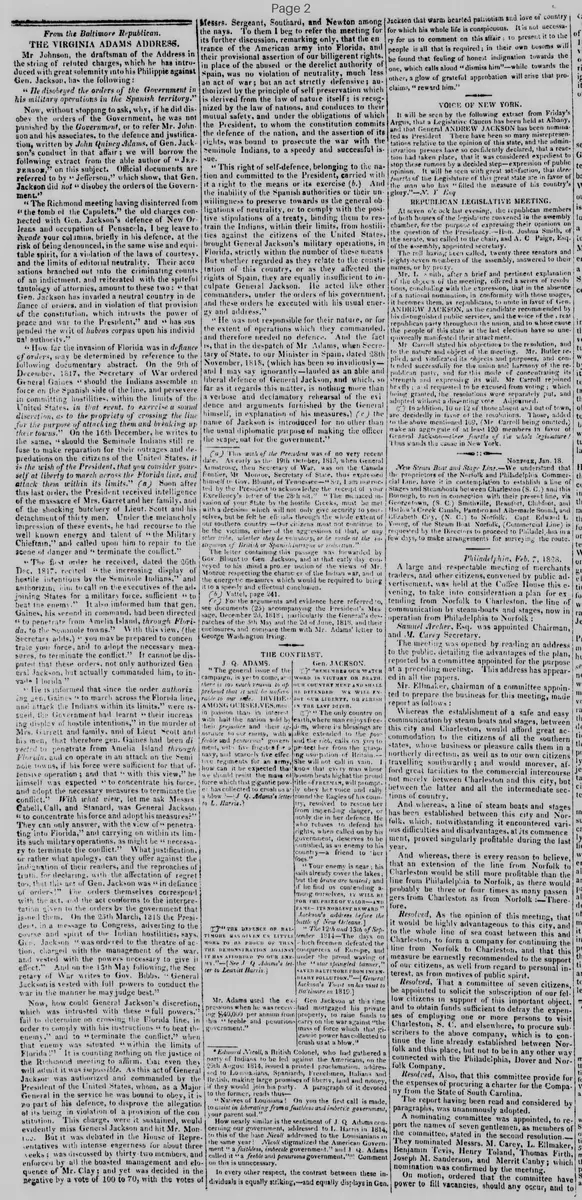
Mr. Johnson, the draftsman of the Address in the string of refuted charges, which he has introduced with great solemnity into his Philippic against Gen. Jackson, has the following:
"He disobeyed the orders of the Government in his military operations in the Spanish territory."
Now, without stopping to ask, why, if he did disobey the orders of the Government, he was not punished by the Government, or to refer Mr. Johnson and his associates, to the defence and justification, written by John Quincy Adams, of Gen. Jackson's conduct in that affair; we will borrow the following extract from the able author of "Jefferson," on this subject. Official documents are referred to by "Jefferson," which show, that Gen. Jackson did not "disobey the orders of the Government."
"The Richmond meeting having disinterred from the tomb of the Capulets." the old charges connected with Gen. Jackson's defence of New Orleans and occupation of Pensacola, I beg leave to invade your columns, briefly in his defence, at the risk of being denounced, in the same wise and equitable spirit, for a violation of the laws of courtesy, and the limits of editorial neutrality. Their accusations branched out into the criminating counts of an indictment. and reiterated with the spiteful tautology of attorneys, amount to these two : "that Gen. Jackson has invaded a neutral country in defiance of orders. and in violation of that provision of the constitution, which intrusts the power of peace and war to the President," and "has suspended the writ of habeas corpus upon his individual authority."
"How far the invasion of Florida was in defiance of orders, may be determined by reference to the following documentary abstract. On the 9th of December, 1817, the Secretary of War ordered General Gaines "should the Indians assemble in force on the Spanish side of the line, and persevere in committing hostilities. within the limits of the United States. in that event, to exercise a sound discretion, as to the propriety of crossing the line for the purpose of attacking them and breaking up their towns." On the 16th December, he writes to the same, "should the Seminole Indians still refuse to make reparation for their outrages and depredations on the citizens of the United States. it is the wish of the President, that you consider yourself at liberty to march across the Florida line, and attack them within its limits." (a) Soon after this last order, the President received intelligence of the massacre of Mrs. Garrett and her family, and of the shocking butchery of Lieut. Scott and his detachment of thirty men. Under the melancholy impression of these events, he had recourse to the well known energy and talent of "the Military Chieftain," and called upon him to repair to the scene of danger and "terminate the conflict."
The first order he received. dated the 26th Dec. 1817. recited "the increasing display of hostile intentions by the Seminole Indians," and authorized him to call on the executives of the adjoining States for a military force. sufficient "to beat the enemy." It also informed him that gen. Gaines, his second in command. had been directed "to penetrate from Amelia Island, through Florida. to the Seminole towns." With this view, (the Secretary adds.) "you may be prepared to concentrate your force, and to adopt the necessary measures. to terminate the conflict." It cannot be disputed that these orders, not only authorized Gen. eral Jackson, but actually commanded him, to invade Florida"
He is informed that since the order authorizing gen. Gaines "to march across the Florida line. and attack the Indians within its limits." were issued, the Government had learnt "their increasing display of hostile intentions," in the murder of Mrs. Garrett and family, and of Lieut Scott and his men, that therefore gen. Gaines had been directed to penetrate from Amelia Island through Florida, and co-operate in an attack on the Seminole towns, if his force were sufficient for that offensive operation; and that "with this view," he himself was expected "to concentrate his force. and adopt the necessary measures to terminate the conflict." With what view, let me ask Messrs. Cabell, Call, and Stanard, was General Jackson "to concentrate his force and adopt his measures?" They can only answer, with the view of "penetrating into Florida," and carrying on within its limits such military operations, as might be "necessary to terminate the conflict." What justification. or rather what apology, can they offer against the indignation of their readers, and the reproaches of truth. for declaring. with the affectation of regret too, that this act of Gen. Jackson was "in defiance of order!" The orders themselves correspond with the act, and the act conforms to the interpretation given to the orders by the government that issued them. On the 25th March, 1818 the President. in a message to Congress, adverting to the course and spirit of the Indian hostilities, says. Gen. Jackson "was ordered to the theatre of action, charged with the management of the war. and vested with the powers necessary to give it effect." And on the 13th May following, the Secretary of War writes to Gov. Bibbs. "General Jackson is vested with full powers to conduct the war in the manner he may judge best."
Now, how could General Jackson's discretion, which was intrusted with these "full powers." fail to determine on crossing the Florida line, in order to comply with his instructions "to beat the enemy," and to "terminate the conflict," when that enemy was situated "within the limits of Florida!" "It is counting nothing on the justice of the Richmond meeting to affirm. that even they will admit it was impossible. As this act of General Jackson was authorized and commanded by the President of the United States, whom, as a Major General in the service he was bound to obey, it is no part of his defence, to disprove the allegation of its being in violation of a provision of the constitution. This charge, were it sustained, would evidently miss General Jackson and hit Mr. Mon. roe. But it was debated in the House of Representatives with intense eagerness for about three weeks; was discussed by thirty-two members, and enforced by all the boasted management and eloquence of Mr. Clay; and yet was decided in the negative by a vote of 100 to 70, with the votes of Messrs. Sergeant, Southard, and Newton among the nays. To them I beg to refer the meeting for its further discussion, remarking only, that the entrance of the American army into Florida, and their provisional assertion of our belligerent rights. in place of the abused or the derelict authority of Spain, was no violation of neutrality, much less an act of war; but an act strictly defensive; authorized by the principle of self preservation which is derived from the law of nature itself; is recognized by the law of nations. and conduces to their mutual safety, and under the obligations of which the President, to whom the constitution commits the defence of the nation, and the assertion of its rights, was bound to prosecute the war with the seminole Indians, to a speedy and successful issue.
"This right of self-defence, belonging to the nation and committed to the President, carried with it a right to the means of its exercise (b.) And the inability of the Spanish authorities or their unwillingness to preserve towards us the general obligations of neutrality, or to comply with the positive stipulations of a treaty. binding them to restrain the Indians, within their limits, from hostilities against the citizens of the United States. brought General Jackson's military operations, in Florida, strictly within the number of these means But whether regarded as they relate to the constitution of this country, or as they affected the rights of Spain, they are equally insufficient to inculpate General Jackson. He acted like other commanders, under the orders of his government. and these orders he executed with his usual energy and address."
"He was not responsible for their nature, or for the extent of operations which they commanded. and therefore needed no defence. And the fact is, that in the despatch of Mr Adams, when Secretary of State, to our Minister in Spain, dated 28th November, 1818, (which has been so invidiously- and I may say ignorantly-lauded as an able and liberal defence of General Jackson, and which, so far as it regards this matter, is nothing more than a verbose and declamatory rehearsal of the evidence and arguments furnished by the General himself, in explanation of his measures.) (c ) the name of Jackson is introduced for no other than the usual diplomatic purpose of making the officer the scape-goat for the government."
(a ) This wish of the President was of no very recent date. As early as the 19th October, 1813, when General Armstrong. then Secretary of War. was on the Canada frontier, Mr Monroe, Secretary of State. thus expressed himself to Gov. Blount. of Tennessee-" Sir, I am instructed by the President to acknowledge the receipt of your Excellency's letter of the 28th ult." "The menaced invasion of your State by the hostile Creeks, must be met with a decision which will not only give security to yourselves, but be felt beneficial, through the whole extent of our southern country -Our citizens must not continue to be the victims, either of the aggressions of that, or any other tribe, whether they be voluntary, or be made at the instigation of British or Spanish intrigue or seduction."
The letter containing this passage was forwarded by Gov. Blount to Gen. Jackson, and at that early day conveyed to his mind a proper notion of the views of Mr. Monroe respecting the character of the Indian war, and of the energetic measures which would be required to bring it to a speedy and effectual conclusion.
b) Vattel, page 241.
c) For the arguments and evidence here referred to, see documents (25) accompanying the President's Message, December 2d. 1818: particularly the General's despatches of the 5th May and the 2d of June, 1818. and their enclosures, and compare them with Mr. Adams' letter to George Washington Irving.
J. Q. ADAMS.
"The general issue of the campaign, is yet to come, and there is too much reason to apprehend that it will be unfavorable to our side. DIVIDE AMONG OURSELVES. MORE in passion than in interest with half the nation sold by their prejudice and their ignorance to our enemy, with a feeble and penurious government, with five frigates for a navy, and scarcely five effective regiments for an army, how can it be expected that we should resist the mass of force which that gigantic power has collected to crush us at a blow -J. Q. Adams's letter to L. Harris.?
"THE DEFENCE OF BALTIMORE WAS GIVEN AS LITTLE MORE TO BE PROUD OF THAN THE DEMONSTRATION AGAINST IT HAS AFFORDED TO OUR ENEMY."-[See J. Q. Adams's letter to Leavitt Harris.]
Mr. Adams used the expressions when he was receiving $40,000 per annum from his "feeble and penurious government."
REMEMBER OUR WATCH WORD IS VICTORY OR DEATH. OUR COUNTRY MUST AND SHALL BE DEFENDED WE WILL. IN. JOY OUR LIUERTY, OR PERISH IN THE LAST DITCH.
("The only country on earth, where man enjoys freedom, where its blessings are alike extended to the poor and the rich, calls on you to protect her from the grasping usurpation of Britain.-- She will not call in vain. I know that every man whose bosom beats high at the proud title of FREEMAN, will promptly obey her voice and rally round the Eagles of his country, resolved to rescue her from impending danger, or nobly die in her defence He who refuses to defend his rights, when called on by his government, deserves to be punished, as an enemy to his country-a friend to -her foes."
"Your enemy is near; his sails already cover the lakes: but the brave are united: and if he find us contending among ourselves, IT WILL BE FOR THE PRIZE OF VALOR-AND FAME- ITS NOBLEST REWARD
Jackson's address before the battle of New Orleans.]
"The 12th and 13th of September 1814-The days on which freemen defeated the conquerors of Europe, and under the proud waving of the "star spangled banner," SAVED BALTIMORE FROM INCENDIARY POLLUTION."-[General Jackson's Toast on his visit to Baltimore in 1819.]
Gen Jackson at this time had mortgaged his private property, to raise funds to carry on the war against "the mass of force which that gigantic power has collected to crush us at a blow."
Edward Nicoll, a British Colonel, who had gathered a party of Indians to be led against the Americans, on the 29th August 1814, issued a printed proclamation, addressed to Louisianians, Spaniards, Frenchmen, Italians and British, making large promises of liberty, land and money, if they would join his party. A paragraph of it devoted to the former, reads thus-
"Natives of Louisiana! On you the first call is made, to assist in liberating from a faithless and imbecile government, your parent soil."
How nearly similar is the sentiment of J. Q Adams concerning our government, addressed to L. Harris in 1814, to this of the base Nicoll addressed to the Louisianians in the same year! Nicoll stigmatized the American Government "a faithless, imbecile government." and J. Q. Adams called it "a feeble and penurious government."! Comment on this is unnecessary.
In every other respect, the contrast between these individuals is equally striking,-and equally displays in Gen. Jackson that warm hearted patriotism and love of country for which his whole life is conspicuous. It is not necessary for us to comment on this affair; to present it to the people is all that is required; in their own bosoms will be found that feeling of honest indignation towards the one, which calls aloud "dismiss him"—while towards the other, a glow of grateful approbation will arise that proclaims, "reward him."
"He disobeyed the orders of the Government in his military operations in the Spanish territory."
Now, without stopping to ask, why, if he did disobey the orders of the Government, he was not punished by the Government, or to refer Mr. Johnson and his associates, to the defence and justification, written by John Quincy Adams, of Gen. Jackson's conduct in that affair; we will borrow the following extract from the able author of "Jefferson," on this subject. Official documents are referred to by "Jefferson," which show, that Gen. Jackson did not "disobey the orders of the Government."
"The Richmond meeting having disinterred from the tomb of the Capulets." the old charges connected with Gen. Jackson's defence of New Orleans and occupation of Pensacola, I beg leave to invade your columns, briefly in his defence, at the risk of being denounced, in the same wise and equitable spirit, for a violation of the laws of courtesy, and the limits of editorial neutrality. Their accusations branched out into the criminating counts of an indictment. and reiterated with the spiteful tautology of attorneys, amount to these two : "that Gen. Jackson has invaded a neutral country in defiance of orders. and in violation of that provision of the constitution, which intrusts the power of peace and war to the President," and "has suspended the writ of habeas corpus upon his individual authority."
"How far the invasion of Florida was in defiance of orders, may be determined by reference to the following documentary abstract. On the 9th of December, 1817, the Secretary of War ordered General Gaines "should the Indians assemble in force on the Spanish side of the line, and persevere in committing hostilities. within the limits of the United States. in that event, to exercise a sound discretion, as to the propriety of crossing the line for the purpose of attacking them and breaking up their towns." On the 16th December, he writes to the same, "should the Seminole Indians still refuse to make reparation for their outrages and depredations on the citizens of the United States. it is the wish of the President, that you consider yourself at liberty to march across the Florida line, and attack them within its limits." (a) Soon after this last order, the President received intelligence of the massacre of Mrs. Garrett and her family, and of the shocking butchery of Lieut. Scott and his detachment of thirty men. Under the melancholy impression of these events, he had recourse to the well known energy and talent of "the Military Chieftain," and called upon him to repair to the scene of danger and "terminate the conflict."
The first order he received. dated the 26th Dec. 1817. recited "the increasing display of hostile intentions by the Seminole Indians," and authorized him to call on the executives of the adjoining States for a military force. sufficient "to beat the enemy." It also informed him that gen. Gaines, his second in command. had been directed "to penetrate from Amelia Island, through Florida. to the Seminole towns." With this view, (the Secretary adds.) "you may be prepared to concentrate your force, and to adopt the necessary measures. to terminate the conflict." It cannot be disputed that these orders, not only authorized Gen. eral Jackson, but actually commanded him, to invade Florida"
He is informed that since the order authorizing gen. Gaines "to march across the Florida line. and attack the Indians within its limits." were issued, the Government had learnt "their increasing display of hostile intentions," in the murder of Mrs. Garrett and family, and of Lieut Scott and his men, that therefore gen. Gaines had been directed to penetrate from Amelia Island through Florida, and co-operate in an attack on the Seminole towns, if his force were sufficient for that offensive operation; and that "with this view," he himself was expected "to concentrate his force. and adopt the necessary measures to terminate the conflict." With what view, let me ask Messrs. Cabell, Call, and Stanard, was General Jackson "to concentrate his force and adopt his measures?" They can only answer, with the view of "penetrating into Florida," and carrying on within its limits such military operations, as might be "necessary to terminate the conflict." What justification. or rather what apology, can they offer against the indignation of their readers, and the reproaches of truth. for declaring. with the affectation of regret too, that this act of Gen. Jackson was "in defiance of order!" The orders themselves correspond with the act, and the act conforms to the interpretation given to the orders by the government that issued them. On the 25th March, 1818 the President. in a message to Congress, adverting to the course and spirit of the Indian hostilities, says. Gen. Jackson "was ordered to the theatre of action, charged with the management of the war. and vested with the powers necessary to give it effect." And on the 13th May following, the Secretary of War writes to Gov. Bibbs. "General Jackson is vested with full powers to conduct the war in the manner he may judge best."
Now, how could General Jackson's discretion, which was intrusted with these "full powers." fail to determine on crossing the Florida line, in order to comply with his instructions "to beat the enemy," and to "terminate the conflict," when that enemy was situated "within the limits of Florida!" "It is counting nothing on the justice of the Richmond meeting to affirm. that even they will admit it was impossible. As this act of General Jackson was authorized and commanded by the President of the United States, whom, as a Major General in the service he was bound to obey, it is no part of his defence, to disprove the allegation of its being in violation of a provision of the constitution. This charge, were it sustained, would evidently miss General Jackson and hit Mr. Mon. roe. But it was debated in the House of Representatives with intense eagerness for about three weeks; was discussed by thirty-two members, and enforced by all the boasted management and eloquence of Mr. Clay; and yet was decided in the negative by a vote of 100 to 70, with the votes of Messrs. Sergeant, Southard, and Newton among the nays. To them I beg to refer the meeting for its further discussion, remarking only, that the entrance of the American army into Florida, and their provisional assertion of our belligerent rights. in place of the abused or the derelict authority of Spain, was no violation of neutrality, much less an act of war; but an act strictly defensive; authorized by the principle of self preservation which is derived from the law of nature itself; is recognized by the law of nations. and conduces to their mutual safety, and under the obligations of which the President, to whom the constitution commits the defence of the nation, and the assertion of its rights, was bound to prosecute the war with the seminole Indians, to a speedy and successful issue.
"This right of self-defence, belonging to the nation and committed to the President, carried with it a right to the means of its exercise (b.) And the inability of the Spanish authorities or their unwillingness to preserve towards us the general obligations of neutrality, or to comply with the positive stipulations of a treaty. binding them to restrain the Indians, within their limits, from hostilities against the citizens of the United States. brought General Jackson's military operations, in Florida, strictly within the number of these means But whether regarded as they relate to the constitution of this country, or as they affected the rights of Spain, they are equally insufficient to inculpate General Jackson. He acted like other commanders, under the orders of his government. and these orders he executed with his usual energy and address."
"He was not responsible for their nature, or for the extent of operations which they commanded. and therefore needed no defence. And the fact is, that in the despatch of Mr Adams, when Secretary of State, to our Minister in Spain, dated 28th November, 1818, (which has been so invidiously- and I may say ignorantly-lauded as an able and liberal defence of General Jackson, and which, so far as it regards this matter, is nothing more than a verbose and declamatory rehearsal of the evidence and arguments furnished by the General himself, in explanation of his measures.) (c ) the name of Jackson is introduced for no other than the usual diplomatic purpose of making the officer the scape-goat for the government."
(a ) This wish of the President was of no very recent date. As early as the 19th October, 1813, when General Armstrong. then Secretary of War. was on the Canada frontier, Mr Monroe, Secretary of State. thus expressed himself to Gov. Blount. of Tennessee-" Sir, I am instructed by the President to acknowledge the receipt of your Excellency's letter of the 28th ult." "The menaced invasion of your State by the hostile Creeks, must be met with a decision which will not only give security to yourselves, but be felt beneficial, through the whole extent of our southern country -Our citizens must not continue to be the victims, either of the aggressions of that, or any other tribe, whether they be voluntary, or be made at the instigation of British or Spanish intrigue or seduction."
The letter containing this passage was forwarded by Gov. Blount to Gen. Jackson, and at that early day conveyed to his mind a proper notion of the views of Mr. Monroe respecting the character of the Indian war, and of the energetic measures which would be required to bring it to a speedy and effectual conclusion.
b) Vattel, page 241.
c) For the arguments and evidence here referred to, see documents (25) accompanying the President's Message, December 2d. 1818: particularly the General's despatches of the 5th May and the 2d of June, 1818. and their enclosures, and compare them with Mr. Adams' letter to George Washington Irving.
J. Q. ADAMS.
"The general issue of the campaign, is yet to come, and there is too much reason to apprehend that it will be unfavorable to our side. DIVIDE AMONG OURSELVES. MORE in passion than in interest with half the nation sold by their prejudice and their ignorance to our enemy, with a feeble and penurious government, with five frigates for a navy, and scarcely five effective regiments for an army, how can it be expected that we should resist the mass of force which that gigantic power has collected to crush us at a blow -J. Q. Adams's letter to L. Harris.?
"THE DEFENCE OF BALTIMORE WAS GIVEN AS LITTLE MORE TO BE PROUD OF THAN THE DEMONSTRATION AGAINST IT HAS AFFORDED TO OUR ENEMY."-[See J. Q. Adams's letter to Leavitt Harris.]
Mr. Adams used the expressions when he was receiving $40,000 per annum from his "feeble and penurious government."
REMEMBER OUR WATCH WORD IS VICTORY OR DEATH. OUR COUNTRY MUST AND SHALL BE DEFENDED WE WILL. IN. JOY OUR LIUERTY, OR PERISH IN THE LAST DITCH.
("The only country on earth, where man enjoys freedom, where its blessings are alike extended to the poor and the rich, calls on you to protect her from the grasping usurpation of Britain.-- She will not call in vain. I know that every man whose bosom beats high at the proud title of FREEMAN, will promptly obey her voice and rally round the Eagles of his country, resolved to rescue her from impending danger, or nobly die in her defence He who refuses to defend his rights, when called on by his government, deserves to be punished, as an enemy to his country-a friend to -her foes."
"Your enemy is near; his sails already cover the lakes: but the brave are united: and if he find us contending among ourselves, IT WILL BE FOR THE PRIZE OF VALOR-AND FAME- ITS NOBLEST REWARD
Jackson's address before the battle of New Orleans.]
"The 12th and 13th of September 1814-The days on which freemen defeated the conquerors of Europe, and under the proud waving of the "star spangled banner," SAVED BALTIMORE FROM INCENDIARY POLLUTION."-[General Jackson's Toast on his visit to Baltimore in 1819.]
Gen Jackson at this time had mortgaged his private property, to raise funds to carry on the war against "the mass of force which that gigantic power has collected to crush us at a blow."
Edward Nicoll, a British Colonel, who had gathered a party of Indians to be led against the Americans, on the 29th August 1814, issued a printed proclamation, addressed to Louisianians, Spaniards, Frenchmen, Italians and British, making large promises of liberty, land and money, if they would join his party. A paragraph of it devoted to the former, reads thus-
"Natives of Louisiana! On you the first call is made, to assist in liberating from a faithless and imbecile government, your parent soil."
How nearly similar is the sentiment of J. Q Adams concerning our government, addressed to L. Harris in 1814, to this of the base Nicoll addressed to the Louisianians in the same year! Nicoll stigmatized the American Government "a faithless, imbecile government." and J. Q. Adams called it "a feeble and penurious government."! Comment on this is unnecessary.
In every other respect, the contrast between these individuals is equally striking,-and equally displays in Gen. Jackson that warm hearted patriotism and love of country for which his whole life is conspicuous. It is not necessary for us to comment on this affair; to present it to the people is all that is required; in their own bosoms will be found that feeling of honest indignation towards the one, which calls aloud "dismiss him"—while towards the other, a glow of grateful approbation will arise that proclaims, "reward him."
What sub-type of article is it?
Historical Event
Military Action
Biography
What themes does it cover?
Justice
Bravery Heroism
Triumph
What keywords are associated?
Jackson Defense
Seminole War
Florida Invasion
Military Orders
Political Charges
Patriotism Contrast
What entities or persons were involved?
Gen. Jackson
Mr. Johnson
John Quincy Adams
President Monroe
Gen. Gaines
Where did it happen?
Florida, New Orleans, Baltimore
Story Details
Key Persons
Gen. Jackson
Mr. Johnson
John Quincy Adams
President Monroe
Gen. Gaines
Location
Florida, New Orleans, Baltimore
Event Date
1817 1818
Story Details
Refutation of charges against Gen. Jackson for disobeying orders in invading Spanish Florida during Seminole hostilities; cites presidential authorizations, official documents, and constitutional justifications to affirm his actions as obedient, defensive, and heroic.