Thank you for visiting SNEWPapers!
Sign up free
Literary
October 17, 1898
The Record Union
Sacramento, Sacramento County, California
What is this article about?
James Cassidy's article in St. Nicholas describes the construction and components of a diver's suit, weighing about 170 pounds, including underclothing, rubber dress, breastplate, heavy boots, weights, helmet, and air pipe for underwater work.
Clipping
OCR Quality
95%
Excellent
Full Text
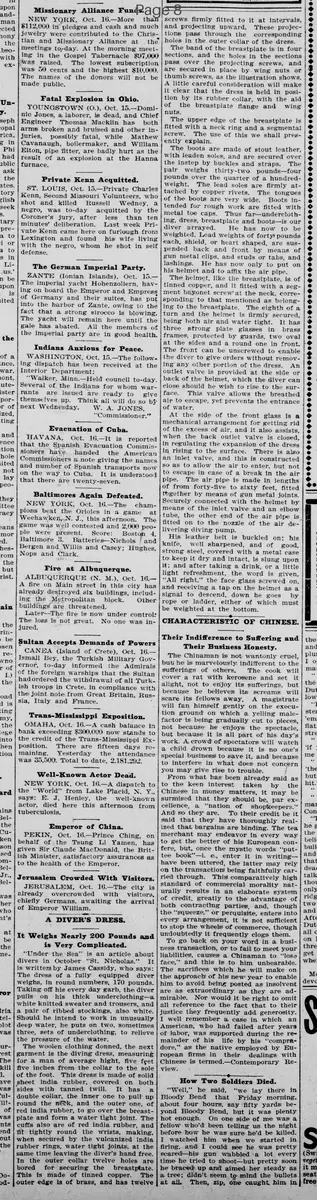
A DIVER'S DRESS.
It Weighs Nearly 200 Pounds and is Very Complicated.
"Under the Sea" is an article about divers in October "St. Nicholas." It is written by James Cassidy, who says:
The dress of a fully equipped diver weighs, in round numbers, 170 pounds. Taking off his every day garb, the diver pulls on his thick underclothing-a white knitted sweater and trousers, and a pair of ribbed stockings, also white. Should he intend to work in unusually deep water, he puts on two, sometimes three, sets of underclothing, to relieve the pressure of the water.
The woolen clothing donned, the next garment is the diving dress, measuring for a man of average height, five feet five inches from the collar to the sole of the foot. This dress is made of solid sheet india rubber, covered on both sides with tanned twill. It has a double collar, the inner one to pull up round the neck, and the outer one, of red india rubber, to go over the breastplate and form a water tight joint. The cuffs also are of red india rubber, and fit tightly round the wrists, making, when secured by the vulcanized india rubber rings, water tight joints, at the same time leaving the diver's hand free.
In the outer collar twelve holes are bored for securing the breastplate. This is made of tinned copper. The outer edge is of brass, and has twelve screws firmly fitted to it at intervals, and projecting upward. These projections pass through the corresponding holes in the outer collar of the dress. The band of the breastplate is in four sections, and the holes in the sections pass over the projecting screws, and are secured in place by wing nuts or thumb screws, as the illustration shows.
A little careful consideration will make it clear that the dress is held in position by its rubber collar, with the aid of the breastplate flange and wing nuts.
The upper edge of the breastplate is fitted with a neck ring and a segmental screw. The use of this we shall presently explain.
The boots are made of stout leather, with leaden soles, and are secured over the instep by buckles and straps. The pair weighs thirty-two pounds-four pounds over the quarter of a hundredweight. The lead soles are firmly attached by copper rivets. The tongues of the boots are very wide. Boots intended for rough work are fitted with metal toe caps. Thus far-underclothing, dress, breastplate and boots--is our diver arrayed.
"He has now to be weighted. Lead weights of forty pounds each, shield, or heart shaped, are suspended back and front by means of gun metal clips, and studs or tabs, and lashings. He has now only to put on his helmet and to affix the air pipe.
The helmet, like the breastplate, is of tinned copper, and it fitted with a segment bayonet screw at the neck, corresponding to that mentioned as belonging to the breastplate. The eighth of a turn and the helmet is firmly secured, being both air and water tight. It has three strong plate glasses in brass frames, protected by guards, two oval at the sides and a round one in front. The front can be unscrewed to enable the diver to give orders without removing any other portion of the dress. An outlet valve is provided at the side or back of the helmet, which the diver can close should he wish to rise to the surface. This valve allows the breathed air to escape, yet prevents the entrance of water.
At the side of the front glass is a mechanical arrangement for getting rid of the excess of air, and it also assists, when the back outlet valve is closed, in regulating the expansion of the dress in rising to the surface. There is also an inlet valve, and this is constructed so as to allow the air to enter, but not to escape in case of a break in the air pipe. The air pipe is made in lengths of from forty-five to sixty feet, fitted together by means of gun metal joints. Securely connected with the helmet by means of the inlet valve and an elbow tube, the other end of the air pipe is fitted on to the nozzle of the air delivering diving pump.
His leather belt is buckled on; his knife, well sharpened, and of good, strong steel, covered with a metal case to keep it dry and intact, is slung upon it; and after taking a drink, or a little light refreshment, the word is given, "All right," the face glass screwed on, and receiving a tap on the helmet as a signal to descend, down he goes by rope or ladder, either of which must be weighted at the bottom.
It Weighs Nearly 200 Pounds and is Very Complicated.
"Under the Sea" is an article about divers in October "St. Nicholas." It is written by James Cassidy, who says:
The dress of a fully equipped diver weighs, in round numbers, 170 pounds. Taking off his every day garb, the diver pulls on his thick underclothing-a white knitted sweater and trousers, and a pair of ribbed stockings, also white. Should he intend to work in unusually deep water, he puts on two, sometimes three, sets of underclothing, to relieve the pressure of the water.
The woolen clothing donned, the next garment is the diving dress, measuring for a man of average height, five feet five inches from the collar to the sole of the foot. This dress is made of solid sheet india rubber, covered on both sides with tanned twill. It has a double collar, the inner one to pull up round the neck, and the outer one, of red india rubber, to go over the breastplate and form a water tight joint. The cuffs also are of red india rubber, and fit tightly round the wrists, making, when secured by the vulcanized india rubber rings, water tight joints, at the same time leaving the diver's hand free.
In the outer collar twelve holes are bored for securing the breastplate. This is made of tinned copper. The outer edge is of brass, and has twelve screws firmly fitted to it at intervals, and projecting upward. These projections pass through the corresponding holes in the outer collar of the dress. The band of the breastplate is in four sections, and the holes in the sections pass over the projecting screws, and are secured in place by wing nuts or thumb screws, as the illustration shows.
A little careful consideration will make it clear that the dress is held in position by its rubber collar, with the aid of the breastplate flange and wing nuts.
The upper edge of the breastplate is fitted with a neck ring and a segmental screw. The use of this we shall presently explain.
The boots are made of stout leather, with leaden soles, and are secured over the instep by buckles and straps. The pair weighs thirty-two pounds-four pounds over the quarter of a hundredweight. The lead soles are firmly attached by copper rivets. The tongues of the boots are very wide. Boots intended for rough work are fitted with metal toe caps. Thus far-underclothing, dress, breastplate and boots--is our diver arrayed.
"He has now to be weighted. Lead weights of forty pounds each, shield, or heart shaped, are suspended back and front by means of gun metal clips, and studs or tabs, and lashings. He has now only to put on his helmet and to affix the air pipe.
The helmet, like the breastplate, is of tinned copper, and it fitted with a segment bayonet screw at the neck, corresponding to that mentioned as belonging to the breastplate. The eighth of a turn and the helmet is firmly secured, being both air and water tight. It has three strong plate glasses in brass frames, protected by guards, two oval at the sides and a round one in front. The front can be unscrewed to enable the diver to give orders without removing any other portion of the dress. An outlet valve is provided at the side or back of the helmet, which the diver can close should he wish to rise to the surface. This valve allows the breathed air to escape, yet prevents the entrance of water.
At the side of the front glass is a mechanical arrangement for getting rid of the excess of air, and it also assists, when the back outlet valve is closed, in regulating the expansion of the dress in rising to the surface. There is also an inlet valve, and this is constructed so as to allow the air to enter, but not to escape in case of a break in the air pipe. The air pipe is made in lengths of from forty-five to sixty feet, fitted together by means of gun metal joints. Securely connected with the helmet by means of the inlet valve and an elbow tube, the other end of the air pipe is fitted on to the nozzle of the air delivering diving pump.
His leather belt is buckled on; his knife, well sharpened, and of good, strong steel, covered with a metal case to keep it dry and intact, is slung upon it; and after taking a drink, or a little light refreshment, the word is given, "All right," the face glass screwed on, and receiving a tap on the helmet as a signal to descend, down he goes by rope or ladder, either of which must be weighted at the bottom.
What sub-type of article is it?
Essay
What keywords are associated?
Diving Suit
Breastplate
Helmet
Air Pipe
Lead Weights
Underclothing
Boots
What entities or persons were involved?
James Cassidy
Literary Details
Title
A Diver's Dress.
Author
James Cassidy
Subject
Description Of A Diver's Suit And Equipment
Form / Style
Descriptive Prose Article
Key Lines
The Dress Of A Fully Equipped Diver Weighs, In Round Numbers, 170 Pounds.
The Helmet, Like The Breastplate, Is Of Tinned Copper, And It Fitted With A Segment Bayonet Screw At The Neck, Corresponding To That Mentioned As Belonging To The Breastplate.
Down He Goes By Rope Or Ladder, Either Of Which Must Be Weighted At The Bottom.