Thank you for visiting SNEWPapers!
Sign up free
Virginia Argus
Richmond, Virginia
What is this article about?
Pennsylvania's Washington County Court of Common Pleas ruled that state courts have jurisdiction over suits for penalties under federal revenue laws, overruling motions to arrest judgment in United States v. Craig, United States v. Robinson, and United States v. Russel, involving unlicensed distilling and bond payments.
Merged-components note: Continuation of the law case 'The United States v. Craig' discussion across pages 2 and 3, based on sequential reading order and direct textual continuation.
Clippings
1 of 2
OCR Quality
Full Text
From the Pittsburg Mercury
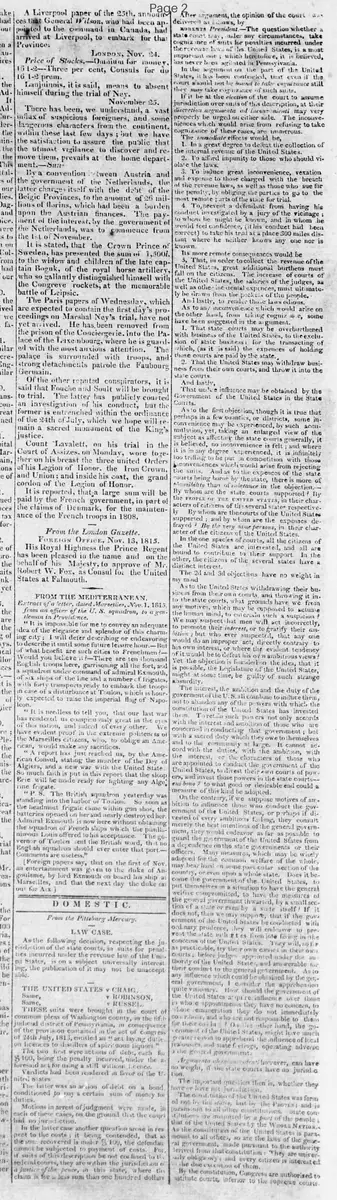
LAW CASE.
As the following decision, respecting the jurisdiction of the state courts, in suits for penalties incurred under the revenue law of the United States, is on a subject universally interesting, the publication of it may not be unacceptable.
THE UNITED STATES v. CRAIG.
Same,
v. ROBINSON.
Same,
v. RUSSEL.
These suits were brought in the court of common pleas of Washington county, in the fifth judicial district of Pennsylvania, in consequence of the provision contained in the act of congress of 24th July, 1813, entitled an "act laying duties on licences to distillers of spirituous liquors."
The two first were actions of debt, each for $100, being the penalty incurred, under the aforesaid act for using a still without licence.
Verdicts had been rendered in favor of the United States.
The latter was an action of debt on a bond, conditioned to pay a certain sum of money for duties.
Motions in arrest of judgment were made, in each of these cases, on the ground that the court had no jurisdiction.
In the latter case another question arose in respect to the costs; it being contended, that as the suit recovered is under $100, the defendant cannot be subjected to payment of costs. For, if suits of this description be not confined to the federal courts, they are within the jurisdiction of a justice of the peace, in this state, where the claim is for a less sum than one hundred dollars.
After argument, the opinion of the court was delivered as follows, by
Honors President.—The question whether a state court may, under any circumstances, take cognizance of suits for penalties incurred under the revenue laws of the United States, is a most important one; which heretofore, it is believed, has never been agitated in Pennsylvania.
In the argument on the part of the United States, it has been contended, that even if the court should not be bound to take cognizance still they may take cognizance of such suits. It being at the election of the court to assume jurisdiction over suits of this description, at their discretion argumenta ad inconvenienti may very properly be urged on either side. The inconveniences which would arise from refusing to take cognizance of these cases, are numerous.
The immediate effects would be,
1. In a great degree to defeat the collection of the internal revenue of the United States.
2. To afford impunity to those who should violate the laws.
3. To induce great inconvenience, vexation and expense to those charged with the breach of the revenue laws, as well as those who sue for the penalty, by obliging the parties to go to the most remote parts of the state for trial.
4. To prevent a defendant from having his conduct investigated by a jury of the vicinage: to whom he might be known, and in whom he would feel confidence, (if his conduct had been correct) to take his trial at a place 300 miles distant where he neither knows any one nor is known.
Its more remote consequences would be
5, That, in order to collect the revenue of the United States, great additional burthens must fall on the citizens. The increase of courts of the United States, the salaries of the judges, as well as other incidental expenses, must ultimately be drawn from the pockets of the people.
And lastly, to render those laws odious.
As to any inconvenience which would arise on the other hand, from taking cognizance, some have been suggested in the argument.
1. That state courts may be overburdened with business of the United States, to the exclusion of state business: for the transacting of which, (as it is said) the expenses of holding those courts are paid by the state.
2. That the United States may withdraw business from their own courts, and throw it into the state courts.
And lastly,
That undue influence may be obtained by the Government of the United States in the State Courts.
As to the first objection, though it is true that perhaps in a few counties, or districts, some inconvenience may be experienced, by such accumulation, yet, taking an enlarged view of the subject as affecting the state courts generally, it is believed, no inconvenience is felt; and where it is in any degree experienced, it is infinitely too trifling to be put in competition with those inconveniences which would arise from rejecting the suits. And as to the expenses of the state courts being borne by the state, there is more of plausibility than of substance in the objection.—
By whom are the state courts supported? By THE PEOPLE OF THE UNITED STATES, in THEIR CHARACTERS of citizens of the several states respectively. By whom are the courts of the United States supported; and by whom are the expenses defrayed? By the very same persons, in their character of the citizens of the United States.
In the one species of courts, all the citizens of the United States are interested, and all are bound to contribute to their support. In the other, the citizens of the several states have a distinct interest.
The 2d and 3d objections have no weight in my mind.
As to the United States withdrawing their business from their own courts, and throwing it into the state courts. what grounds have we from any motives, which may be supposed to actuate the human mind, to entertain such a suspicion?
We may suspect that men will act incorrectly, to promote their interest, or to gratify their ambition; but who ever suspected, that any one would do an improper act, directly contrary to his own interest, or where the evident tendency of it would be to defeat his own ambitious views?
Yet the objection is founded on the idea, that it is possible, the Legislature of the United States, might at some time, be guilty of such strange absurdity.
The interest, the ambition and the duty of the government of the U.S. all combine to induce them, not to abandon any of the powers with which the constitution of the United States has invested them. To retain such powers not only accords with the interest and ambition of those who are concerned in conducting that government; but with a sacred duty which they owe to themselves and to the community at large. It cannot accord with the duties. with the ambition, with the interest, or the characters of those who are appointed to conduct the government of the United States, to divest their own courts of powers, and invest those powers in the state courts—
eui bono? to what good or desirable end could a measure of this kind be adopted.
On the contrary, if we suppose motives of ambition to influence those who conduct the government of the United States, or perhaps if divested of every ambitious feeling, they consult merely the best interests of the general government, they would endeavor as far as possible to guard the government of the United States from a dependence on the state governments or their officers. Many measures, which may be wisely adopted for the common welfare of the whole, may bear hard on some particular section of the country, or even upon a whole state. Does it become the government of the United States, to put themselves in a situation to have the general welfare compromitted, to have the measures of the general government thwarted, by a small section of a state or even by a state itself? If it does not, then we may suppose, that if the government of the United States be conducted with ordinary prudence, they will endeavor to prevent the state authorities from interfering in the concerns of the United States. They will, so far as practicable. try their own causes in their own courts; before judges appointed under the authority of the United States. and answerable for their conduct to the general government. As to any influence which could be obtained by the general government, I consider the apprehension quite visionary. How should the government of the United States acquire influence over those in whose appointments they have no concern, to whose remuneration they do not immediately contribute, and who are not responsible to them for their conduct? On the other hand, the government of the United States, might have much greater reason to apprehend the influence of local jealousies, and state feelings, operating adversely to the general government.
Arguments of inconvenience however, can have no weight, if the state courts have no jurisdiction.
The important question then is, whether they have or have not jurisdiction.
The constitution of the United States was formed not by the states. but by the People; and is paramount to all other Constitutions. State constitutions are instituted by a part of the people that of the United States by the Whole Nation.—
As the constitution of the United States is paramount to all others, so are the laws of the general government, made pursuant to the authority derived from that constitution : They are universally obligatory; and every Citizen is interested in the due execution of them.
By the Constitution, Congress are authorised to institute courts, inferior to the supreme court.
It is not conceived to be necessary to assert, that under this clause, they may invest the state courts with power. The state courts are already invested with power to determine all civil and criminal causes, arising within the limits of their jurisdiction respectively, and all transitory actions arise where they may: debitum et contractus sunt nullius loci.
It has been urged as a reason for excluding suits of the United States, that the state courts are maintained at the expense of the particular states, for the benefit of their citizens respectively. This objection would apply with much greater force to exclude the citizens or subjects of foreign nations. They certainly do not contribute to the support of the particular state courts yet their suits are not excluded. Is it the United States alone, when appearing in the state courts in the character of a suitor, that shall be rejected? Are the claims of individuals, altogether unconnected with the state, of right to have all their claims enforced, and shall claims arising under the laws of the United States, laws made by common consent of all the citizens of the United States, for the common benefit of all, be rejected? As to claims arising on contracts made by individuals with the United States, it seems difficult to conceive upon what correct principles they could be excluded. Not only private citizens, subjects of foreign countries, but foreign sovereigns themselves may be received as suitors in our courts.
Upon what ground shall suits arising under the revenue laws of the United States be rejected? It is said they are penal laws: be it so: and what is the consequence? Are they penal laws of a foreign government? An idea so extravagant cannot be entertained. The penal laws, indeed, of a foreign country could not be enforced; for, although the comity of nations admits of a recovery, on a civil contract, made in a foreign sovereignty, in the decision whereof, the lex loci shall prevail, which law shall be proved as a fact, yet to enforce their penal statutes or laws, would involve a strange absurdity. The penal laws of every country are enforced not only against the citizens who transgress, but every man who treads the soil is subjected to them, and to them alone, as respects all crime, misdemeanors, and misfeasances, which subject to punishment or forfeitures.
That the constitution of the United States is universally obligatory throughout the United States, will not be denied. Every officer, not only of the federal government, but of the state government also, is sworn to support it. Now, the sixth article of that constitution contains the following provisions, viz. "This constitution, and the laws of the United States, which shall be made in pursuance thereof, and all treaties made or which shall be made under the authority of the United States, shall be the supreme law of the land: and the judges in every state shall be bound thereby, any thing in the constitution or laws of any state, to the contrary thereof notwithstanding."
At the first session of the Congress of the United States, held under the constitution, in the "act to establish the judicial courts of the United States," passed on the 24th September, 1789, we find Congress declaring in what cases the courts of the United States should have exclusive jurisdiction, and where jurisdiction concurrent with the state courts. I refer to this act, not on account of any particular provision contained in it, but as a contemporaneous exposition of the constitution, in respect to the powers which Congress derive under it, of determining where the federal courts shall have exclusive jurisdiction, and where jurisdiction concurrent with the courts of the several states.
The laws on which the present question arises are enacted by the legislature of the United States, pursuant to the powers with which the whole people have invested them, by the constitution of the United States. They are, in the words of the constitution, "the supreme law of the land," by which every individual in the United States is bound. They are enacted for the general benefit of all the citizens of the United States. The revenue for the collection of which the law in question provides, is collected for the mutual benefit of all the citizens. The money arising from the collection belongs to them. Every fraud committed against the revenue is a fraud by which every citizen of the United States suffers, unless it be the fraudulent individual. All then are interested in enforcing those laws. What shall prevent a state court from enforcing them?
The difficulty seems to have arisen, from a want of distinguishing the true grounds upon which the suits, in which the United States may be a party are determinable in the courts of the United States.
The 3rd art. of the constitution of the United States, 1, provides, that "the judicial power of the United States shall be vested in one supreme court, and in such inferior courts, as the Congress may from time to time ordain and establish."
This article vests in the general government a power essential to the supreme authority in a nation. It invests them with the privilege of having all their causes determined in their own courts; but this, like every other privilege, may be waived.
By the 2d s of the 3rd art, it is declared, that "the judicial power of the United States shall extend to all cases in law and equity, arising under the constitution and laws of the United States and treaties made, or which shall be made under their authority; to all cases affecting ambassadors, and other public ministers and consuls; to all cases of admiralty & maritime jurisdiction: to controversies, to which the United States shall be a party; to controversies between two or more states; between a state and the citizens of another state: between citizens of different states; between citizens of the same state, claiming lands under grants of different states; and between a state, or the citizens thereof, and foreign states, citizens, or subjects."
Now, it is evident that this section, from the beginning to the end, confers, privileges, which may or may not be waived. Citizens of different states have a right to prosecute their claims in the federal courts. But can it be imagined that they may not waive the privilege! It not only may be, but actually is waived, in three cases out of four; perhaps in nine cases out of ten. Shall it be said that an ambassador, or other public minister, may not waive this privilege; And if it may be waived by these, shall it not be in the power of the United States to waive their privilege? The error arises from not distinguishing between conferring jurisdiction and waiving a right or privilege. I do not believe that the United States can confer power on our courts, to transact business different from that for the transacting of which they are constituted. They could not, for instance, give power to a court constituted for transacting of criminal business only, to try civil causes; but where the business is of such a nature, that the court might and would take cognizance of it if not precluded by the privilege: the privilege being waived, the court cannot avoid taking cognizance.
The act of congress, by which this privilege is waived, may be considered rather as directory to their own officers, in respect to instituting suits. The party privileged to sue, or be sued, in a particular court, may insist upon the privilege himself; but it would be anomalous in the administration of justice, for one to set up the privilege of his adversary to exclude him.
At an early period of our government, when its revenue depended on external duties, the jurisdiction, in respect to fines and penalties, was by act of congress, confined to the federal courts. • See 1 Vol. U. S. Laws, 47.
in when an internal revenue was contemplated, concurrent jurisdiction was given to the state courts. The stamp act [passed in 1797] declares that the penalties and forfeitures shall be sued for, by bill, or information, in any circuit or district court of the United States, or in any court of either of the states. A similar provision for the recovery of penalties is contained in the act to provide for the valuation of lands, &c.
These provisions were made with a view to the case of the citizens, and to facilitate the collection of the revenue. With the like view, has the provision in the act in question been introduced.
The privilege being thus waived, it becomes the duty of those prosecuting on behalf of the United States, within the limits prescribed, to sue in the state courts. And we are of the opinion, that there is nothing to prevent the court from taking cognizance of such causes, and that we are bound to take cognizance of them.
The only remaining question is, whether in an action of debt, upon a bond, which might have been prosecuted in a court of the United States, were the sum recovered in this court, is less than one hundred dollars, costs shall be awarded.
Costs are incident to the recovery of the debt, unless the act giving jurisdiction to justices of the peace of "all causes of action arising from contract either express or implied, where the sum demanded is not above one hundred dollars," could apply to this case; but we are of opinion that the act cannot apply.
This is a case in which a justice of the peace could have no jurisdiction, at least, unless the United States had waived the privilege, which pertains to them, and permitted the suit to be instituted before him, which has not been done.
Motions in arrest of judgment over-ruled: and judgment for the United States in each of the cases.
‡ 4 Vol. U S. Laws, 33.
Vol. U. S Laws, 158.
What sub-type of article is it?
What keywords are associated?
What entities or persons were involved?
Where did it happen?
Domestic News Details
Primary Location
Washington County, Pennsylvania
Key Persons
Outcome
motions in arrest of judgment over-ruled; judgment for the united states in each case.
Event Details
Suits brought in the court of common pleas of Washington county, Pennsylvania, under the act of Congress of 24th July 1813 for penalties on unlicensed distilling and bond for duties; court affirmed jurisdiction of state courts over federal revenue penalty suits and awarded costs where applicable.