Thank you for visiting SNEWPapers!
Sign up free
Imperial Valley Press
El Centro, Imperial County, California
What is this article about?
Flaxseed markets strengthened toward the end of the 1937-38 season, with prices rising from late May lows, per the Bureau of Agricultural Economics review. Key factors for 1938-39 include low July 1 stocks, expected larger Argentine crop, steady oil consumption, and low European oil stocks offsetting larger US holdings.
Clipping
OCR Quality
Full Text
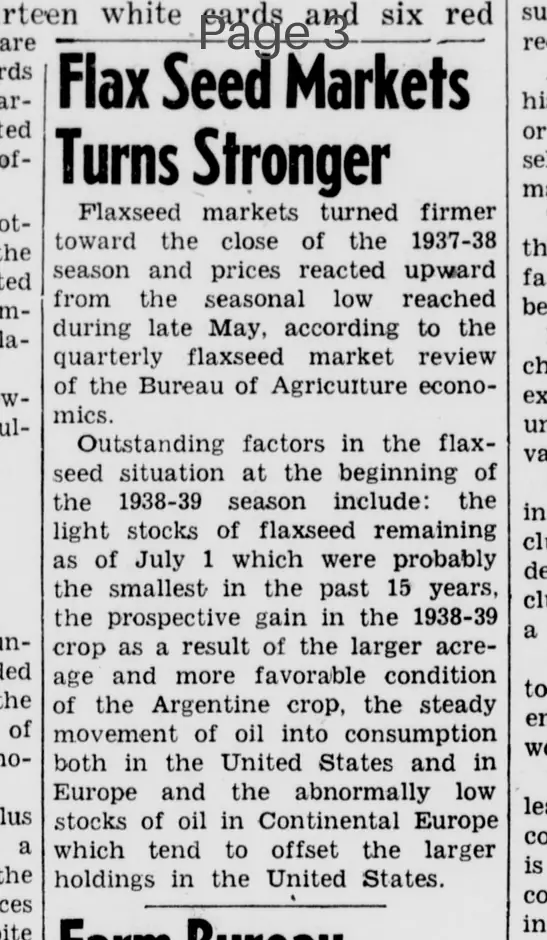
Flaxseed markets turned firmer toward the close of the 1937-38 season and prices reacted upward from the seasonal low reached during late May, according to the quarterly flaxseed market review of the Bureau of Agriculture economics.
Outstanding factors in the flaxseed situation at the beginning of the 1938-39 season include: the light stocks of flaxseed remaining as of July 1 which were probably the smallest in the past 15 years, the prospective gain in the 1938-39 crop as a result of the larger acreage and more favorable condition of the Argentine crop, the steady movement of oil into consumption both in the United States and in Europe and the abnormally low stocks of oil in Continental Europe which tend to offset the larger holdings in the United States.
What sub-type of article is it?
What keywords are associated?
Where did it happen?
Domestic News Details
Primary Location
United States
Event Date
1937 38 Season To 1938 39 Season
Outcome
markets turned firmer; prices reacted upward from late may low; light stocks as of july 1, smallest in 15 years; prospective crop gain
Event Details
Flaxseed markets turned firmer toward the close of the 1937-38 season and prices reacted upward from the seasonal low reached during late May, according to the quarterly flaxseed market review of the Bureau of Agriculture economics. Outstanding factors in the flaxseed situation at the beginning of the 1938-39 season include: the light stocks of flaxseed remaining as of July 1 which were probably the smallest in the past 15 years, the prospective gain in the 1938-39 crop as a result of the larger acreage and more favorable condition of the Argentine crop, the steady movement of oil into consumption both in the United States and in Europe and the abnormally low stocks of oil in Continental Europe which tend to offset the larger holdings in the United States.