Thank you for visiting SNEWPapers!
Sign up free
Letter to Editor
September 25, 1802
Rhode Island Republican
Newport, Newport County, Rhode Island
What is this article about?
A spectator reports examining letters published in the Rhode-Island Republican, claiming they are forgeries by John Rutledge disguised as Nicholas Geffroy. He accuses Rutledge's friends of predetermined denial, lack of candor in comparison, and intent to create a riot to seize the letters.
Clipping
OCR Quality
95%
Excellent
Full Text
For the RHODE-ISLAND REPUBLICAN.
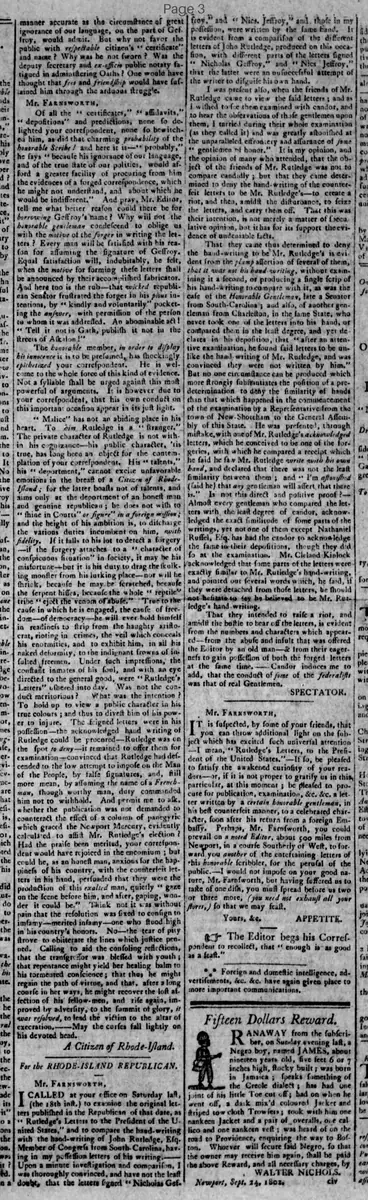
Mr. Farnsworth,
CALLED at your office on Saturday last, (the 18th inst.) to examine the original letters published in the Republican of that date, as "Rutledge's Letters to the President of the United States," and to compare the hand-writing with the hand-writing of John Rutledge, Esq. Member of Congress from South-Carolina, having in my possession letters of his writing.
Upon a minute investigation and comparison, I was thoroughly convinced, and have not the least doubt, that the letters signed "Nicholas Geffroy." and "Nics. Jeffroy." and those in my possession, were written by the same hand. It is evident from a comparison of the different letters of John Rutledge, produced on this occasion, with different parts of the letters signed "Nicholas Geffroy," and "Nics. Jeffroy." that the latter were an successful attempt of the writer to disguise his own hand.
I was present also, when the friends of Mr. Rutledge came to view the said letters; and as I wished to see them examined with candor, and to hear the observations of those gentlemen upon them, I carried during their whole examination (as they called it) and was greatly astonished at the unparalleled effrontery and assurance of some "gentlemen of honor." It is my opinion, and the opinion of many who attended, that the object of the friends of Mr. Rutledge was not to compare candidly; but that they came determined to deny the hand-writing of the counterfeit letters to be Mr. Rutledge's--to create a riot, and then, amidst the disturbance, to seize the letters, and carry them off. That this was their intention, is not merely a matter of speculative opinion, but it has for its support the evidence of undeniable facts.
That they came thus determined to deny the hand-writing to be Mr. Rutledge' is evident from the plump assertion of several of them, that it was not his hand-writing, without examining it a second, or producing a single scrap of his hand-writing to compare with it, as was the case of the Honorable Gentleman, late a Senator from South-Carolina: and also, of another gentleman from Charleston, in the same State, who never took one of the letters into his hand, or compared them in the least degree, and yet declares in his deposition, that "after an attentive examination, he found said letters to be unlike the hand-writing of Mr. Rutledge, and was convinced they were not written by him."
But no one circumstance can be produced which more strongly substantiates the position of a pre-determination to deny the similarity of hands than that which happened in the commencement of the examination by a Representative from the town of New-Shoreham to the General Assembly of this State. He was presented, through mistake, with one of Mr. Rutledge's acknowledged letters, which he conceived to be one of the forgeries, with which he compared a receipt which he said he saw Mr. Rutledge write with his own hand, and declared that there was not the least similarity between them; and "I'm astonished (said he) that any gentleman will assert that there is." Is not this direct and positive proof?--
Almost every gentleman who compared the letters with the least degree of candor, acknowledged the exact similitude of some parts of the writings, yet not one of them except Nathaniel Russell, Esq. has had the candor to acknowledge the same in their depositions, though they did so at the examination. Mr. Cleland Kinlock acknowledged that some parts of the letters were exactly similar to Mr. Rutledge's hand-writing. and pointed out several words which, he said, if they were detached from those letters, he should not hesitate to say he believed to be Mr. Rutledge's hand writing.
That they intended to raise a riot, and amidst the bustle to bear off the letters, is evident from the numbers and characters which appeared--from the abuse and insult that was offered the Editor by an old man--& from their eagerness to gain possession of both the forged letters at the same time.--Candor induces me to add, that the conduct of some of the federalists was that of real Gentlemen.
SPECTATOR.
Mr. Farnsworth,
CALLED at your office on Saturday last, (the 18th inst.) to examine the original letters published in the Republican of that date, as "Rutledge's Letters to the President of the United States," and to compare the hand-writing with the hand-writing of John Rutledge, Esq. Member of Congress from South-Carolina, having in my possession letters of his writing.
Upon a minute investigation and comparison, I was thoroughly convinced, and have not the least doubt, that the letters signed "Nicholas Geffroy." and "Nics. Jeffroy." and those in my possession, were written by the same hand. It is evident from a comparison of the different letters of John Rutledge, produced on this occasion, with different parts of the letters signed "Nicholas Geffroy," and "Nics. Jeffroy." that the latter were an successful attempt of the writer to disguise his own hand.
I was present also, when the friends of Mr. Rutledge came to view the said letters; and as I wished to see them examined with candor, and to hear the observations of those gentlemen upon them, I carried during their whole examination (as they called it) and was greatly astonished at the unparalleled effrontery and assurance of some "gentlemen of honor." It is my opinion, and the opinion of many who attended, that the object of the friends of Mr. Rutledge was not to compare candidly; but that they came determined to deny the hand-writing of the counterfeit letters to be Mr. Rutledge's--to create a riot, and then, amidst the disturbance, to seize the letters, and carry them off. That this was their intention, is not merely a matter of speculative opinion, but it has for its support the evidence of undeniable facts.
That they came thus determined to deny the hand-writing to be Mr. Rutledge' is evident from the plump assertion of several of them, that it was not his hand-writing, without examining it a second, or producing a single scrap of his hand-writing to compare with it, as was the case of the Honorable Gentleman, late a Senator from South-Carolina: and also, of another gentleman from Charleston, in the same State, who never took one of the letters into his hand, or compared them in the least degree, and yet declares in his deposition, that "after an attentive examination, he found said letters to be unlike the hand-writing of Mr. Rutledge, and was convinced they were not written by him."
But no one circumstance can be produced which more strongly substantiates the position of a pre-determination to deny the similarity of hands than that which happened in the commencement of the examination by a Representative from the town of New-Shoreham to the General Assembly of this State. He was presented, through mistake, with one of Mr. Rutledge's acknowledged letters, which he conceived to be one of the forgeries, with which he compared a receipt which he said he saw Mr. Rutledge write with his own hand, and declared that there was not the least similarity between them; and "I'm astonished (said he) that any gentleman will assert that there is." Is not this direct and positive proof?--
Almost every gentleman who compared the letters with the least degree of candor, acknowledged the exact similitude of some parts of the writings, yet not one of them except Nathaniel Russell, Esq. has had the candor to acknowledge the same in their depositions, though they did so at the examination. Mr. Cleland Kinlock acknowledged that some parts of the letters were exactly similar to Mr. Rutledge's hand-writing. and pointed out several words which, he said, if they were detached from those letters, he should not hesitate to say he believed to be Mr. Rutledge's hand writing.
That they intended to raise a riot, and amidst the bustle to bear off the letters, is evident from the numbers and characters which appeared--from the abuse and insult that was offered the Editor by an old man--& from their eagerness to gain possession of both the forged letters at the same time.--Candor induces me to add, that the conduct of some of the federalists was that of real Gentlemen.
SPECTATOR.
What sub-type of article is it?
Investigative
Persuasive
Provocative
What themes does it cover?
Politics
What keywords are associated?
Rutledge Forgery
Handwriting Comparison
Political Scandal
Rhode Island Republican
Letter Seizure Attempt
What entities or persons were involved?
Spectator.
Mr. Farnsworth,
Letter to Editor Details
Author
Spectator.
Recipient
Mr. Farnsworth,
Main Argument
the letters signed 'nicholas geffroy' and 'nics. jeffroy' are forgeries by john rutledge, as proven by handwriting comparison; his friends predetermined to deny this, lacked candor, and intended to create a riot to seize the letters.
Notable Details
Handwriting Comparison At Farnsworth's Office On The 18th Inst.
Friends' Denial Without Proper Examination
Mistake With New Shoreham Representative
Acknowledgments By Nathaniel Russell And Cleland Kinlock
Abuse Towards The Editor
Conduct Of Federalists