Thank you for visiting SNEWPapers!
Sign up free
Literary
March 21, 1958
The Coastland Times
Manteo, Dare County, North Carolina
What is this article about?
Ben Dixon MacNeill reflects on the record cold winter at Cape Hatteras, where the Gulf Stream has nearly frozen, bringing codfish from northern waters. He critiques radio weather experts for ignoring water temperatures and highlights local knowledge, park improvements, and the unique island climate.
Clipping
OCR Quality
98%
Excellent
Full Text
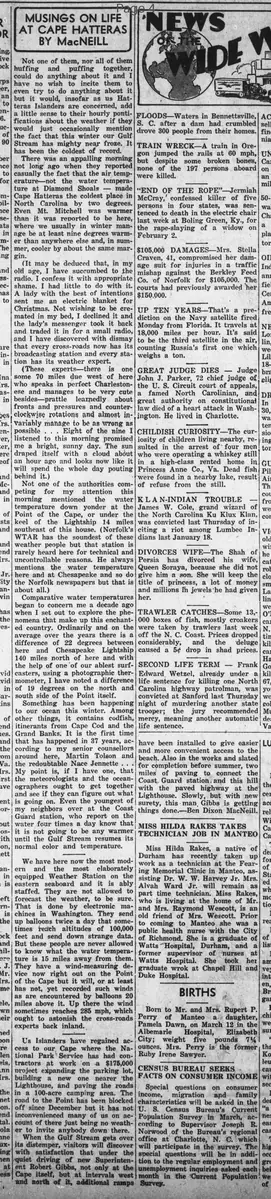
MUSINGS ON LIFE
AT CAPE HATTERAS
BY MacNEILL
Not one of them, nor all of them huffing and puffing together, could do anything about it and I have no wish to incite them to even try to do anything about it but it would, insofar as us Hatteras Islanders are concerned, add a little sense to their hourly pontifications about the weather if they would just occasionally mention the fact that this winter our Gulf Stream has mighty near froze. It has been the coldest of record.
There was an appalling morning not long ago when they reported casually the fact that the air temperature not the water temperature at Diamond Shoals - made Cape Hatteras the coldest place in North Carolina by two degrees. Even Mt. Mitchell was warmer than it was reported to be here where 'we usually in winter manage be at least nine degrees warmer than anywhere else and, in summer, cooler by about the same margin.
(It may be deduced that, in my old age, I have succumbed to the radio. I confess it with appropriate shame. I had little to do with it. A lady with the best of intentions sent me an electric blanket for Christmas. Not wishing to be cremated in my bed, I declined it and the lady's messenger took it back and traded it in for a small radio, and I have discovered with dismay that every cross-roads now has its broadcasting station and every station has its weather expert.
(These experts—there is one some 70 miles due west of here who speaks in perfect Charleston-ese and manages to be very cute besides—prattle learnedly about fronts and pressures and counter-clockwise rotations and almost invariably manage to be as wrong as possible . . . Eight of the nine I listened to this morning promised me a bright, sunny day. The sun draped itself with a cloud about an hour ago and looks now like it will spend the whole day pouting behind it.)
Not one of the authorities competing for my attention this morning mentioned the water temperature down yonder at the Point of the Cape, or under the keel of the Lightship 14 miles southeast of this house. (Norfolk's WTAR has the soundest of these weather people but that station is rarely heard here for technical and uncontrollable reasons. He always mentions the water temperature here and at Chesapeake and so do the Norfolk newspapers but that is about all.)
Comparative water temperatures began to concern me a decade ago when I set out to explore the phenomena that make up this enchanted country. Ordinarily and on the average over the years there is a difference of 22 degrees between here and Chesapeake Lightship 140 miles north of here and with the help of one of our ablest surfcasters, using a photographic thermometer, I have noted a difference of 19 degrees on the north and south side of the Point itself.
Something has been happening to our ocean this winter. Among other things, it contains codfish, itinerants from Cape Cod and the Grand Banks. It is the first time that has happened in 37 years, according to my senior counsellors around here, Martin Tolson and the redoubtable Nace Jennette . . .
My point is, if I have one, that the meteorologists and the oceanographers ought to get together and see if they can figure out what is going on. Even the youngest of my neighbors over at the Coast Guard station, who report on the water four times a day know that it is not going to be any warmer until the Gulf Stream resumes its normal color and temperature.
We have here now the most modern and the most elaborately equipped Weather Station on the eastern seaboard and it is ably staffed. They are not allowed to forecast the weather, to be sure. That is done by electronic machines in Washington. They send up balloons twice a day that sometimes reach altitudes of 100,000 feet and send down strange data. But these people are never allowed to know what the water temperature is 15 miles away from them. They have a wind-measuring device now right out on the Point of the Cape but it will, or at least has not, yet recorded such winds as are encountered by balloons 20 miles above it. Up there the wind sometimes reaches 285 mph, which ought to astonish the cross-roads experts back inland.
Us Islanders have regained access to our Cape where the National Park Service has had contractors at work on a $175,000 project expanding the parking lot, building a new one nearer the Lighthouse, and paving the roads in a 100-acre camping area. The road to the Point has been blocked off since December but it has not inconvenienced many of us on account of there just being no weather to invite anybody down there.
When the Gulf Stream gets over its distemper, visitors will discover with satisfaction that under the quiet driving of new Superintendent Robert Gibbs, not only at the Cape itself, but at intervals west and north of it, additional ramps have been installed to give easier and more convenient access to the beach. Also in the works and slated for completion before summer, two miles of paving to connect the Coast Guard station, and this hill with the paved highway at the Lighthouse. Slowly, but with new surety, this man, Gibbs is getting things done.—Ben Dixon MacNeill.
AT CAPE HATTERAS
BY MacNEILL
Not one of them, nor all of them huffing and puffing together, could do anything about it and I have no wish to incite them to even try to do anything about it but it would, insofar as us Hatteras Islanders are concerned, add a little sense to their hourly pontifications about the weather if they would just occasionally mention the fact that this winter our Gulf Stream has mighty near froze. It has been the coldest of record.
There was an appalling morning not long ago when they reported casually the fact that the air temperature not the water temperature at Diamond Shoals - made Cape Hatteras the coldest place in North Carolina by two degrees. Even Mt. Mitchell was warmer than it was reported to be here where 'we usually in winter manage be at least nine degrees warmer than anywhere else and, in summer, cooler by about the same margin.
(It may be deduced that, in my old age, I have succumbed to the radio. I confess it with appropriate shame. I had little to do with it. A lady with the best of intentions sent me an electric blanket for Christmas. Not wishing to be cremated in my bed, I declined it and the lady's messenger took it back and traded it in for a small radio, and I have discovered with dismay that every cross-roads now has its broadcasting station and every station has its weather expert.
(These experts—there is one some 70 miles due west of here who speaks in perfect Charleston-ese and manages to be very cute besides—prattle learnedly about fronts and pressures and counter-clockwise rotations and almost invariably manage to be as wrong as possible . . . Eight of the nine I listened to this morning promised me a bright, sunny day. The sun draped itself with a cloud about an hour ago and looks now like it will spend the whole day pouting behind it.)
Not one of the authorities competing for my attention this morning mentioned the water temperature down yonder at the Point of the Cape, or under the keel of the Lightship 14 miles southeast of this house. (Norfolk's WTAR has the soundest of these weather people but that station is rarely heard here for technical and uncontrollable reasons. He always mentions the water temperature here and at Chesapeake and so do the Norfolk newspapers but that is about all.)
Comparative water temperatures began to concern me a decade ago when I set out to explore the phenomena that make up this enchanted country. Ordinarily and on the average over the years there is a difference of 22 degrees between here and Chesapeake Lightship 140 miles north of here and with the help of one of our ablest surfcasters, using a photographic thermometer, I have noted a difference of 19 degrees on the north and south side of the Point itself.
Something has been happening to our ocean this winter. Among other things, it contains codfish, itinerants from Cape Cod and the Grand Banks. It is the first time that has happened in 37 years, according to my senior counsellors around here, Martin Tolson and the redoubtable Nace Jennette . . .
My point is, if I have one, that the meteorologists and the oceanographers ought to get together and see if they can figure out what is going on. Even the youngest of my neighbors over at the Coast Guard station, who report on the water four times a day know that it is not going to be any warmer until the Gulf Stream resumes its normal color and temperature.
We have here now the most modern and the most elaborately equipped Weather Station on the eastern seaboard and it is ably staffed. They are not allowed to forecast the weather, to be sure. That is done by electronic machines in Washington. They send up balloons twice a day that sometimes reach altitudes of 100,000 feet and send down strange data. But these people are never allowed to know what the water temperature is 15 miles away from them. They have a wind-measuring device now right out on the Point of the Cape but it will, or at least has not, yet recorded such winds as are encountered by balloons 20 miles above it. Up there the wind sometimes reaches 285 mph, which ought to astonish the cross-roads experts back inland.
Us Islanders have regained access to our Cape where the National Park Service has had contractors at work on a $175,000 project expanding the parking lot, building a new one nearer the Lighthouse, and paving the roads in a 100-acre camping area. The road to the Point has been blocked off since December but it has not inconvenienced many of us on account of there just being no weather to invite anybody down there.
When the Gulf Stream gets over its distemper, visitors will discover with satisfaction that under the quiet driving of new Superintendent Robert Gibbs, not only at the Cape itself, but at intervals west and north of it, additional ramps have been installed to give easier and more convenient access to the beach. Also in the works and slated for completion before summer, two miles of paving to connect the Coast Guard station, and this hill with the paved highway at the Lighthouse. Slowly, but with new surety, this man, Gibbs is getting things done.—Ben Dixon MacNeill.
What sub-type of article is it?
Essay
What themes does it cover?
Nature
Seasonal Cycle
What keywords are associated?
Cape Hatteras
Gulf Stream
Cold Winter
Weather Experts
Island Life
Ocean Anomalies
National Park
What entities or persons were involved?
Ben Dixon Macneill
Literary Details
Title
Musings On Life At Cape Hatteras
Author
Ben Dixon Macneill
Subject
On The Cold Winter And Gulf Stream Anomalies At Cape Hatteras
Key Lines
Not One Of Them, Nor All Of Them Huffing And Puffing Together, Could Do Anything About It And I Have No Wish To Incite Them To Even Try To Do Anything About It But It Would, Insofar As Us Hatteras Islanders Are Concerned, Add A Little Sense To Their Hourly Pontifications About The Weather If They Would Just Occasionally Mention The Fact That This Winter Our Gulf Stream Has Mighty Near Froze.
Something Has Been Happening To Our Ocean This Winter. Among Other Things, It Contains Codfish, Itinerants From Cape Cod And The Grand Banks.
My Point Is, If I Have One, That The Meteorologists And The Oceanographers Ought To Get Together And See If They Can Figure Out What Is Going On.
We Have Here Now The Most Modern And The Most Elaborately Equipped Weather Station On The Eastern Seaboard And It Is Ably Staffed.