Thank you for visiting SNEWPapers!
Sign up free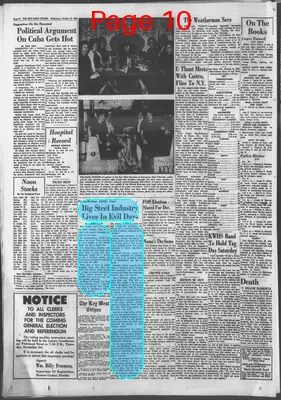
The Key West Citizen
Key West, Monroe County, Florida
What is this article about?
The $16-billion U.S. steel industry is in a slump with profits at 16-year lows, exemplified by U.S. Steel's dividend cut and earnings drop. Causes include economic stagnation, competition from imports and substitutes, stockpiling, pricing battles with Kennedy, and outdated plants. Impacts broader employment and prosperity.
Clipping
OCR Quality
Full Text
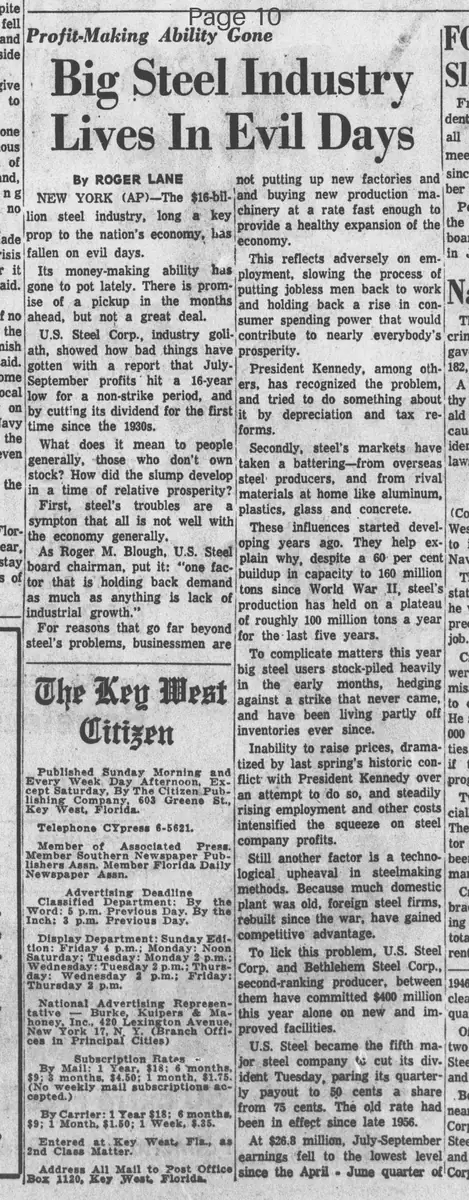
Big Steel Industry Lives In Evil Days
By Roger Lane
NEW YORK (AP)—The $16-billion steel industry, long a key pillar, has fallen on evil days.
Its money-making ability has gone to pot lately. There is promise of a pickup in the months ahead, but not a great deal.
U.S. Steel Corp., industry colossus, showed how bad things have gotten with a report that July-September profits hit a 16-year low for a non-strike period, and by cutting its dividend for the first time since the 1930s.
What does it mean to people generally, those who don't own stock? How did the slump develop in a time of relative prosperity?
First, steel's troubles are a symptom that all is not well with the economy generally.
As Roger M. Blough, U.S. Steel board chairman, put it: "one factor that is holding back demand as much as anything is lack of industrial growth."
For reasons that go far beyond steel's problems, businessmen are not putting up new factories and buying new production machinery at a rate fast enough to provide a healthy expansion of the economy.
This reflects adversely on employment, slowing the process of putting jobless men back to work and holding back a rise in consumer spending power that would contribute to nearly everybody's prosperity.
President Kennedy, among others, has recognized the problem, and tried to do something about it by depreciation and tax reforms.
Secondly, steel's markets have taken a battering—from overseas steel producers and from rival materials at home like aluminum, plastics, glass and concrete.
These influences started developing years ago. They help explain why, despite a 60 per cent buildup in capacity to 160 million tons since World War II, steel's production has held on a plateau of roughly 100 million tons a year for the last five years.
To complicate matters this year big steel users stock-piled heavily in the early months, hedging against a strike that never came, and have been living partly off inventories ever since.
Inability to raise prices, dramatized by last spring's historic conflict with President Kennedy over an attempt to do so, and steadily rising employment and other costs intensified the squeeze on steel company profits.
Still another factor is a technological upheaval in steelmaking methods. Because much domestic plant was old, foreign steel firms, rebuilt since the war, have gained competitive advantage.
To lick this problem, U.S. Steel Corp. and Bethlehem Steel Corp., second-ranking producer, between them have committed $400 million this year alone on new and improved facilities.
U.S. Steel became the fifth major steel company to cut its dividend Tuesday, paring its quarterly payout to 50 cents a share from 75 cents. The old rate had been in effect since late 1956.
At $26.8 million, July-September earnings fell to the lowest level since the April-June quarter of 1946 when $13.9 million was cleared. Profits in the 1961 third quarter were $51.8 million.
Of the 10 largest steel firms, two went into the red - Kaiser Steel Corp. and Colorado Fuel and Iron Corp.
Bethlehem's earnings dropped nearly 60 per cent, Republic Steel Corp.'s fell 45 per cent, National Steel Corp.'s about 35 per cent and Jones & Laughlin Steel Corp.'s almost 80 per cent.
What sub-type of article is it?
What themes does it cover?
What keywords are associated?
What entities or persons were involved?
Where did it happen?
Story Details
Key Persons
Location
New York
Event Date
July September 1962
Story Details
The U.S. steel industry faces declining profits due to lack of industrial growth, foreign and domestic competition, stockpiling by users, inability to raise prices, rising costs, and outdated facilities. U.S. Steel reports lowest non-strike quarterly earnings in 16 years and cuts dividend for first time since 1930s. Other major firms see sharp profit drops, with two in the red.