Thank you for visiting SNEWPapers!
Sign up free
Domestic News
January 9, 1806
Alexandria Daily Advertiser
Alexandria, Virginia
What is this article about?
The Middlesex Gazette reports complaints of canker worms returning to damage apple orchards and proposes a method to destroy their eggs by scraping bark in fall and using turf barriers on trunks in spring to prevent worms from ascending, followed by shaking trees to dislodge them.
Clipping
OCR Quality
95%
Excellent
Full Text
From the MIDDLESEX GAZETTE.
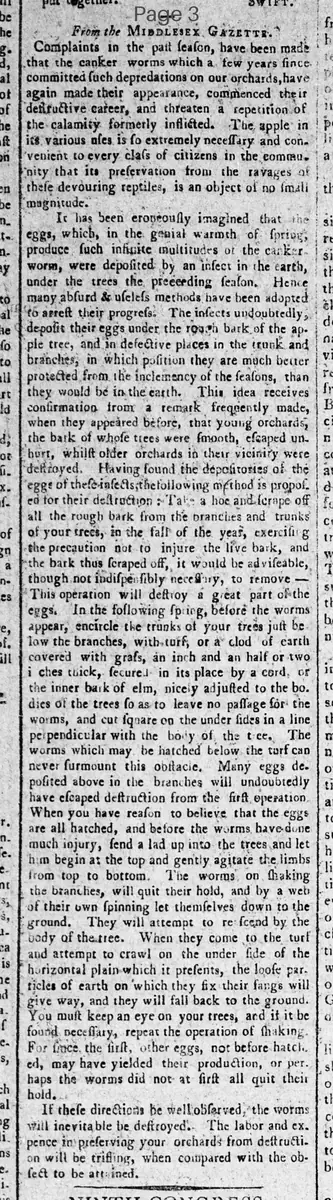
Complaints in the past season, have been made that the canker worms which a few years since committed such depredations on our orchards, have again made their appearance, commenced their destructive career, and threaten a repetition of the calamity formerly inflicted. The apple in its various uses is so extremely necessary and convenient to every class of citizens in the community that its preservation from the ravages of these devouring reptiles, is an object of no small magnitude.
It has been erroneously imagined that the eggs, which, in the genial warmth of spring, produce such infinite multitudes of the canker worm, were deposited by an insect in the earth, under the trees the preceding season. Hence many absurd & useless methods have been adopted to arrest their progress: The insects undoubtedly, deposit their eggs under the rough bark of the apple tree, and in defective places in the trunk and branches, in which position they are much better protected from the inclemency of the seasons, than they would be in the earth. This idea receives confirmation from a remark frequently made, when they appeared before, that young orchards, the bark of whose trees were smooth, escaped unhurt, whilst older orchards in their vicinity were destroyed. Having found the depositories of the eggs of these insects, the following method is proposed for their destruction: Take a hoe and scrape off all the rough bark from the branches and trunks of your trees, in the fall of the year, exercising the precaution not to injure the live bark, and the bark thus scraped off, it would be advisable, though not indispensably necessary, to remove -- This operation will destroy a great part of the eggs. In the following spring, before the worms appear, encircle the trunks of your trees just below the branches, with turf, or a clod of earth covered with grass, an inch and an half or two inches thick,- secured in its place by a cord, or the inner bark of elm, nicely adjusted to the bodies of the trees so as to leave no passage for the worms, and cut square on the under sides in a line perpendicular with the body of the tree. The worms which may be hatched below the turf can never surmount this obstacle. Many eggs deposited above in the branches will undoubtedly have escaped destruction from the first operation. When you have reason to believe that the eggs are all hatched, and before the worms have done much injury, send a lad up into the trees and let him begin at the top and gently agitate the limbs from top to bottom. The worms' on shaking the branches, will quit their hold, and by a web of their own spinning let themselves down to the ground. They will attempt to re-ascend by the body of the tree. When they come to the turf and attempt to crawl on the under side of the horizontal plain which it presents, the loose particles of earth on which they fix their fangs will give way, and they will fall back to the ground. You must keep an eye on your trees, and if it be found necessary, repeat the operation of shaking. For since the first, other eggs, not before hatched, may have yielded their production, or perhaps the worms did not at first all quit their hold..
If these directions be well observed, the worms will inevitably be destroyed.. The labor and expense in preserving your orchards from destruction will be trifling, when compared with the object to be attained.
Complaints in the past season, have been made that the canker worms which a few years since committed such depredations on our orchards, have again made their appearance, commenced their destructive career, and threaten a repetition of the calamity formerly inflicted. The apple in its various uses is so extremely necessary and convenient to every class of citizens in the community that its preservation from the ravages of these devouring reptiles, is an object of no small magnitude.
It has been erroneously imagined that the eggs, which, in the genial warmth of spring, produce such infinite multitudes of the canker worm, were deposited by an insect in the earth, under the trees the preceding season. Hence many absurd & useless methods have been adopted to arrest their progress: The insects undoubtedly, deposit their eggs under the rough bark of the apple tree, and in defective places in the trunk and branches, in which position they are much better protected from the inclemency of the seasons, than they would be in the earth. This idea receives confirmation from a remark frequently made, when they appeared before, that young orchards, the bark of whose trees were smooth, escaped unhurt, whilst older orchards in their vicinity were destroyed. Having found the depositories of the eggs of these insects, the following method is proposed for their destruction: Take a hoe and scrape off all the rough bark from the branches and trunks of your trees, in the fall of the year, exercising the precaution not to injure the live bark, and the bark thus scraped off, it would be advisable, though not indispensably necessary, to remove -- This operation will destroy a great part of the eggs. In the following spring, before the worms appear, encircle the trunks of your trees just below the branches, with turf, or a clod of earth covered with grass, an inch and an half or two inches thick,- secured in its place by a cord, or the inner bark of elm, nicely adjusted to the bodies of the trees so as to leave no passage for the worms, and cut square on the under sides in a line perpendicular with the body of the tree. The worms which may be hatched below the turf can never surmount this obstacle. Many eggs deposited above in the branches will undoubtedly have escaped destruction from the first operation. When you have reason to believe that the eggs are all hatched, and before the worms have done much injury, send a lad up into the trees and let him begin at the top and gently agitate the limbs from top to bottom. The worms' on shaking the branches, will quit their hold, and by a web of their own spinning let themselves down to the ground. They will attempt to re-ascend by the body of the tree. When they come to the turf and attempt to crawl on the under side of the horizontal plain which it presents, the loose particles of earth on which they fix their fangs will give way, and they will fall back to the ground. You must keep an eye on your trees, and if it be found necessary, repeat the operation of shaking. For since the first, other eggs, not before hatched, may have yielded their production, or perhaps the worms did not at first all quit their hold..
If these directions be well observed, the worms will inevitably be destroyed.. The labor and expense in preserving your orchards from destruction will be trifling, when compared with the object to be attained.
What sub-type of article is it?
Agriculture
What keywords are associated?
Canker Worms
Apple Orchards
Pest Destruction
Bark Scraping
Turf Barrier
Domestic News Details
Event Date
Past Season
Outcome
destruction of canker worm eggs and worms, preservation of apple orchards
Event Details
Complaints of canker worms reappearing and damaging orchards; eggs deposited under rough bark; method proposed: scrape bark in fall to destroy eggs, encircle trunks with turf in spring to block worms, shake trees to dislodge them