Thank you for visiting SNEWPapers!
Sign up free
Story
March 19, 1802
The National Intelligencer And Washington Advertiser
Washington, District Of Columbia
What is this article about?
Congressional speech defending the judiciary act as a necessary reform, not partisan, proposed in 1791 amid Federalist strength. Quotes Randolph's 1790 critique of amalgamating supreme and circuit courts, advocating separation for impartial justice.
Clipping
OCR Quality
98%
Excellent
Full Text
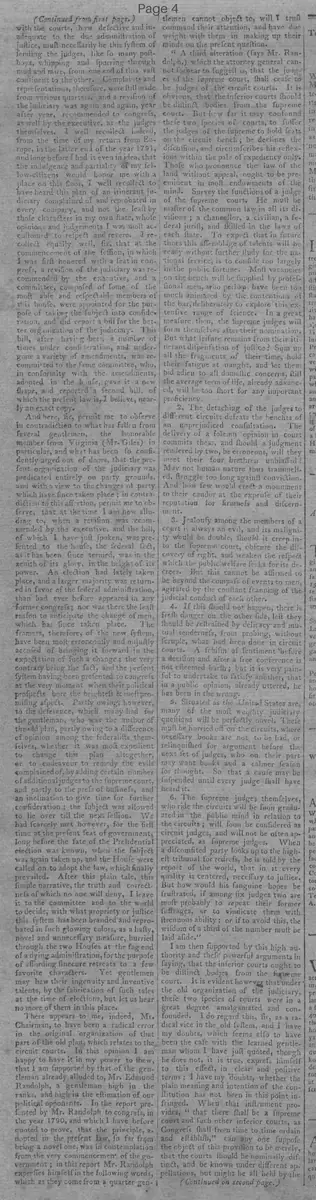
(Continued from first page.)
With the courts, how defective and inadequate to the due administration of justice, must necessarily be this system of sending the judges, like so many post-boys, whipping and spurring through mud and mire, from one end of this vast continent to the other. Complaints and representations, therefore, were still made from various quarters, and a revision of the judiciary was again and again, year after year, recommended to Congress, as well by the executive, as the judges themselves. I well recollect indeed, from the time of my return from Europe, in the latter end of the year 1791, and long before I had it even in idea, that the indulgence and partiality of my fellow-citizens would honor me with a place on this floor, I well recollect to have heard this plan of an itinerant judiciary complained of and reprobated in every company, and not the least by those characters in my own state, whose opinions and judgements I was wont accustomed to respect and revere. I recollect equally well, sir, that at the commencement of the session, in which I was first honored with a seat in Congress, a revision of the judiciary was recommended by the executive, and a committee, composed of some of the most able and respectable members of this house, were appointed for the purpose of taking the subject into consideration, and did report a bill for the better organization of the judiciary. This bill, after having been a number of times under consideration, and undergone a variety of amendments, was recommitted to the same committee, who, in conformity with the amendments, adopted in the house, gave it a new shape, and reported a second bill, of which the present law is, I believe, nearly an exact copy.
And here, sir, permit me to observe in contradiction to what has fallen from several gentlemen, the honorable member from Virginia (Mr. Giles) in particular, and what has been so confidently argued out of doors, that the present organization of the judiciary was predicated entirely on party grounds, and with a view to the changes of party which have since taken place; in contradiction to this assertion, permit me to observe, that at the time I am now alluding to, when a revision was recommended by the executive, and the bill, of which I have just spoken, was presented to the house, the federal sect, as it has been since termed, was in the zenith of its glory, in the height of its power. An election had lately taken place, and a larger majority was returned in favor of the federal administration, than had ever before appeared in any former Congress; nor was there the least reason to anticipate the change of men, which has since taken place. The framers, therefore, of the new system, have been most erroneously and unjustly accused of bringing it forward in the expectation of such a change; the very contrary being the fact, and the present system having been presented to Congress at the very moment when their political prospects bore the brightest & most promising aspect. Partly owing, however, to the deference, which many had for the gentleman, who was the author of the old plan, partly owing to a difference of opinion among the federalists themselves, whether it was most expedient to change this plan altogether, or to endeavour to remedy the evils complained of, by adding certain number of additional judges to the supreme court, and partly to the press of business, and an inclination to give time for further consideration; the subject was allowed to lie over till the next session. We had scarcely met however, for the first time at the present seat of government, long before the fate of the Presidential election was known, when the subject was again taken up, and the House were called on to adopt the law, which finally prevailed. After this plain tale, this simple narrative, the truth and correctness of which no one will deny, I leave it to the committee and to the world to decide, with what propriety or justice this system has been branded and reprobated in such glowing colors, as a hasty, novel and unnecessary measure, hurried through the two Houses at the fag end of a dying administration, for the purpose of affording insecure retreats to a few favorite characters. Yet gentlemen may shew their ingenuity and inventive talents, by the fabrication of such tales at the time of elections, but let us hear no more of them in this place.
There appears to me, indeed, Mr. Chairman, to have been a radical error in the original organization of that part of the old plan, which relates to the circuit courts. In this opinion I am happy to have it in my power to shew, that I am supported by that of the gentleman already alluded to, Mr. Edmund Randolph, a gentleman high in the ranks, and high in the estimation of our political opponents. In the report presented by Mr. Randolph to Congress, in the year 1790, and which I have before quoted to prove, that the principle, adopted in the present law, so far from being a novel one, was in contemplation from the very commencement of the government; in this report Mr. Randolph expresses himself in the following words, which as they come from a quarter gentlemen cannot object to, will I trust command their attention, and have due weight with them in making up their minds on the present question.
"A third alteration (says Mr. Randolph,) which the attorney general cannot forbear to suggest is, that the judges of the supreme court, shall cease to be judges of the circuit courts. It is obvious, that the inferior courts should be distinct bodies from the supreme court. But how far it may confound these two species of courts, to suffer the judges of the supreme to hold seats on the circuit bench: he declines the discussion, and circumscribes his reflections within the pale of expediency only. Those who pronounce the law of the land without appeal, ought to be pre-eminent in most endowments of the mind. Survey the functions of a judge of the supreme court. He must be master of the common law in all its divisions; a chancellor, a civilian, a federal jurist, and skilled in the laws of each state. To expect that in future times this assemblage of talents will be ready without further study for the national service, is to confide too largely in the public fortune. Most vacancies on the bench will be supplied by professional men, who perhaps, have been too much animated by the contentions of the bar, deliberately to explore this extensive range of science. In a great measure then, the supreme judges will form themselves after their nomination. But what leisure remains from their itinerant dispensation of justice? Sum up all the fragments of their time, hold their fatigue at naught, and let them bid adieu to all domestic concerns, still the average term of life, already advanced, will be too short for any important proficiency.
2. The detaching of the judges to different circuits defeats the benefits of an unprejudiced consultation. The delivery of a solemn opinion in court commits them, and should a judgment rendered by two, be erroneous, will they meet their four brethren unbiased? May not human nature thus trammelled, struggle too long against conviction. And how few would erect a monument to their candor at the expense of their reputation for acuteness and discernment.
3. Jealousy among the members of a court is always an evil, and its malignity would be double, should it creep in to the supreme court, obscure the discovery of right, and weaken the respect which the public welfare seeks for its decrees. But this cannot be affirmed to be beyond the compass of events to men, agitated by the constant scanning of the judicial conduct of each other.
4. If this should not happen, there is fresh danger on the other side, lest they should be restrained by delicacy and mutual tenderness, from probing, without scruple, what had been done in circuit Courts. A chasm of sentiment before a decision and after a free conference is not deemed harsh; but it is very painful to undertake to satisfy another, that in a public opinion, already uttered, he has been in the wrong.
5. Situated as the United States are, many of the most weighty judiciary questions will be perfectly novel. These must be hurried off on the circuits, where necessary books are not to be had, or relinquished for argument before the next set of judges, who on their part may want books and a calmer season for thought. So that a cause may be suspended until every judge shall have heard it.
6. The supreme judges themselves, who ride the circuits will be soon graduated in the public mind in relation to the circuits; will soon be considered as circuit judges, and will not be often appreciated, as supreme judges. When a discomfited party looks up to the highest tribunal for redress, he is told by the report of the world, that in it every quality is centered, necessary to justice. But how would his sanguine hopes be frustrated, if among six judges two are most probably to repeat their former suffrages, or to vindicate them with strenuous ability; or if to avoid this, the wisdom of a third of the number must be laid aside."
I am then supported by this high authority and these powerful arguments in saying, that the inferior courts ought to be distinct bodies from the supreme court. It is evident however that under the old organization of the judiciary, these two species of courts were in a great degree amalgamated and confounded. I do regard this, sir, as a radical vice in the old system, and I have my doubts, which seems also to have been the case with the learned gentleman whom I have just quoted, though he does not, it is true, express himself to this effect, in clear and positive terms; I have my doubts, whether the plain meaning and intention of the constitution has not been in this point infringed. When that instrument provides, "that there shall be a supreme court and such other inferior courts, as Congress shall from time to time ordain and establish," can any one suppose the object of this provision to be merely, that the courts should be nominally distinct, and be known under different appellations, but might be all held by the
(Continued on second page.)
With the courts, how defective and inadequate to the due administration of justice, must necessarily be this system of sending the judges, like so many post-boys, whipping and spurring through mud and mire, from one end of this vast continent to the other. Complaints and representations, therefore, were still made from various quarters, and a revision of the judiciary was again and again, year after year, recommended to Congress, as well by the executive, as the judges themselves. I well recollect indeed, from the time of my return from Europe, in the latter end of the year 1791, and long before I had it even in idea, that the indulgence and partiality of my fellow-citizens would honor me with a place on this floor, I well recollect to have heard this plan of an itinerant judiciary complained of and reprobated in every company, and not the least by those characters in my own state, whose opinions and judgements I was wont accustomed to respect and revere. I recollect equally well, sir, that at the commencement of the session, in which I was first honored with a seat in Congress, a revision of the judiciary was recommended by the executive, and a committee, composed of some of the most able and respectable members of this house, were appointed for the purpose of taking the subject into consideration, and did report a bill for the better organization of the judiciary. This bill, after having been a number of times under consideration, and undergone a variety of amendments, was recommitted to the same committee, who, in conformity with the amendments, adopted in the house, gave it a new shape, and reported a second bill, of which the present law is, I believe, nearly an exact copy.
And here, sir, permit me to observe in contradiction to what has fallen from several gentlemen, the honorable member from Virginia (Mr. Giles) in particular, and what has been so confidently argued out of doors, that the present organization of the judiciary was predicated entirely on party grounds, and with a view to the changes of party which have since taken place; in contradiction to this assertion, permit me to observe, that at the time I am now alluding to, when a revision was recommended by the executive, and the bill, of which I have just spoken, was presented to the house, the federal sect, as it has been since termed, was in the zenith of its glory, in the height of its power. An election had lately taken place, and a larger majority was returned in favor of the federal administration, than had ever before appeared in any former Congress; nor was there the least reason to anticipate the change of men, which has since taken place. The framers, therefore, of the new system, have been most erroneously and unjustly accused of bringing it forward in the expectation of such a change; the very contrary being the fact, and the present system having been presented to Congress at the very moment when their political prospects bore the brightest & most promising aspect. Partly owing, however, to the deference, which many had for the gentleman, who was the author of the old plan, partly owing to a difference of opinion among the federalists themselves, whether it was most expedient to change this plan altogether, or to endeavour to remedy the evils complained of, by adding certain number of additional judges to the supreme court, and partly to the press of business, and an inclination to give time for further consideration; the subject was allowed to lie over till the next session. We had scarcely met however, for the first time at the present seat of government, long before the fate of the Presidential election was known, when the subject was again taken up, and the House were called on to adopt the law, which finally prevailed. After this plain tale, this simple narrative, the truth and correctness of which no one will deny, I leave it to the committee and to the world to decide, with what propriety or justice this system has been branded and reprobated in such glowing colors, as a hasty, novel and unnecessary measure, hurried through the two Houses at the fag end of a dying administration, for the purpose of affording insecure retreats to a few favorite characters. Yet gentlemen may shew their ingenuity and inventive talents, by the fabrication of such tales at the time of elections, but let us hear no more of them in this place.
There appears to me, indeed, Mr. Chairman, to have been a radical error in the original organization of that part of the old plan, which relates to the circuit courts. In this opinion I am happy to have it in my power to shew, that I am supported by that of the gentleman already alluded to, Mr. Edmund Randolph, a gentleman high in the ranks, and high in the estimation of our political opponents. In the report presented by Mr. Randolph to Congress, in the year 1790, and which I have before quoted to prove, that the principle, adopted in the present law, so far from being a novel one, was in contemplation from the very commencement of the government; in this report Mr. Randolph expresses himself in the following words, which as they come from a quarter gentlemen cannot object to, will I trust command their attention, and have due weight with them in making up their minds on the present question.
"A third alteration (says Mr. Randolph,) which the attorney general cannot forbear to suggest is, that the judges of the supreme court, shall cease to be judges of the circuit courts. It is obvious, that the inferior courts should be distinct bodies from the supreme court. But how far it may confound these two species of courts, to suffer the judges of the supreme to hold seats on the circuit bench: he declines the discussion, and circumscribes his reflections within the pale of expediency only. Those who pronounce the law of the land without appeal, ought to be pre-eminent in most endowments of the mind. Survey the functions of a judge of the supreme court. He must be master of the common law in all its divisions; a chancellor, a civilian, a federal jurist, and skilled in the laws of each state. To expect that in future times this assemblage of talents will be ready without further study for the national service, is to confide too largely in the public fortune. Most vacancies on the bench will be supplied by professional men, who perhaps, have been too much animated by the contentions of the bar, deliberately to explore this extensive range of science. In a great measure then, the supreme judges will form themselves after their nomination. But what leisure remains from their itinerant dispensation of justice? Sum up all the fragments of their time, hold their fatigue at naught, and let them bid adieu to all domestic concerns, still the average term of life, already advanced, will be too short for any important proficiency.
2. The detaching of the judges to different circuits defeats the benefits of an unprejudiced consultation. The delivery of a solemn opinion in court commits them, and should a judgment rendered by two, be erroneous, will they meet their four brethren unbiased? May not human nature thus trammelled, struggle too long against conviction. And how few would erect a monument to their candor at the expense of their reputation for acuteness and discernment.
3. Jealousy among the members of a court is always an evil, and its malignity would be double, should it creep in to the supreme court, obscure the discovery of right, and weaken the respect which the public welfare seeks for its decrees. But this cannot be affirmed to be beyond the compass of events to men, agitated by the constant scanning of the judicial conduct of each other.
4. If this should not happen, there is fresh danger on the other side, lest they should be restrained by delicacy and mutual tenderness, from probing, without scruple, what had been done in circuit Courts. A chasm of sentiment before a decision and after a free conference is not deemed harsh; but it is very painful to undertake to satisfy another, that in a public opinion, already uttered, he has been in the wrong.
5. Situated as the United States are, many of the most weighty judiciary questions will be perfectly novel. These must be hurried off on the circuits, where necessary books are not to be had, or relinquished for argument before the next set of judges, who on their part may want books and a calmer season for thought. So that a cause may be suspended until every judge shall have heard it.
6. The supreme judges themselves, who ride the circuits will be soon graduated in the public mind in relation to the circuits; will soon be considered as circuit judges, and will not be often appreciated, as supreme judges. When a discomfited party looks up to the highest tribunal for redress, he is told by the report of the world, that in it every quality is centered, necessary to justice. But how would his sanguine hopes be frustrated, if among six judges two are most probably to repeat their former suffrages, or to vindicate them with strenuous ability; or if to avoid this, the wisdom of a third of the number must be laid aside."
I am then supported by this high authority and these powerful arguments in saying, that the inferior courts ought to be distinct bodies from the supreme court. It is evident however that under the old organization of the judiciary, these two species of courts were in a great degree amalgamated and confounded. I do regard this, sir, as a radical vice in the old system, and I have my doubts, which seems also to have been the case with the learned gentleman whom I have just quoted, though he does not, it is true, express himself to this effect, in clear and positive terms; I have my doubts, whether the plain meaning and intention of the constitution has not been in this point infringed. When that instrument provides, "that there shall be a supreme court and such other inferior courts, as Congress shall from time to time ordain and establish," can any one suppose the object of this provision to be merely, that the courts should be nominally distinct, and be known under different appellations, but might be all held by the
(Continued on second page.)
What sub-type of article is it?
Historical Event
What themes does it cover?
Justice
What keywords are associated?
Judiciary Reform
Circuit Courts
Supreme Court
Federalists
Edmund Randolph
Judicial Organization
What entities or persons were involved?
Mr. Giles
Edmund Randolph
Where did it happen?
Congress
Story Details
Key Persons
Mr. Giles
Edmund Randolph
Location
Congress
Event Date
1790 1791
Story Details
A speaker defends the judiciary revision against claims of partisanship, noting it was proposed when Federalists were strong. Quotes Edmund Randolph's 1790 report criticizing the old system's amalgamation of supreme and circuit courts, arguing for separation to ensure better justice administration.