Thank you for visiting SNEWPapers!
Sign up free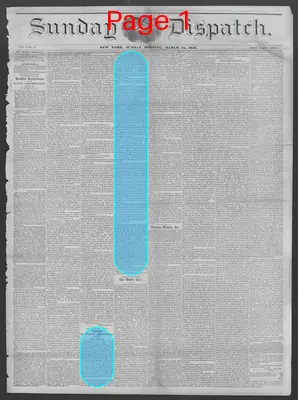
Story
March 15, 1846
Sunday Dispatch
New York, New York County, New York
What is this article about?
Satirical sketch of Ohio Congressman Joshua R. Giddings, an abolitionist from Ashtabula District, portrayed as a demagogue using anti-slavery rhetoric for votes. Includes anecdote of predecessor Elisha Whittlesey defying President Tyler by resigning rather than dismissing post office staff.
Clipping
OCR Quality
95%
Excellent
Full Text
[Written for the Sunday Dispatch.]
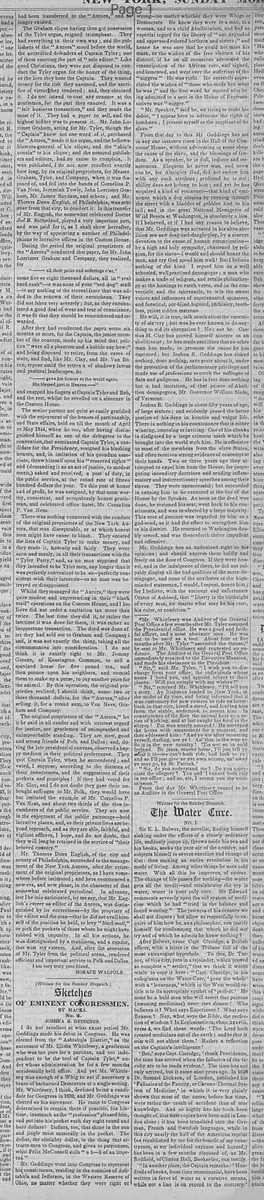
Sketches
OF EMINENT CONGRESSMEN.
BY MACKS.
No. 2.
JOSHUA R. GIDDINGS.
I do not recollect at what exact period Mr.
Giddings made his debut in Congress. He was
elected from the “Ashtabula District,” as the
successor of Mr. Elisha Whittlesey, a gentleman
who was too pure for a partizan, and too inde-
pendent to be the tool of Captain Tyler,* un-
der whose administration he for a few months
accidentally held office. And yet Mr. Whittlesey
was enough of a Whig to eat if necessary a
brace of barbecued Democrats at a single setting.
Mr. Whittlesey, I think, declined being a candi-
date for Congress in 1839, and Mr. Giddings was
elected as his successor. He came to Congress
determined to remain there if possible, his life-
time, inasmuch as the “profession” pleased him,
and put into his pocket each day eight round and
hard dollars! Dollars, too, that shine in the sun
and jingle most musically in the pocket. The
dollar, the almighty dollar, is the thing that at-
tracts men to Congress, and gives to patriotism,
what Felix McConnell calls “a h—ll of an impe-
tus.”
Mr. Giddings went into Congress to represent
his constituents, residing in the counties of Ash-
tabula and Jefferson, in the Western Reserve of
Ohio, no matter whether they were right or
wrong—no matter whether they were Whigs or
Democrats. He knew they were to a man, to a
woman, and to a child Abolitionists, and had an
especial regard for the liberty of “our degraded
and oppressed colored brethren and sisters;” and
hence he was sure that he could not miss his
mark, or the wishes of the free electors of his
district, if he on all occasions advocated the
emancipation of the African race, and sighed,
and lamented, and wept over the sufferings of the
“niggers.” He was right. He correctly appre-
ciated the wishes of “those who made him what
he was;” and the first word he uttered after be-
ing admitted to a seat in the House of Represen-
tatives was “nigger.”
“Mr. Speaker,” said he, on rising to make his
maiden speech, “I appear here to advocate the rights of
bondmen; I present myself as the suppliant of the
slave.”
From that day to this Mr. Giddings has not
in any one instance risen in the Hall of the Con-
gress House, without advocating in some shape
the cause of the slave, and the blessings of free-
dom. As a speaker, he is dull, tedious and me-
notonous. Eloquent he never was, and never
can be, for Almighty God, did not endow him
with any such attribute; profound he is not:
ability does not belong to him; and yet he has
acquired a kind of eminence—that kind of emi-
nence which a dog obtains by running through
the street with a bladder of pebbles tied to his
tail; and in the great National Menagerie of
Wild Beasts at Washington, is absolutely a lion.
If I believed, or if I had any reason to believe,
that Mr. Giddings was actuated in his ultra-abo-
lition sea-saw drag-and-dangle-play, by a sincere
devotion to the cause of human emancipation—
by a high and holy sympathy, chastened by reli-
gion, for the slave—I would and should honor the
man, and cry God speed him well! But I believe
nothing of the kind. I regard him as a well
schooled, well practised demagogue; a man who
makes a trade of religion, and retails philanthro-
py at the hustings to catch votes, and in the con-
venticle and the tabernacle, to win the sweet
voices and influences of superannuated spinsters,
and fanatical, pur-blind, bigoted, phthisicy, tooth-
less, priest ridden matrons.
He will, it is true, talk much about the enormi-
ty of slavery; but was he ever known to do any-
thing to aid its abrogation? No; not he. Cas-
sius M. Clay has proved himself sincere as an
abolitionist; he has made sacrifices that no other
man has made, to promote the cause he has
espoused: but Joshua R. Giddings has risked
othing, done nothing, save prate about it, under
the protection of the parliamentary privilege and
made use of professions to catch the suffrages of
flats and gudgeons. He has in fact done nothing
but a bad imitation, of that prince of Aboli-
tion demagogues, Mr. Governor William Slade,
of Vermont.
Joshua R. Giddings is about fifty years of age,
of large stature; and evidently passed the better
portion of his days in humble and vulgar life.
There is nothing in his countenance that is either
winning, imposing or inviting. One of his cheeks
is disfigured by a large crimson mark which he
brought into the world with him. He is offensive
to most of the members from the slave States,
and often receives strong evidence of contempt at
their hands. Two or three years ago they at-
tempted to expel him from the House, for propo-
gating incendiary doctrines and sending inflam-
matory and insurrectionary speeches among their
slaves. They were unsuccessful; but succeeded
in causing him to be censured at the bar of the
House by the Speaker. As soon as the deed was
done, he resigned his seat, went back to his con-
stituents, and was re-elected by a large majority.
This vote of censure was regarded by him as a
god-send, as it had the effect to strengthen him
in his district. He returned to Washington dou-
bly armed, and was thenceforth thrice impudent
and offensive.
Mr. Giddings has an undoubted right to his
opinions; and should express them boldly and
freely on the floor of Congress. If they were hon-
est, and in the indulgence of them, he did not pal-
pably display all the bad qualities of the mere de-
magogue, and none of the attributes of the high-
minded statesman, I would, I repeat, honor him;
for I believe, with the eminent and unfortunate
Orator of Ashland, that “liberty is the birthright
of every man, no matter what may be his caste,
his color, or condition.”
*Mr. Whittlesey was Auditor of the General
Post Office a few months after Mr. Tyler assumed
the Presidential office. He was a good and faith-
ful officer, and a most obstinate man. He was
not to be used as a tool. About four or five
months after Mr. Tyler “ascended the throne,”
he sent to Mr. Whittlesey and requested an au-
dience. The Auditor of the General Post Office
immediately repaired to the Executive Mansion,
and made his obeisance to the President.
“Sir,” said Mr. Tyler, “I wish you to dis-
charge from your office, the individuals whose
name I hand you, and appoint others to their
places. Will you comply with my wishes?”
“Sir,” returned Mr. Whittlesey. “I'll tell you
a story. An Irishman landed in New York, in
the midst of fly time, and being informed that it
was customary for new comers to ride on horse-
back in that city, hired a steed, and leading him
from the stable, undertook to mount him. In
consequence of the flies the animal kept up a se-
ries of kicking, and at last caught his hoof in the
stirrup! Pat was utterly amazed! He surveyed
the horse with amazement for a moment, and
thus addressed him: And ye are after mounting
yerself, darling, are ye? An' this is the way ye
do it in the new country! 'Tis not so in ould
Ireland. Be jasus, master horse, I'll just tell ye
what it is—we can't both ride, bad luck to ye;
and so I'll just give ye yer own stirrup, an' away
ye may go, by St. Patrick.'"
“Sir, do you understand me? Do you appre-
ciate the allegory? You and I cannot both rule
in my office; and so, sir, I return you my com-
mission.”
From that day Mr. Whittlesey ceased to be
an Auditor in the General Post Office.
Sketches
OF EMINENT CONGRESSMEN.
BY MACKS.
No. 2.
JOSHUA R. GIDDINGS.
I do not recollect at what exact period Mr.
Giddings made his debut in Congress. He was
elected from the “Ashtabula District,” as the
successor of Mr. Elisha Whittlesey, a gentleman
who was too pure for a partizan, and too inde-
pendent to be the tool of Captain Tyler,* un-
der whose administration he for a few months
accidentally held office. And yet Mr. Whittlesey
was enough of a Whig to eat if necessary a
brace of barbecued Democrats at a single setting.
Mr. Whittlesey, I think, declined being a candi-
date for Congress in 1839, and Mr. Giddings was
elected as his successor. He came to Congress
determined to remain there if possible, his life-
time, inasmuch as the “profession” pleased him,
and put into his pocket each day eight round and
hard dollars! Dollars, too, that shine in the sun
and jingle most musically in the pocket. The
dollar, the almighty dollar, is the thing that at-
tracts men to Congress, and gives to patriotism,
what Felix McConnell calls “a h—ll of an impe-
tus.”
Mr. Giddings went into Congress to represent
his constituents, residing in the counties of Ash-
tabula and Jefferson, in the Western Reserve of
Ohio, no matter whether they were right or
wrong—no matter whether they were Whigs or
Democrats. He knew they were to a man, to a
woman, and to a child Abolitionists, and had an
especial regard for the liberty of “our degraded
and oppressed colored brethren and sisters;” and
hence he was sure that he could not miss his
mark, or the wishes of the free electors of his
district, if he on all occasions advocated the
emancipation of the African race, and sighed,
and lamented, and wept over the sufferings of the
“niggers.” He was right. He correctly appre-
ciated the wishes of “those who made him what
he was;” and the first word he uttered after be-
ing admitted to a seat in the House of Represen-
tatives was “nigger.”
“Mr. Speaker,” said he, on rising to make his
maiden speech, “I appear here to advocate the rights of
bondmen; I present myself as the suppliant of the
slave.”
From that day to this Mr. Giddings has not
in any one instance risen in the Hall of the Con-
gress House, without advocating in some shape
the cause of the slave, and the blessings of free-
dom. As a speaker, he is dull, tedious and me-
notonous. Eloquent he never was, and never
can be, for Almighty God, did not endow him
with any such attribute; profound he is not:
ability does not belong to him; and yet he has
acquired a kind of eminence—that kind of emi-
nence which a dog obtains by running through
the street with a bladder of pebbles tied to his
tail; and in the great National Menagerie of
Wild Beasts at Washington, is absolutely a lion.
If I believed, or if I had any reason to believe,
that Mr. Giddings was actuated in his ultra-abo-
lition sea-saw drag-and-dangle-play, by a sincere
devotion to the cause of human emancipation—
by a high and holy sympathy, chastened by reli-
gion, for the slave—I would and should honor the
man, and cry God speed him well! But I believe
nothing of the kind. I regard him as a well
schooled, well practised demagogue; a man who
makes a trade of religion, and retails philanthro-
py at the hustings to catch votes, and in the con-
venticle and the tabernacle, to win the sweet
voices and influences of superannuated spinsters,
and fanatical, pur-blind, bigoted, phthisicy, tooth-
less, priest ridden matrons.
He will, it is true, talk much about the enormi-
ty of slavery; but was he ever known to do any-
thing to aid its abrogation? No; not he. Cas-
sius M. Clay has proved himself sincere as an
abolitionist; he has made sacrifices that no other
man has made, to promote the cause he has
espoused: but Joshua R. Giddings has risked
othing, done nothing, save prate about it, under
the protection of the parliamentary privilege and
made use of professions to catch the suffrages of
flats and gudgeons. He has in fact done nothing
but a bad imitation, of that prince of Aboli-
tion demagogues, Mr. Governor William Slade,
of Vermont.
Joshua R. Giddings is about fifty years of age,
of large stature; and evidently passed the better
portion of his days in humble and vulgar life.
There is nothing in his countenance that is either
winning, imposing or inviting. One of his cheeks
is disfigured by a large crimson mark which he
brought into the world with him. He is offensive
to most of the members from the slave States,
and often receives strong evidence of contempt at
their hands. Two or three years ago they at-
tempted to expel him from the House, for propo-
gating incendiary doctrines and sending inflam-
matory and insurrectionary speeches among their
slaves. They were unsuccessful; but succeeded
in causing him to be censured at the bar of the
House by the Speaker. As soon as the deed was
done, he resigned his seat, went back to his con-
stituents, and was re-elected by a large majority.
This vote of censure was regarded by him as a
god-send, as it had the effect to strengthen him
in his district. He returned to Washington dou-
bly armed, and was thenceforth thrice impudent
and offensive.
Mr. Giddings has an undoubted right to his
opinions; and should express them boldly and
freely on the floor of Congress. If they were hon-
est, and in the indulgence of them, he did not pal-
pably display all the bad qualities of the mere de-
magogue, and none of the attributes of the high-
minded statesman, I would, I repeat, honor him;
for I believe, with the eminent and unfortunate
Orator of Ashland, that “liberty is the birthright
of every man, no matter what may be his caste,
his color, or condition.”
*Mr. Whittlesey was Auditor of the General
Post Office a few months after Mr. Tyler assumed
the Presidential office. He was a good and faith-
ful officer, and a most obstinate man. He was
not to be used as a tool. About four or five
months after Mr. Tyler “ascended the throne,”
he sent to Mr. Whittlesey and requested an au-
dience. The Auditor of the General Post Office
immediately repaired to the Executive Mansion,
and made his obeisance to the President.
“Sir,” said Mr. Tyler, “I wish you to dis-
charge from your office, the individuals whose
name I hand you, and appoint others to their
places. Will you comply with my wishes?”
“Sir,” returned Mr. Whittlesey. “I'll tell you
a story. An Irishman landed in New York, in
the midst of fly time, and being informed that it
was customary for new comers to ride on horse-
back in that city, hired a steed, and leading him
from the stable, undertook to mount him. In
consequence of the flies the animal kept up a se-
ries of kicking, and at last caught his hoof in the
stirrup! Pat was utterly amazed! He surveyed
the horse with amazement for a moment, and
thus addressed him: And ye are after mounting
yerself, darling, are ye? An' this is the way ye
do it in the new country! 'Tis not so in ould
Ireland. Be jasus, master horse, I'll just tell ye
what it is—we can't both ride, bad luck to ye;
and so I'll just give ye yer own stirrup, an' away
ye may go, by St. Patrick.'"
“Sir, do you understand me? Do you appre-
ciate the allegory? You and I cannot both rule
in my office; and so, sir, I return you my com-
mission.”
From that day Mr. Whittlesey ceased to be
an Auditor in the General Post Office.
What sub-type of article is it?
Biography
What themes does it cover?
Deception
Moral Virtue
What keywords are associated?
Joshua Giddings
Abolitionist Congressman
Demagogue
Elisha Whittlesey
John Tyler
Anti Slavery Rhetoric
Political Satire
What entities or persons were involved?
Joshua R. Giddings
Elisha Whittlesey
Captain Tyler
Cassius M. Clay
William Slade
Felix Mcconnell
Orator Of Ashland
Where did it happen?
Washington, Ashtabula District, Ohio
Story Details
Key Persons
Joshua R. Giddings
Elisha Whittlesey
Captain Tyler
Cassius M. Clay
William Slade
Felix Mcconnell
Orator Of Ashland
Location
Washington, Ashtabula District, Ohio
Event Date
1839
Story Details
Biographical sketch criticizing Giddings as an abolitionist demagogue who uses anti-slavery speeches to gain votes without real action; includes anecdote of Whittlesey resigning from post office rather than obey Tyler's dismissal order, using an Irish horse story as allegory.