Thank you for visiting SNEWPapers!
Sign up free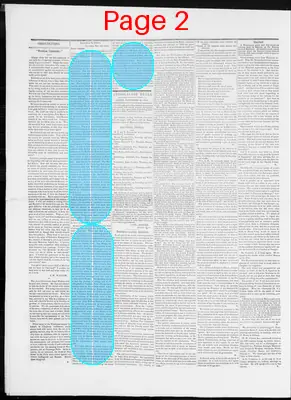
Anti Slavery Bugle
New Lisbon, Salem, Columbiana County, Ohio
What is this article about?
Abolitionists report on their anti-slavery lecturing in Edinburg and Ravenna, Ohio, facing deep sectarian prejudice and threats, but finding some interest and meeting principled supporters who have rejected political and religious ties for the cause. They analogize a village rescue to the plight of slaves.
Merged-components note: These components form a continuous report on an anti-slavery tour, starting in Edinburg and continuing to Ravenna.
Clipping
OCR Quality
Full Text
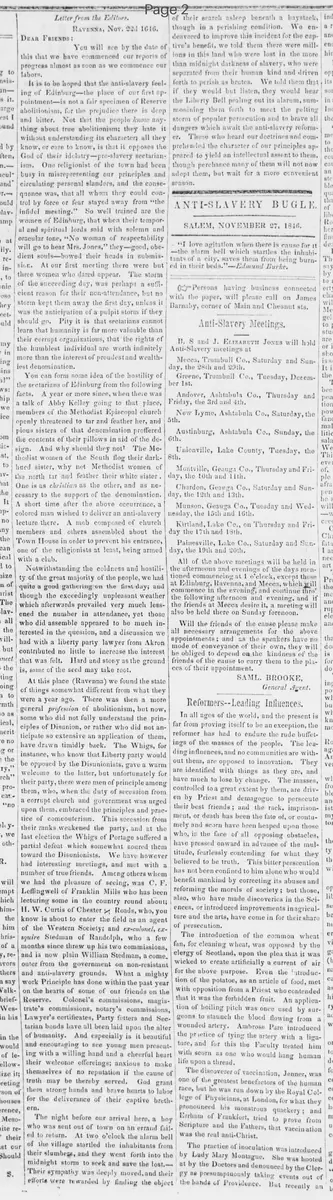
It is to be hoped that the anti-slavery feeling of Edinburg—the place of our first appointment—is not a fair specimen of Reserve abolitionism, for the prejudice there is deep and bitter. Not that the people know anything about true abolitionism; they hate it without understanding its character; all they know, or care to know, is that it opposes the God of their idolatry—pro-slavery sectarianism. One religionist of the town had been busy in misrepresenting our principles and circulating personal slanders, and the consequence was, that all whom they could control by force or fear stayed away from "the infidel meeting." So well trained are the women of Edinburg, that when their temporal and spiritual lords said with solemn and oracular tone, "No woman of respectability will go to hear Mrs. Jones," they—good, obedient souls—bowed their heads in submission. At our first meeting there were but three women who dared appear. The storm of the succeeding day, was perhaps a sufficient reason for their non-attendance, but no storm kept them away the first day, unless it was the anticipation of a pulpit storm if they should go. Pity it is that sectarians cannot learn that humanity is far more valuable than their corrupt organizations, that the rights of the humblest individual are worth infinitely more than the interest of proudest and wealthiest denomination.
You can form some idea of the hostility of the sectarians of Edinburg from the following facts. A year or more since, when there was a talk of Abby Kelley going to that place, members of the Methodist Episcopal church openly threatened to tar and feather her, and pious sisters of that denomination proffered the contents of their pillows in aid of the design. And why should they not? The Methodist women of the South flog their dark-hued sister, why not Methodist women of the north tar and feather their white sister. One is as christian as the other, and as necessary to the support of the denomination.
A short time after the above occurrence, a colored man wished to deliver an anti-slavery lecture there. A mob composed of church members and others assembled about the Town House in order to prevent his entrance, one of the religionists at least, being armed with a club.
Notwithstanding the coldness and hostility of the great majority of the people, we had quite a good gathering on the first day; and though the exceedingly unpleasant weather which afterwards prevailed very much lessened the number in attendance, yet those who did assemble appeared to be much interested in the question, and a discussion we had with a liberty party lawyer from Akron contributed no little to increase the interest that was felt. Hard and stony as the ground is, some of the seed may take root.
At this place (Ravenna) we found the state of things somewhat different from what they were a year ago. There was then a more general profession of abolitionism, but now, some who did not fully understand the principles of Disunion, or rather who did not anticipate so extensive an application of them, have drawn timidly back. The Whigs, for instance, who know that Liberty party would be opposed by the Disunionists, gave a warm welcome to the latter, but unfortunately for their party, there were men of principle among them, who, when the duty of secession from a corrupt church and government was urged upon them, embraced the principles and practice of comeouterism. This secession from their ranks weakened the party, and at the last election the Whigs of Portage suffered a partial defeat which somewhat soured them toward the Disunionists. We have however had interesting meetings, and met with a number of true friends. Among others whom we had the pleasure of seeing, was C. F. Leffingwell of Franklin Mills who has been lecturing some in the country round about; H. W. Curtis of Chester Roads, who, you know is about to enter the field as an agent of the Western Society; and ex-colonel, ex-squire Stedman of Randolph, who a few months since threw up his two commissions, and is now plain William Stedman, a come-outer from the government on non-resistant and anti-slavery grounds. What a mighty work Principle has done within the past year on the hearts of some of our friends on the Reserve.
Colonel's commissions, magistrate's commissions, notary's commissions, Lawyer's certificates, Party fetters and Sectarian bonds have all been laid upon the altar of humanity. And especially is it beautiful and encouraging to see young men presenting with a willing hand and a cheerful heart their welcome offerings; anxious to make themselves of no reputation if the cause of truth may be thereby served. God grant them strong hands and brave hearts to labor for the deliverance of their captive brethren.
The night before our arrival here, a boy who was sent out of town on an errand failed to return. At two o'clock the alarm bell of the village startled the inhabitants from their slumbers, and they went forth into the midnight storm to seek and save the lost.—Their sympathy was deeply moved, and their efforts were rewarded by finding the object of their search asleep beneath a haystack though in a perishing condition. We endeavored to improve this incident for the captive's benefit. we told them there were millions in this land who were lost in the more than midnight darkness of slavery, who were separated from their human kind and driven forth to perish as brutes. We told them that if they would but listen, they would hear the Liberty Bell pealing out its alarum, summoning them forth to meet the pelting storm of popular persecution and to brave all dangers which await the anti-slavery reformer. Those who heard our doctrines and comprehended the character of our principles appeared to yield an intellectual assent to them, though perchance many of them will not now adopt them, but wait for a more convenient season.
What sub-type of article is it?
What themes does it cover?
What keywords are associated?
What entities or persons were involved?
Where did it happen?
Story Details
Key Persons
Location
Edinburg, Ravenna, Western Reserve, Ohio
Story Details
Abolitionists face sectarian hostility and threats in Edinburg while lecturing on anti-slavery and disunion principles, recall past mob actions, find some interest despite weather; in Ravenna, note shifts in support with principled individuals rejecting church and government ties; use a local boy rescue incident to analogize the plight of slaves and call for action.