Thank you for visiting SNEWPapers!
Sign up free
The Hillsdale Standard
Hillsdale, Hillsdale County, Michigan
What is this article about?
Senator Sumner delivered a major speech in the U.S. Senate on the 'Barbarism of Slavery,' condemning its extension into Kansas and territories, refuting pro-slavery arguments, and urging Kansas's admission as a free state. Senator Chestnut (S.C.) criticized Sumner, who replied it illustrated his points. Reported in Philadelphia Inquirer, 4th inst.
Merged-components note: These components are a continuous article on Senator Sumner's speech on slavery, with adjacent bounding boxes and identical topic.
Clipping
OCR Quality
Full Text
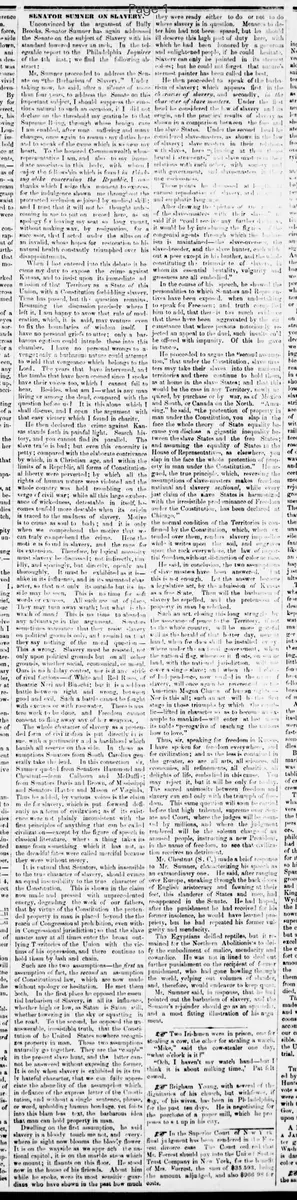
Unconvinced by the argument of Bully Brooks, Senator Sumner has again addressed the Senate on the subject of Slavery with his standard lowered never an inch. In the telegraphic report to the Philadelphia Inquirer of the 4th inst.; we find the following abstract:
Mr. Sumner proceeded to address the Senate on "the Barbarism of Slavery." Undertaking now, he said, after a silence of more than four years, to address the Senate on this important subject, I should suppress the emotions natural to such an occasion, if I did not declare on the threshold my gratitude to that Supreme Being, through whose benign care I am enabled, after much suffering and many changes, once again to resume my duties here and to speak of the cause which is so near my heart. To the honored Commonwealth whose representative I am, and also to my immediate associates in this body, with whom I enjoy the fellowship which is found in thinking alike concerning the Republic, I owe thanks which I seize this moment to express, for the indulgence shown me throughout the protracted seclusion enjoined by medical skill; and I trust that it will not be thought unbecoming in me to put on record here, as an apology for leaving my seat so long vacant, without making way, by resignation, for a successor, that I acted under the advice of an invalid, whose hopes for restoration to his natural health constantly triumphed over his disappointments.
When I last entered into this debate it became my duty to expose the crime against Kansas, and to insist upon its immediate admission of that Territory as a State of this Union, with a Constitution forbidding slavery Time has passed, but the question remains. Resuming the discussion precisely where I left it, I am happy to avow that rule of moderation, which, it is said, may venture even to fix the boundaries of wisdom itself. I have no personal griefs to utter; only a barbarous egotism could intrude these into this chamber. I have no personal wrongs to avenge; only a barbarous nature could attempt to wield that vengeance which belongs to the Lord. The years that have intervened, and the tombs that have been opened since I spoke have their voices too, which I cannot fail to hear. Besides, what am I—what is any man living or among the dead, compared with the question before us? It is this alone which I shall discuss, and I open the argument with that easy victory which I found in charity.
He then declared the crime against Kansas stands forth in painful light. Search history, and you cannot find its parallel. The slave trade is bad; but even this enormity is petty, compared with the elaborate contrivance by which, in a Christian age, and within the limits of a Republic, all forms of Constitutional liberty were perverted; by which all the rights of human nature were violated and the whole country was held trembling on the verge of civil war; while all this large exuberance of wickedness, detestable in itself, becomes tenfold more detestable when its origin is traced to the madness of slavery. Motive is to crime as soul to body; and it is only when we comprehend the motive that we can truly comprehend the crime. Here the motive is found in slavery, and the rage for its extension. Therefore, by logical necessity must slavery be discussed: not indirectly, timidly, and sparingly, but directly, openly and thoroughly. It must be exhibited as it is— alike in its influence, and in its animated character, so that not only its outside but its inside may be seen. This is no time for soft words or excuses. All such are out of place, They may turn away wrath; but what is the wrath of man? This is no time to abandon any advantage in the argument. Senators sometimes announce that they resist slavery on political grounds only, and remind us that they say nothing of the moral question— This is wrong. Slavery must be resisted, not only upon political grounds but on all other grounds, whether social, economical, or moral. Ours is no holiday contest, nor is it any strife of rival fictions—of White and Red Roses, of theatric Nero and Bianchi; but it is a solemn battle between right and wrong, between good and evil. Such a battle cannot be fought with excuses or with rosewater. There is austere work to be done, and Freedom cannot consent to fling away any of her weapons.
The whole character of slavery as a pretended form of civilization is put directly in issue, with a pertinacity and a hardihood which banish all reserve on this side. In these assumptions Senators from South Carolina generally take the lead. In this connection Mr. Sumner quoted from Senators Hammond and Chestnut—from Calhoun and McDuffie; from Senators Davis and Brown, of Mississippi and Senators Hunter and Mason of Virginia. Thus aided, by various voices is the claim made for slavery, which is put forward defiantly as a form of civilization; as if its existence were not plainly inconsistent with the first principles of anything that can be called civilization—except by the figure of speech in classical literature, where a thing takes its name from something which it has not, as the dreadful fates were called merciful because they were without mercy.
It is natural that Senators, which insensible to the true character of slavery, should evince an equal insensibility to the true character of the Constitution. This is shown in the claim now made and pressed with unprecedented energy, degrading the work of our fathers, that by virtue of the Constitution the pretended property in man is placed beyond the reach of Congressional prohibition, even within Congressional jurisdiction; so that the slave master may at all times enter the broad outlying Territories of the Union with the victims of his oppression, and there continue to hold them by lash and chain.
Such are the two assumptions—the first an assumption of fact, the second an assumption of Constitutional law, which are now made without apology or hesitation. He met them both. In the first place he opposed the essential barbarism of Slavery, in all its influence whether high or low, as Satan is Satan still, whether towering in the sky or squatting in the road. To the second, he opposed the unanswerable, irresistible truth, that the Constitution of the United States nowhere recognizes property in man. These two assumptions naturally go together. They are the "couple" in the present slave hunt, and the latter cannot be answered without exposing the former It is only when slavery is exhibited in its true hateful character, that we can fully appreciate the absurdity of the assumption which in defiance of the express letter of the Constitution, and without a single sentence, phrase, or word, upholding human bondage, yet forces into this blameless text, the barbarous idea that man can hold property in man.
Dwelling on the first assumption, he said slavery is a bloody touch me not, and everywhere in sight now blooms the blood's flower It is on the wayside as we approach the national capitol, it is on the marble steps which we mount; it flaunts on this floor. He stood now in the house of his friends. About him while he spoke, were its most sensitive guardians who have shown in the past how much they were ready either to do or not to do where slavery is in question. Menaces to deter him had not been spared, but he should ill deserve this high post of duty here, with which he had been honored by a generous and enlightened people, if he could hesitate. Slavery can only be painted in its sternest colors; but he could not forget that nature's sternest painter has been called the best.
He then proceeded to speak of the barbarism of slavery; which appears first in the character of slavery, and secondly, in the character of slave masters. Under the first head he considered the law of slavery and its origin, and the practical results of slavery as shown in a comparison between the free and the slave States. Under the second head he considered slave-masters, as shown in the law of slavery: slave masters in their relations with slaves, here "playing at the toes brutal instruments," as slave masters' relations with each other, with society, with government, slave-masters in the possession.
These points he used at earnest reprobation or derision, and emphatic language A
After drawing the picture of the slave-masters with their slaves, said if it "could receive any further s.
it would be by introducing the figures as congenial agents through which the barbarism is maintained—the slave-overseer, the slave-breeder, and the slave hunter, each without a peer except in his brother, and the wolf, constituting the triumvirate of slavery, in whom its essential brutality, vulgarity and grossness are all embodied."
In the course of his speech, he showed the personalities to which Senators and Representatives have been exposed, when undertaking to speak for Freedom: and truth compelled him to add, that there is too much evidence that these have been aggravated by the circumstance that where persons notoriously rejected an appeal to the duel, such insult could be offered with impunity. Of this he gave instances.
He proceeded to argue the "second assumption," that under the Constitution, slave masters may take their slaves into the national territories and there continue to hold them, as at home in the slave States; and that this would be the case in any Territory, newly acquired, by purchase or by war, as of Mexico and South, or Canada on the North. "Assuming," he said, "the pretension of property in man under the Constitution, you slap in the face the whole theory of State equality because you disclose a gigantic inequality between the slave States and the free States; and assuming the equality of States in the House of Representatives, as elsewhere, you slap in the face the whole pretension of property in man under the Constitution."
He argued, the true principle, which, reversing the assumptions of slave-masters makes freedom national and slavery sectional, while every just claim of the slave States is harmonized with the irresistible predominance of Freedom under the Constitution, has been declared at Chicago. the normal condition of the Territories is confirmed by the Constitution, which, when extended over them, renders slavery impossible while it writes upon the soil, and engraves upon the rock everywhere, the law of equal freedom, without distinction of color or race.
He said, in conclusion, the two assumptions of slave masters have been answered. But this is not enough. Let the answer become a legislative act, by the admission of Kansas as a free State. Then will the barbarism of slavery be repelled, and the pretension of property in man be rebuked.
Such an act, closing this long struggle, by the assurance of peace to the Territory, not to the whole country, will be more glorious still as the herald of that better day, near at hand, when freedom shall be installed everywhere under the national government, when the national flag, wherever it floats, on sea or land, with the national jurisdiction, will cover a single slave; and when the Declaration of Independence, now rigid in the iron of slavery, will once again be reverenced as the American Magna Charta of human rights—
Nor is this all: such an act will be the first stage in those triumphs by which the republic—lifted in character so as to become an example to mankind—will enter at last upon its noble "prerogative of teaching the nations how to live." Thus, sir, speaking for freedom in Kansas I have spoken for freedom everywhere, and for civilization; and as the less is contained in the greater, so are all arts, all sciences, all economies, all refinements, all charities, all delights of life, embodied in this cause. You may reject it, but it will be only for to day. The sacred animosity between freedom and slavery can end only with the triumph of freedom. This same question will soon be carried before that high tribunal, supreme over Senate and Court, where the judges will be counted by millions, and where the judgment rendered will be the solemn charge of an aroused people, instructing a new President, in the name of freedom, to see that civilization receives no detriment.
Mr. Chestnut (S. C.) made a brief response to Mr. Sumner, characterizing his speech as an extraordinary one. He said, after ranging over Europe, sneaking through the back doors of English aristocracy and fawning at their feet, this slanderer of States and men, had re-appeared in the Senate. He had hoped, after the punishment he had received for his former insolence, he would have learned propriety, but he had repeated his former vulgarity and mendacity.
The Egyptians deified reptiles, but it remained for the Northern Abolitionists to deify the embodiment of malice, mendacity and cowardice. He was not inclined to deal out further punishment on the recipient of former punishment, who had gone howling through the world, yelping out volumes of slander. and, therefore, would endeavor to keep quiet.
Mr. Sumner said, in response, that he had pointed out the barbarism of slavery, and the Senator's rejoinder should go as an appendix, and a most fitting illustration of his argument.
What sub-type of article is it?
What keywords are associated?
What entities or persons were involved?
Where did it happen?
Domestic News Details
Primary Location
United States Senate
Event Date
4th Inst.
Key Persons
Outcome
mr. chestnut responded briefly, criticizing sumner's speech and character; sumner replied that chestnut's rejoinder illustrated his argument on the barbarism of slavery.
Event Details
Senator Sumner addressed the Senate on 'the Barbarism of Slavery,' resuming his debate after over four years, expressing gratitude for his recovery and support. He condemned the crime against Kansas, argued against slavery's extension into territories, refuted assumptions of slavery as civilization and constitutional property in man, and called for Kansas's admission as a free state. He discussed slavery's barbarism in law, origins, results comparing free and slave states, and slave masters' relations. He highlighted personalities and insults faced by anti-slavery speakers. Mr. Chestnut (S.C.) responded critically, accusing Sumner of slander and vulgarity; Sumner retorted that it exemplified his points.